
By purchasing from this page you are supporting this site as we receive an associate payment for each completed purchase.

|
A Century of Submarines |
| Peter Lawrence | |
| Arriving in 1901, they heralded a new age of naval warfare. However, due to naval rivalries and hierarchies and an institutional misinterpretation of sumarine tactic and strategy, the British submarine service took a long time to grow. The First World War saw German success with U-Boat warfare but the British response was more inventive than effective - it included feasibility studies into the employment of sea lions and gulls to defeat the underwater menace. Full realisation of the submarine's fighting capabilities did not come until the Second World War. The advent of sonar, radar and the application of air power changed both the tools and tactics of war. In the post-war period submarines went 'nuclear' and played a pivotal role in the stratagems of the Cold War. This knowledgeable and passionate account of submarine history is complimented by nearly 200 illustrations, from the crude beginnings to the highly technological present, and will appeal to those interested in the tactics and politics of war as well as those with a specialist interest in the submarine. |
|
|
Related Pages: 2001 Centenary |
|

|
A Submarine at War The Brief Life of HMS Trooper |
| David Renwick Grant | |
| This book encapsulates the life of a wartime submarine. It includes photographs and diary entries, log extracts and sailing orders and exciting personal accounts. Written by a relative of one of the crew, it gives a different flavour to that found in the several excellent books already published by wartime submariners, and now mostly out of print. It is also a salute to all World War Two submariners. HMS Trooper's operational life lasted from commissioning on 29th August 1942 to her loss in mid-October 1943. Brief indeed. The author was two when his half-brother was killed, and had he not become curious to know more about him, Trooper's story would have remained untold. |
|
|
Related Pages: Trooper (N 91) |
|

|
A Submariner's Story The Memoirs of a Submarine Engineer in Peace and War |
| Joel C.E. Blamey | |
| After six years in the Royal Navy, Joel Blamey was conscripted into Britain's submarine service in 1926, aged 22. He went on to serve an unprecedented 28 years as a submariner, surviving peacetime accidents and World War II. At the age of 50, Joe returned to general service. He served on several submarines and survived several accidents, such as hitting an underwater pinnacle in Sidon and a collision in Seahorse, from which he was transferred before it was lost to enemy action. While Joel served in Porpoise, it supplied Malta with fuel and ammunition and sank several supply ships. The captured U570 came under his jurisdiction. Later, he survived almost certain destruction in Strongbow. In all Joel survived more than two hundred depth charges. These are but a few of the tales related in this book, told in Joel's matter-of-fact engineer's way. |
|
|
Related Pages: Porpoise (N 14) Strongbow (P 235) Sidon (P 259) Seahorse (S 98) |
|

|
Above Us the Waves The Story of Midget Submarines and Human Torpedoes |
| C.E.T. Warren / James Benson | |
| It was the Italians who pioneered the use of two-man human torpedoes or 'chariots', and their attacks on ships of the Royal Navy in Alexandria Harbour in 1941 caused Winston Churchill to write to the Chief of Staffs committee to enquire what was being done to emulate these daring attacks. The result was the development of British 'chariots' which were regarded as stop-gaps until the X-Craft or midget submarines could be deployed. |
|
|
Related Pages: Building X Craft Submarines Chariots 1954 - 1958: Stickleback Class 1942 - 1946: X Class 1944 - 1952: XE Class 1943 - 1946: XT Class |
|

|
Astute Class Nuclear Submarine Owners' Workshop Manual |
| Jonathan Gates | |
| The Astute-class is the largest, most advanced and most powerful attack submarine ever operated by the Royal Navy, combining world-leading sensors, design and weaponry in a versatile vessel. The submarines are nuclear-propelled and fuelled by a nuclear reactor powerful enough to supply a city the size of Southampton. | |
|
Related Pages: 2010 - Present: Astute Class |
|

|
Baku A non-submarine related sc-fi novel written by the author of this site |
| Ian Hillbeck | |
| Galabell thought he was taking his family to the Baku Festival and a long overdue visit to his parents. The trip becomes a nightmare as they all become caught in the middle of a conflict between trans-galactic Industry and the Federal Government. | |
|
Related Pages: About Me |
|

|
Beneath the Waves A History of Hm Submarine Losses 1904-1971 |
| A.S. Evans | |
| Since the beginning of the Royal Navy Submarine Service in 1901, 173 submarines have been lost and in many circumstances with their entire crew. War inevitably takes a heavy toll: in World War Two alone, 341 officer and 2,801 ratings failed to return to harbour. Accounts of these losses and many others of submarine escape are described within this history and whenever possible in the words of survivors or witness. |
|
|
Related Pages: Losses |
|

|
Blind Mans Bluff The Untold Story of Cold War Submarine Espionage |
| Christopher Drew / Sherry Sontag | |
| In Blind Mans Bluff, veteran investigative journalist Sherry Sontag and award-winning New York Times reporter Christopher Drew reveal an extraordinary underwater world. Showing for the first time how the American Navy sent submarines wired with self-destruct charges into the heart of Soviet seas to tap crucial underwater telephone cables, Sontag and Drew unveil new evidence that the Navy's own negligence might have been responsible for the loss of the USS Scorpion, a submarine that disappeared with all hands at the height of the Cold War. They disclose for the first time details of the bitter war between the CIA and the Navy and how it threatened to sabotage one of America's most important undersea missions. They tell the complete story of the audacious attempt to steal a Soviet submarine with the help of eccentric billionaire Howard Hughes, and how it was doomed from the start. And Sontag and Drew reveal how the Navy used the comforting notion of deep-sea rescue vehicles to hide operations that were more James Bond than Jacques Cousteau. Stretching from the years immediately after World War II to the post-Cold War new reality of warfare, Blind Mans Bluff reads like a spy thriller, but with one important difference - everything in it is true. |
|
|
Related Pages: Affray - Subsmash Commentary |
|

|
Coffin Boats Japanese Midget Submarine Operations in the Second World War |
| Peggy Warner / Sadao Seno | |
| Japanese midget submarines carried out torpedo attacks during WWII at Pearl Harbour, Sydney, and Diego Suarez in Madagascar. The Coffin Boats presents an in-depth examination of these three attacks and provides background information on Japanese midget submarines and their pilots |
|
|
Related Pages: The Tenth Man |
|

|
Cold War Command The Dramatic Story of a Nuclear Submariner |
| Dan Conley | |
| The part played in the Cold War by the Royal Navy's submarines still retains a great degree of mystery and, in the traditions of the 'Silent Service,' remains largely shrouded in secrecy. Cold War Command brings us as close as is possible to the realities of commanding nuclear hunter-killer submarines, routinely tasked to hunt out and covertly follow Soviet submarines in order to destroy them should there be any outbreak of hostilities. Dan Conley takes the reader through his early career in diesel submarines, prior to his transition to the complex and very demanding three-dimensional world of operating nuclear submarines; he describes the Royal Navy's shortcomings in ship and weapons procurement and delivers many insights into the procurement failures which led to the effective bankrupting of the Defence budget in the first decade of the 21st century. In command of the hunter killer submarines Courageous and Valiant in the 1980s, he achieved exceptional success against Soviet submarines at the height of the Cold War. He was also involved in the initial deployment of the Trident nuclear weapon system, and divulges hitherto un-revealed facets of nuclear weapons strategy and policy during this period. This gripping read takes you onboard a nuclear submarine and into the depths of the ocean, and relays the excitement and apprehensions experienced by British submariners confronted by a massive Soviet Navy. |
|
|
Related Pages: Courageous (S 50) Valiant (S 102) |
|

|
Cold War Submarines The Design and Construction of U.S. and Soviet Submarines, 1945-2001 |
| Norman Polmar | |
| By the 1990s the superpowers had created submarine fleets of radically different designs and capabilities. Written in collaboration with the former Soviet submarine design bureaus, Norman Polmar and K J Moore authoritatively demonstrate in this landmark study how differing submarine missions, antisubmarine priorities, levels of technical competence, and approaches to submarine design organizations and management caused the divergence. |
|
|
Related Pages: The Silent Deep |
|

|
Concepts in Submarine Design |
| Roy Burcher | |
| This book explores the many engineering and architectural aspects of submarine design and how they relate to each other and the operational performance required of the vessel. Concepts of hydrodynamics, structure, powering and dynamics are explained, in addition to architectural considerations which bear on the submarine design process. |
|
|
Related Pages: The Silent Deep |
|

|
Dive! Australian Submariners at War |
| Mike Carlton | |
| Submariners are a special breed. Not for them a life on the ocean wave, the fresh air and sunshine of other naval sailors. With stealth and daring they go deep and dark, alone and unseen, in often dangerous waters. They sometimes call themselves the Silent Service, with good reason. Australian submariners have done extraordinary deeds in the First and Second World Wars and, more recently, the Cold War. In April 1915 the Australian submarine AE2 penetrated the Dardanelles Strait to 'run amuck', a historic feat that was a turning point in the Gallipoli campaign. Eventually captured, her crew spent three harrowing years as prisoners-of-war in Turkey. In the Second World War Australian naval volunteers made their name serving in midget submarines, attacking Hitler’s mightiest battleship, the Tirpitz, in the icy waters of a Norwegian fjord. Later, they fought the Japanese in the South China Sea. And in the last half of the twentieth century, RAN submarines played a vital role tracking the Soviet navy in the Pacific Ocean. One wrong move could have led to outright war. The risks they ran, the perils they met and the intelligence they gathered are still classified Top Secret. Submarines and the sailors who serve in them have been and remain the tip of the spear of Australia's defences. For the first time, this is their unique story. |
|
|
Related Pages: AE 1 - Missing Sub |
|

|
Down to the Sea in Submarines A Cold War Odyssey |
| Dan Conley | |
| This unique memoir charts the career of the author in the Royal Navy Submarine Service during the period 1967 to 1997, and in doing so details many of the Silent Service's remarkable achievements since the end of the Second World War. And it provides a dramatic first-hand account of the underwater confrontation during the Cold War between submarines of the West and the huge submarine force of the Soviet Union. Dan Conley narrates the successive stages from his basic submarine training to taking command of two nuclear attack submarines, but he does not demur from describing the personal and professional difficulties he encountered in this journey. He sets out in detail what life was like serving onboard both diesel and nuclear submarines, and in particular, the book describes the British submariner's remarkable transformation from the somewhat buccaneering, free spirit serving on a clapped-out WW2 boat during the sunset of the British Empire, to the highly professional individual who spends prolonged periods under the sea in a platform which matches the complexity of a space craft. The book describes the long and difficult challenges encountered in developing effective weapon systems for the British submarine force, and discusses the difficulties and shortcomings in the UK's defence procurement system, a situation which still exists today. Ultimately, however, Western technological superiority and crew proficiency enabled the submarines of the Royal and United States Navies to match those of the Soviet Union, and he describes vividly the suspense and tension of underwater confrontations which might so easily have escalated to another dimension of warfare. And the book sets out hitherto undisclosed details of submarine activities during the 1962 Cuban Missile Crisis, when the world confronted the real possibility of a massive nuclear exchange. But it is not all serious content, and he also offers a glimpse for the reader of many humorous situations and events, of animals that found themselves under the sea in a submarine, in one case during a war patrol, and other moments of levity that broke the tension of serving in a highly complex and sophisticated fighting machine. The Cold War era is now long past. However, it is evident that as the West now confronts an aggressive, recidivist Russia and a more aggressive China, Britain's submarine force once again will be key to the security of all its citizens. This fine memoir captures vividly the key events and history of the Cold War, and in doing so will open the reader's eyes to the significance and importance today of the Royal Navy Submarine Service. |
|
|
Related Pages: Rob Forsyth - My Life As A Cold War Submariner |
|

|
Fatal Ascent HMS Seal 1940 |
| Melanie Wiggins | |
| The story of how HMS Seal's crew miraculously escaped death in their flooded submarine but are forced to surrender to the Germans and endure five years as prisoners of war while bombs rain on Germany. | |
|
Related Pages: Lieutenant-Commander Canon Rupert Lonsdale Seal (N 37) RN Submarines scuttled or captured in WWII |
|
|
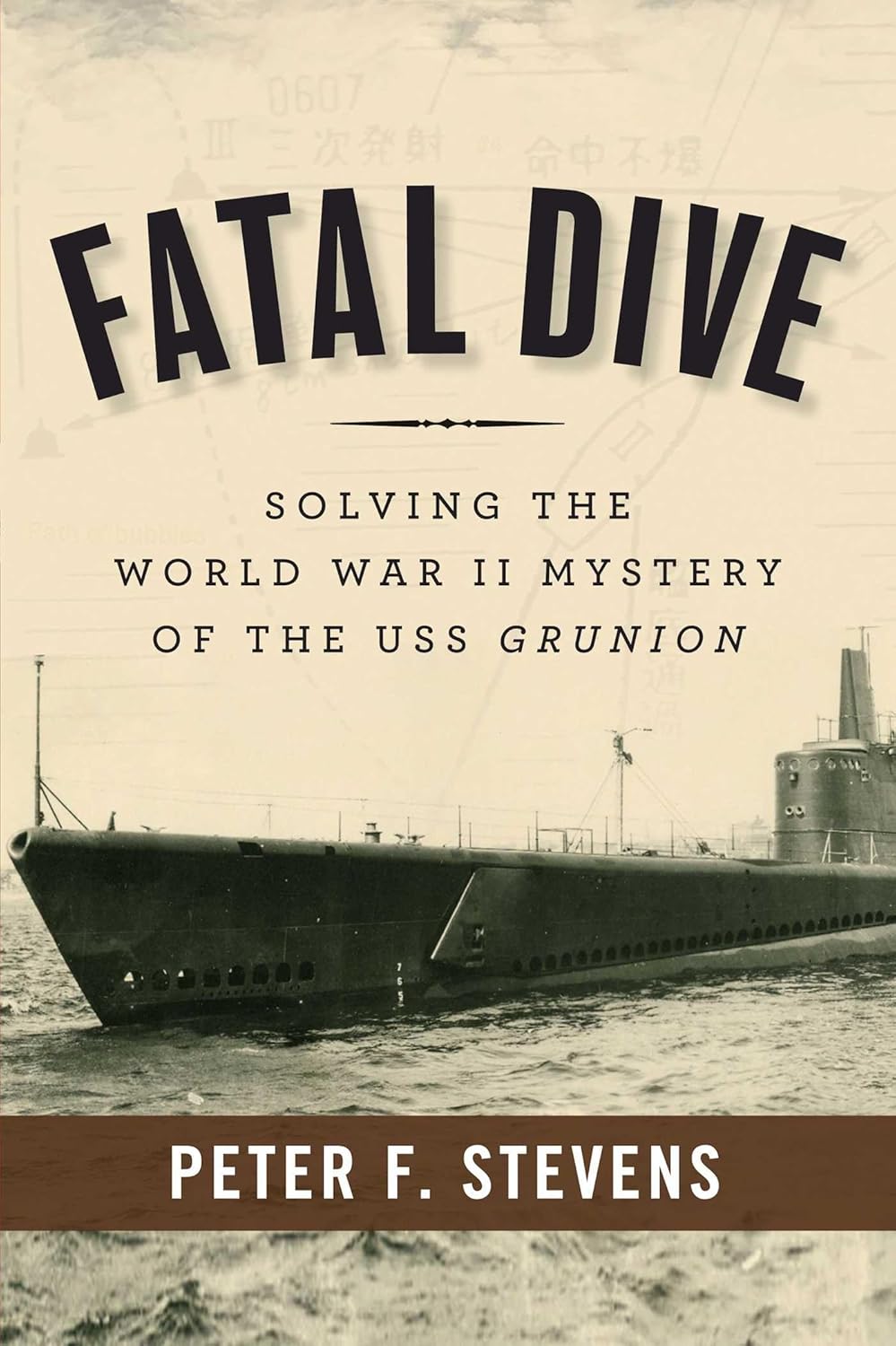
Fatal Dive Solving the World War II Mystery of the USS Grunion |
| Peter F. Stevens | |
| The incredible true story of the search for and discovery of the USS Grunion. Discovered in 2006 after a decades-long, high-risk search by the Abele brothers, whose father commanded the submarine and met his untimely death aboard it. One question remained: what sank the USS Grunion? Was it a round from a Japanese ship, a catastrophic mechanical failure, or something else? one of the sub's own torpedoes? For almost half the war, submarine skippers' complaints about the MK 14 torpedo's dangerous flaws were ignored by naval brass, who sent the subs out with the defective weapon. Fatal Dive is the first book that documents the entire saga of the ship and its crew and provides compelling evidence that the Grunion was a victim of the Great Torpedo Scandal of 1941-43. Fatal Dive finally lays to rest one of World War II's greatest mysteries. |
|

|
Few Survived A History of Submarine Disasters |
| Edwyn Gray | |
| A revised edition of an account of peacetime submarine disasters from 1774 to the present day, previously published in 1991. Examines the development of the submarine from experimental stages in the late 18th century to the present day, and provides details of all disasters ever reported. | |
|
Related Pages: Lost & Found |
|

|
Fort Blockhouse |
| Keith Hall | |
| Until recently Fort Blockhouse or HMS DOLPHIN provided a spiritual and physical home for the Royal Navy's Submarine Service. This short article details the Forts long history |
|
|
Related Pages: Fort Blockhouse |
|

|
Going Deep John Philip Holland and the Invention of the Attack Submarine |
| Lawrence Goldstone | |
| From Twenty Thousand Leagues Under the Sea to The Hunt for Red October, readers the world over have demonstrated an enduring fascination with travel under the sea. Yet the riveting story behind the invention of the submarine, an epic saga of genius, persistence, ruthlessness, and deceit is almost completely unknown. Like Henry Ford and the Wright brothers, John Philip Holland was completely self-taught, a brilliant man raised in humble circumstances, earning his living as a schoolteacher and choirmaster. But all the while he was obsessed with creating a machine that could successfully cruise beneath the waves. His struggle to unlock the mystery behind controlled undersea navigation would take three decades, during which he endured scepticism, disappointment, and betrayal. But his indestructible belief in himself and his ideas led him to finally succeed where so many others had failed. Going Deep is a vivid chronicle of the fierce battles not only under the water but also in the back rooms of Wall Street and the committee rooms of Congress. A rousing adventure at its heart, surrounded by an atmosphere of corruption and greed, this is a story of bravery, passion, and the unbreakable determination to succeed against long odds. |
|
|
Related Pages: Story Of The First Dive 1901 - 1913: Holland Class The Man Who Invented The Submarine The First Barrow Submarines Chapter 3: The Spindle Hull Types - Holland, A, B and C Classes |
|

|
Grey Funnel Lines Traditional Song & Verse of the Royal Navy 1900-1970 |
| Cyril Tawney | |
| Originally published in 1987. In this book we find songs reflecting every aspect of life in the twentieth-century Royal Navy, both upper and lower deck: war, ship's routine, aviation, submarines, the antics of dockyard personnel, not to mention the matelot's shore-going adventures, both amorous and bibulous. | |
|
Related Pages: Naval Poetry Song Lyrics |
|

|
Harwich Submarines in the Great War The first submarine campaign of the Royal Navy in 1914 |
| Mark Harris / Rear Admiral Jonathan Westbrook CBE | |
| The authoritative story of the Royal Navy's first submarine campaign, told using new research. The Harwich Submarine Flotilla played a key role establishing British dominance in the North Sea at the beginning of the First World War. Letters, diaries, memoirs and combat reports of the participants are used to give a complete account. Much of this is in print for the first time. Foreword by Rear Admiral Jonathan Westbrook CBE, former Royal Navy Submariner. Written in collaboration with the Friends of the Royal Navy Submarine Museum, with profits from royalties contributing towards the work of the Museum. |
|
|
Related Pages: 1902 - 1920: A Class Lieutenant Edward Courtney Boyle 1907 - 1919: D Class 1911 - 1924: E Class 1914 - 1922: F Class 1914 - 1921: G Class Lieutenant Commander Geoffrey Saxon White The Harwich Submarine Flotilla in WWI Lieutenant Norman Douglas Holbrook 1915 - 1929: J Class 1915 - 1926: K Class Lieutenant Commander Anthony Cecil Chapel Miers Lieutenant Commander Martin Eric Nasmith Lieutenant Richard Douglas Sandford 1941 - 1958: V Class |
|

|
Hitler's Attack U-Boats The Kriegsmarine's Submarine Strike Force |
| Jak P Mallmann Showell | |
| This is the story of the Types II, VII and IX that became the workhorse' of the Kriegsmarine's submarine fleet and put out to sea to attack Allied shipping right up to the end of the war. The Type II was a small coastal boat that struggled to reach the Atlantic; the Type VII was perfectly at home there, but lacked the technology to tackle well protected convoys; whilst the Type IX was a long-range variety that was modified so that it could operate in the Indian Ocean. In this latest book by the renowned Kriegsmarine historian Jak Mallmann Showell, these attack U-boats are explored at length. This includes details of their armament, capabilities, crew facilities, and just what it was like to operate such a vessel, and of course the story of their development and operational history. |
|
|
Related Pages: The U-Boats that Surrendered U-Boats in the Royal Navy post May 1945 The Sinking of U-593 U889 a TYPE IXC U-Boat U Boats & Other Navy's 1941 - 1944: VIIC Class |
|

|
HMS Dolphin Gosport's Submarine Base |
| Keith Hall | |
| Fort Blockhouse, originally established in 1495, was updated and became the home of the Royal Engineers' Submarine Mining School in 1873. This book looks at the history of this submarine base at Gosport. | |
|
Related Pages: Fort Blockhouse Training Submariners: The Early Days |
|

|
HMS Thetis Secrets and Scandal - Aftermath of a Disaster |
| David Roberts | |
| After an exhaustive two-year search for the truth about the events and aftermath of this terrible Submarine disaster in Liverpool Bay, June 1939, David Roberts has at last found some shocking hitherto unpublished details. | |
|
Related Pages: Thetis (N 25) Thunderbolt (N 25) The Thetis Disaster Relief Fund The Loss of HMS Thetis |
|

|
How to Trace Your Family Tree Traditional Royal Navy recipes |
| Kathy Chater | |
| Discover and Record Your Personal Roots and Heritage: Everything from Accessing Archives, Public Record Offices and Using the Internet | |
|
Related Pages: RN Family History Research |
|

|
Hunter Killers The Dramatic Untold Story of the Royal Navy's Most Secret Service |
| Iain Ballantyne | |
| Hunter Killers will follow the careers of four daring British submarine captains who risked their lives to keep the rest of us safe, their exploits consigned to the shadows until now. Their experiences encompass the span of the Cold War, from voyages in WW2-era submarines under Arctic ice to nuclear-powered espionage missions in Soviet-dominated seas. |
|

|
Iron Coffins A U-boat Commander's War, 1939-45 |
| Herbert Werner | |
| A first hand account of the German U-boat battles of World War II, by one of the very few surviving commanders. This is a story of triumph, disaster and eventual survival against all odds. Herbert Werner was one of the few U-boat commanders whose skill, daring and incredible luck saw him safely through to the end of the war. His is an epic and chilling description of the fearful havoc wrought by one small U-boat on the Atlantic convoys. But easy success ebbed away in the face of ever-improving Allied detection and attack techniques. The hunters became the prey, to suffer appalling losses. Of 842 U-boats launched 779 were sunk, 'iron-coffins' to 28,000 men. Herbert Werner's graphic account of war waged from beneath the sea, of horror and cold, cruel death, is dedicated to the seamen of all nations who died in the Battle of the Atlantic. |
|

|
K Boat Catastrophe Eight Ships and Five Collisions |
| N S Nash | |
| The Full Story of the 'Battle' of the Isle of May Island. As they approached navigational confusion broke out, caused by the misinterpretation of ship's steaming lights and mayhem followed. During the next couple of hours five collisions occurred involving eight ships and resulting in the death of 105 officers and ratings. This fiasco and the resulting naval investigation and court marshal were shielded from the general public and kept in secret files until the full details were released in 1994. From this official report, the author now tells the full story of that dreadful night and the proceedings that followed. Background information on the evolution of the ill-fated and much hated K Class submarines is also included together with the investigation and court marshal proceedings of the events surrounding that tragic night. |
|
|
Related Pages: 1915 - 1926: K Class K 14 Steam Submarines Unlucky Thirteen |
|

|
K Boats Steam-powered Submarines in World War I |
| Don Everitt | |
| The twin-funnelled K Boat was the biggest, fastest submarine of World War I. It suffered a series of accidents from the day trials began. This documentary answers questions about the numerous accidents, had while reconstructing the best concealed debacle in British naval history. |
|
|
Related Pages: 1915 - 1926: K Class Steam Submarines Unlucky Thirteen |
|

|
K13 Remembered An untold Story |
| Keith Hall | |
| The British submarine, K13, was due to leave the Fairfield yard in Govan on the River Clyde, for her final acceptance trials at 0800 on Monday, 29th January 1917. On board were 80 men, both naval personnel and civilian contractors. A problem with one of the mooring wires caused a delay, and she had only travelled a mile down the river when the submarine ran aground at Whiteinch, Despite this, she reached the Gareloch by 11:30 and carried out various tests that were required as part of the acceptance program. After the diving trial, her engineer, Lieutenant Arthur Lane, reported that there was a small leak in the boiler room. He suggested a further short dive to determine the source of the leak As the submarine dived, the aft compartments of the submarine flooded, and it sank. 32 crew members and contractors lost their lives, and 48 were saved. It is the worst ever British submarine accident; conversely, despite the loss of life, it remains the most successful submarine rescue ever The Board of Inquiry laid the blame for the accident solely on Lt Arthur Lane, the vessel's engineer. The book will provide an in-depth analysis of the sinking of the K 13 in the Gare Loch. It will offer a different perspective on the accident, a view that calls into question the legitimacy and accuracy of the Board of Inquiry's findings and verdict. The investigations and conclusions that lead to this interpretation are based on detailed examination of archived records, personal accounts and in-depth analysis of the evidence. |
|
|
Related Pages: K 13 (K 22) Wartime Memoirs of Coxn Oscar Moth Steam Submarines Unlucky Thirteen |
|

|
Lousy Poems on Morbid Themes A non-submarine related title by the author of this site |
| Ian Hillbeck | |
| A selection of eclectic poetry and prose on various topics which will hopefully entertain, inspire and stimulate the mind. | |
|
Related Pages: About Me Naval Poetry |
|

|
M-class Submarines |
| Martin H. Brice | |
|
Related Pages: Chapter 9: Monitor M Class Types 1916 - 1932: M Class M 1 M 2 M 3 M 4 Supergun Submarine located 74 years after tragic loss |
|

|
Midget Submarine Commander The Life of Godfrey Place VC |
| Paul Watkins | |
| Of all the acts of gallantry in World War II few were as audacious as the attack by midget submarines on the pride of the German fleet, the battleship Tirpitz, lying in her fortified mooring in a Norwegian fjord. Lieutenant Godfrey Place was in command of submarine X7 in September 1943 and travelled over 1000 miles, negotiating minefields and antisubmarine nets to accurately place four tons of high explosive under the hull of the Tirpitz. |
|
|
Related Pages: Lieutenant Donald Cameron. Royal Naval Reserve Lieutenant Basil Charles Godfrey Place |
|

|
Midget Submarines of the Second World War |
| Paul Kemp | |
| An account of the development and use of the human torpedoes, semi-submersible and midget submarines mainly in WW2 but including some of the developments that took place in 1918, with many half tone photo ills. and brief accounts of many of the actions involving these craft | |
|
Related Pages: Lieutenant Donald Cameron. Royal Naval Reserve Lieutenant Ian Edward Fraser, Royal Naval Reserve Temporary Acting Leading Seaman James Joseph Magennis Bill Morrison Lieutenant Basil Charles Godfrey Place 1942 - 1946: X Class |
|

|
Modern Submarines: 1990 - Present Attack * Ballistic * Nuclear (Technical Guides) |
| E V Martindale | |
| Submarines are a key component of modern naval warfare, providing countries with the ability to make missile strikes against their enemies from anywhere in the world. Organised by type, Modern Submarines offers a compact guide to the major submarines deployed in the world today. Find out about the nuclear-powered Virginia class, the US Navy's premier fast attack submarine, with its stealth capabilities; discover the Chinese navy's Type 039 diesel-electric submarine, designed for a blue-water defensive role; and learn about the venerable Russian Delta IV class, a type dating from the 1980s and which is able to deploy uncrewed underwater vehicles (UUVs). Illustrated with more than 100 vivid artworks, Modern Submarines is an essential reference guide for modellers and naval warfare enthusiasts. |
|

|
Never Forgotten The Search and Discovery of Israel's Lost Submarine Dakar |
| David W. Jourdan | |
| This book tells the exhilarating story of the will, endurance, and technical know-how of extraordinary people who made a lifelong impact on an entire nation and sixty-nine grieving families, recounting the search, discovery and the resulting attempts to find out what really happened that night, over thirty years previous. The story of the lost submarine captured the public's heart. Many Israeli cities and towns have a Dakar Street, and several schools and other public institutions are also named for the lost submarine. Full Circle, a television documentary of the project was first aired on the National Geographic Channel in November 2003, adding to public recognition of this event. |
|
|
Related Pages: Israeli sub wreck found 31 years on Totem (P 352) |
|

|
No Occupation for a Gentleman The story of a boy who became a man serving in H.M. Submarines Thrasher and Trenchant during World War Two |
| Roy Broome | |
| This gripping personal account of life as a young World War Two submariner on two famous Royal Navy submarines, gives vivid detail of depth charging, gun actions and other operations. | |
|
Related Pages: Petty Officer Thomas William Gould The Lucky Thirteen Lieutenant Peter Scawen Watkinson Roberts |
|
|
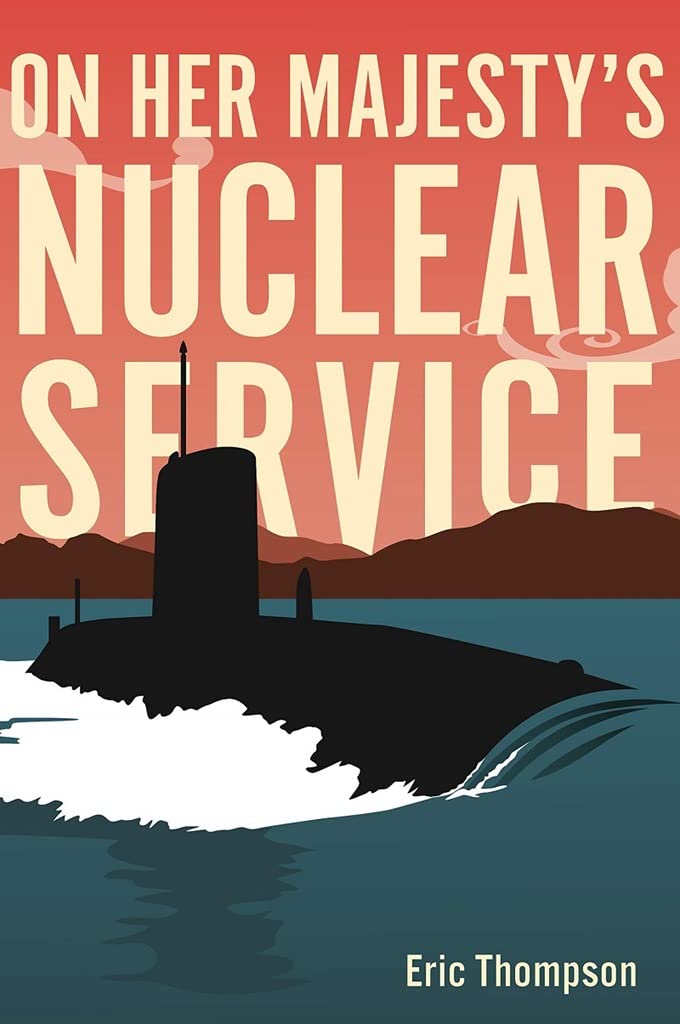
On Her Majesty's Nuclear Service |
| Eric Thompson | |
| During the Cold War, nuclear submarines performed the greatest public service of all: prevention of a third world war. History shows that they succeeded; the Cold War ended peacefully, but for security reasons, only now can this story be told. Eric Thompson is a career nuclear submarine officer who served from the first days of the Polaris missile boats until after the end of the Cold War. He joined the Navy in the last days of Empire, made his first sorties in World War II type submarines and ended up as the top engineer in charge of the navy's nuclear power plants. Along the way, he helped develop all manner of kit, from guided torpedoes to the Trident ballistic missile system. In this vivid personal account of his submarine operations, he reveals what it was like to literally have your finger on the nuclear button. In his journey, the author leads the reader through top-secret submarine patrols, hush-hush scientific trials, underwater weapon developments, public relations battles with nuclear protesters, arm-wrestling with politicians and the changing roles of females and homosexuals in the Navy. It is essentially a human story, rich in both drama and comedy, like the Russian spy trawler that played dance music at passing submarines. There was never a dull moment. Behind the lighter moments was a deadly serious game. This, the inside story of Britain's nuclear deterrent, reveals the secretive life of submarines and the men who served on them; they kept their watch, and by maintaining the threat of 'Mutually Assured Destruction' helped keep Britain and the world safe. |
|
|
Related Pages: 1970 - 1990: Churchill Class 1963 - 1980: Dreadnought Class 1959 - 1998: Oberon Class 1956 - 1988: Porpoise Class 1973 - 2010: Swiftsure Class 1966 - 1994: Valiant Class |
|

|
Only Four Escaped The Sinking of the Submarine Thetis |
| James D Benson / Charles Esme Thornton W | |
| The hour-by-hour account of the bravery, bungling, helplessness and heroism of men trapped by the sea. On June 1, 1939, the Submarine Thetis sailed out of Liverpool Bay with 103 men on board for diving trials, but on the very first dive it failed to surface, the escape hatch jammed, and help was too slow in coming. |
|
|
Related Pages: Thetis (N 25) Thunderbolt (N 25) The Thetis Disaster Relief Fund The Loss of HMS Thetis |
|

|
Operation Title Sink the Tirpitz |
| Glyn L Evans | |
| rime Minister Winston Churchill referred to Tirpitz as 'The Beast' and on 25th January 1942 he wrote, The destruction or even the crippling of this ship is the greatest event at this present time. No other target is comparable to it. With these words the seeds were sown for Operation TITLE, an Allied mission to sink Tirpitz. | |
|
Related Pages: Chariots |
|

|
Otto Kretschmer The Life of Germany's Highest Scoring U-Boat Commander |
| Lawrence Paterson | |
| Otto Kretschmer was only in combat from September 1939 until March 1941 but was Germany's highest-scoring U-boat commander sinking 47 ships totalling 274,333 tons. This definitive work details his personal story and the political backdrop from his earliest days. Aged 17 he spent 8 months studying literature at Exeter University where he learned to speak English fluently. The following year, on 1 April 1930, he enlisted as an officer candidate in the Weimar Republic's small navy. After completing his officer training and time on the training ship Niobe he served aboard the light cruiser Emden. In December 1934 he was transferred to the light cruiser K ln, then in January 1936 made the move to the fledgling U-boat service. His first operational posting was to the 2nd U-Flotilla s Type VII U35 where he almost being drowned during training in the Baltic Sea! During the Spanish Civil War, he was involved in several patrols as part of the international non-intervention force. He was finally given command of U23, a post which he held until April 1940. He had already sunk 8 ships including the destroyer HMS Daring east of Pentland Firth on 18 February 1940. He demonstrated a cool approach to combat: his mantra one torpedo for one ship proved that the best way for his boat to succeed against a convoy was to remain surfaced as much as possible, penetrating the convoy and using the boats high speed and small silhouette to avoid retaliation. His nickname Silent Otto referred to his ability to remain undetected and his reluctance to provide the regular radio reports required by Donitz: he had guessed that the Allies had broken German codes. Alongside his military skill was a character that remained rooted in the traditions of the Prussian military. While other U-boat commanders and crew returned from patrol with beards and a relaxed demeanour, U99 always returned with all men clean-shaven and paraded on deck. In the Bowmanville POW camp he organised a 2-way radio link to the German Naval High Command and planned a mass breakout with a U-boat rendezvous arranged. He was also instrumental in the Battle of Bowmanville that lasted for 3 days in October 1942. His antics behind the wire became the inspiration for the 1970 film The McKenzie Break. Postwar he answered the call for volunteers upon the establishment of the Bundesmarine. He retired from the rank of Flotillenadmiral in 1970. He suffered a fall celebrating his 50th wedding anniversary aboard a boat and died two days later at the age of 86. |
|
|
Related Pages: The U-Boats that Surrendered U-Boats in the Royal Navy post May 1945 The Sinking of U-593 U889 a TYPE IXC U-Boat U Boats & Other Navy's 1941 - 1944: VIIC Class |
|

|
Perisher 100 Years of the Submarine Command Course |
| David Parry | |
| The Royal Navy's Submarine Command Course, or 'Perisher', is a unique course, training, assessing and qualifying officers for submarine command which is, itself, unique, challenging and demanding; the epitome of mission command, with no succour, referral or support in a continuously threatening environment. It is therefore essential that those 'in command' are proven to be worthy and capable of their appointment. The evolution of 'Perisher' is in recognisable periods: the earliest days, following the submarine's introduction into the Royal Navy, was an autodidactic existence with COs learning from their peers and by experimentation. By 1917 circumstances had conflated to create the Periscope School and the Periscope Course to train and qualify COs whose characteristics were now fully formed. The interwar period was a difficult time, but it produced new submarines and technological innovations just in time for the Second World War and the most intense evolutionary period for 'Perisher'. Post-1945 to 1969 experienced two evolutions: Commander Sandy Woodward's codification of the art of attacking and a shift in emphasis from purely 'periscope eye' attacking toward the development of safety and tactical prowess in students. In the 1970s-1980s, two parallel courses satisfied the demand for COs from an expanding diesel-nuclear submarine fleet using SSKs and then in 1989, an SSN. The final period, 1990-2017 continues today with an all-nuclear Perisher and a curriculum to meet a changing battlespace, new weapons and tactics. Throughout its history, 'Perisher' has shaped the submarine commanding officer and he, in return, has shaped 'Perisher'. |
|
|
Related Pages: Perisher The History Of The Submarine Attack Teacher |
|

|
Polaris The History of the UK's Submarine Force |
| Keith Hall | |
| Between 15 June 1968 and 13 May 1960, the first missile-armed nuclear-powered submarine (SSBN) left on patrol, with forty more to follow in subsequent years. Two years later, when Britain's Blue Streak and Skybolt plans were cancelled, Harold Macmillan and John F. Kennedy agreed for Polaris to be supplied to the Royal Navy. In 1996, the Polaris submarines of the 10th Submarine Squadron carried out a total of 229 patrols, travelling over 2 million miles |
|
|
Related Pages: 1967 - 1996: Resolution Class One Submarine, Two Captains - The Early Years of HMS Repulse |
|

|
Polaris Submarines, Missiles, the US Navy and the Royal Navy |
| John Boyes | |
| The atom bombs dropped on Japan at the end of the Second World War opened the door to the nuclear age. Seeing the potential for developing nuclear energy for the US Navy, Captain Hyman Rickover initiated a research programme that culminated in the launch of USS Nautilus, the world's first nuclear-powered submarine. Meanwhile, ballistic missile technology was developing fast but was still reliant on complex liquid fuels. The US Navy partnered with the army to develop a ballistic missile for both services but withdrew when solid fuels became a practical proposition. Under the leadership of Rear Admiral William Raborn, the US Navy set up its own project: the Polaris weapon system. In 1960, the first missile-armed nuclear-powered submarine left on patrol, with forty more to follow in subsequent years. Two years later, when Britain's Blue Streak and Skybolt plans were cancelled, Harold Macmillan and John F Kennedy agreed for Polaris to be supplied to the Royal Navy. At a time of intensive re-examination of the NATO alliance, the 'special relationship' between the UK and USA, and Britain's role as a nuclear power, this is the first comprehensive history of Polaris. It brings together technical aspects, the key characters, and the full stories of the American and British programmes. |
|
|
Related Pages: 1967 - 1996: Resolution Class One Submarine, Two Captains - The Early Years of HMS Repulse |
|

|
Red Star Under the Baltic A First hand Account of Life on Board a Soviet Submarine in World War 2 |
| Viktor Korzh | |
| Red Star Under The Baltic is the graphic memoir of a Soviet submariner during his years at sea in the Baltic during the Second World War. Not only is this a superb record of the appalling conditions endured on these basic craft, but a very human account detailing the comradeship and tensions among the crew as they operated in the most life-threatening conditions. | |
|
Related Pages: The Silent Deep |
|

|
Royal Navy Submarine Manual 1945 onward ('A' class - HMS Alliance) |
| Peter Goodwin | |
| Launched in 1945 and commissioned two years later, submarine HMS Alliance was built for service with the Royal Navy in the Far East. Alliance had a long and distinguished career of more than 28 years that took her all over the world. Today, Alliance is the centrepiece at the Royal Navy Submarine Museum, Gosport, where the submarine experience is brought to life by tours around the boat. Former submariner and historian Peter Goodwin gives Alliance the Haynes Manual treatment, examining in detail her construction and restoration, and describing what it was like to live, work and go to war in a submarine. |
|
|
Related Pages: 1943 - 1977: Amphion Class Diesel Submarines 1948 - 1958 Origins Of The Amphion Class Submarine Alliance (P 417) |
|

|
Sea Wolves The Extraordinary Story of Britain's WW2 Submarines |
| Tim Clayton | |
| Sea Wolves is the story of the crews who bravely manned British submarines in the Second World War. This small band of highly trained and highly skilled individuals fought in the front line for six long years, undertaking some of the most dangerous missions of the war. Britain's Sea Wolves operated close to shore in mined waters, attacking warships and heavily guarded convoys. But in the course of these vital operations, the submariners suffered devastating casualties. This is the vivid, thrilling story of the survivors and their promising young comrades who fought with such courage, in the face of the sickening terror of depth-charge attacks and the cold fear of having to escape from a sunken submarine filled with the bodies of close friends. |
|
|
Related Pages: In Service |
|

|
Secret Warriors British Submarines in the Cold War |
| Paul Brown | |
| A highly illustrated history of the Cold War operations of the submarines of the Royal Navy from 1948 to 1990. The Cold War was a period of intense activity for submarines of the Royal Navy, with many hair-raising incidents involving Soviet vessels. They were engaged in frequent hazardous surveillance patrols investigating Soviet submarines and surface warships and their operational tactics, and trailing Soviet strategic submarines (SSBNs), as well as conducting British deterrent SSBN patrols and protecting those patrols using attack submarines (SSNs). There were also dangerous patrols which trialled submarine operation under the Arctic ice-cap. In addition to these activities there were operations in other conflicts and war theatres including the Falklands War, the Suez campaign, the Northern Ireland Troubles, and the Indonesian confrontation. |
|
|
Related Pages: 1970 - 1990: Churchill Class 1963 - 1980: Dreadnought Class 1959 - 1998: Oberon Class 1956 - 1988: Porpoise Class 1973 - 2010: Swiftsure Class 1966 - 1994: Valiant Class |
|

|
Secrets of the Conqueror The Untold Story of Britain's Most Famous Submarine |
| Stuart Prebble | |
| HMS Conqueror is Britain's most famous submarine. It is the only sub since World War Two to have sunk an enemy ship. Conqueror's sinking of the Argentine cruiser Belgrano made inevitable an all-out war over the future of the Falkland Islands, and sparked off one of the most controversial episodes of twentieth century politics. The controversy was fuelled by a war-diary kept by an officer on board HMS Conqueror, and as a young TV producer in the 1980s Stuart Prebble scooped the world by locating the diary's author and getting his story on the record. But in the course of uncovering his Falklands story, Stuart Prebble also learned a military secret which could have come straight out of a Cold War thriller. It involved the Top Secret activities of the Conqueror in the months before and after the Falklands War. Prebble has waited for thirty years to tell his story. It is a story of incredible courage and derring-do, of men who put their lives on the line and were never allowed to tell what they had done. This story, buried under layers of official secrecy for three decades, is one of Britain's great military success stories and can now finally be told. |
|
|
Related Pages: Conqueror (S 48) |
|

|
Sink the Belgrano |
| Mike Rossiter | |
| The sinking of the Belgrano was one of the most dramatic moments of the Falklands conflict. For many it signalled Britain's entry into the war and it has been seen as a politically motivated decision deliberately designed to take the country irrevocably into the fight. Now Mike Rossiter - with unprecedented access to sailors from the Belgrano and HMS Conqueror - gives us a dramatic and definitive retelling of the events that led up to the sinking. With all the pace and tension of a thriller, Sink the Belgrano takes us inside the battle for the South Atlantic and shows us the human drama behind the famous, and controversial, Sun headline 'Gotcha!' We track the collision course between the British submarine Conqueror and the Argentine warship - as the two sides and everyone aboard head towards the climactic moment just outside the exclusion zone set up by the British around the Falkland Isles. We witness the behind-the-scenes arguments, discussions and powerbroking that led to the decision to fire the three torpedoes. And, for the first time, we hear from the sailors on both sides - the personal testimony of the hunt for and attack on the Belgrano, and from the Argentine side the experience of being under attack and the sinking that left 340 members of her crew dead. |
|
|
Related Pages: Conqueror (S 48) |
|

|
Songs & Ditties of the Fleet A Miscellany of Maritime Melodies & Memorabilia |
| Richard Barr / Bernie Bruen | |
| A collection of song lyrics, poems and humorous observations informed by the authors' combined experiences in the Royal Navy 1950s-1980s Richard Barr and Bernie Bruen met while serving in the Royal Navy in the 1970s aboard the aircraft carrier HMS Bulwark. With other crew members they formed a ship's band, which went on to perform under the unlikely name The Malawi International Airways String Quartet, MIASQ for short, entertaining audiences in various far-flung parts of the world with their light-hearted ditties about nautical life |
|
|
Related Pages: Naval Poetry Song Lyrics |
|
|
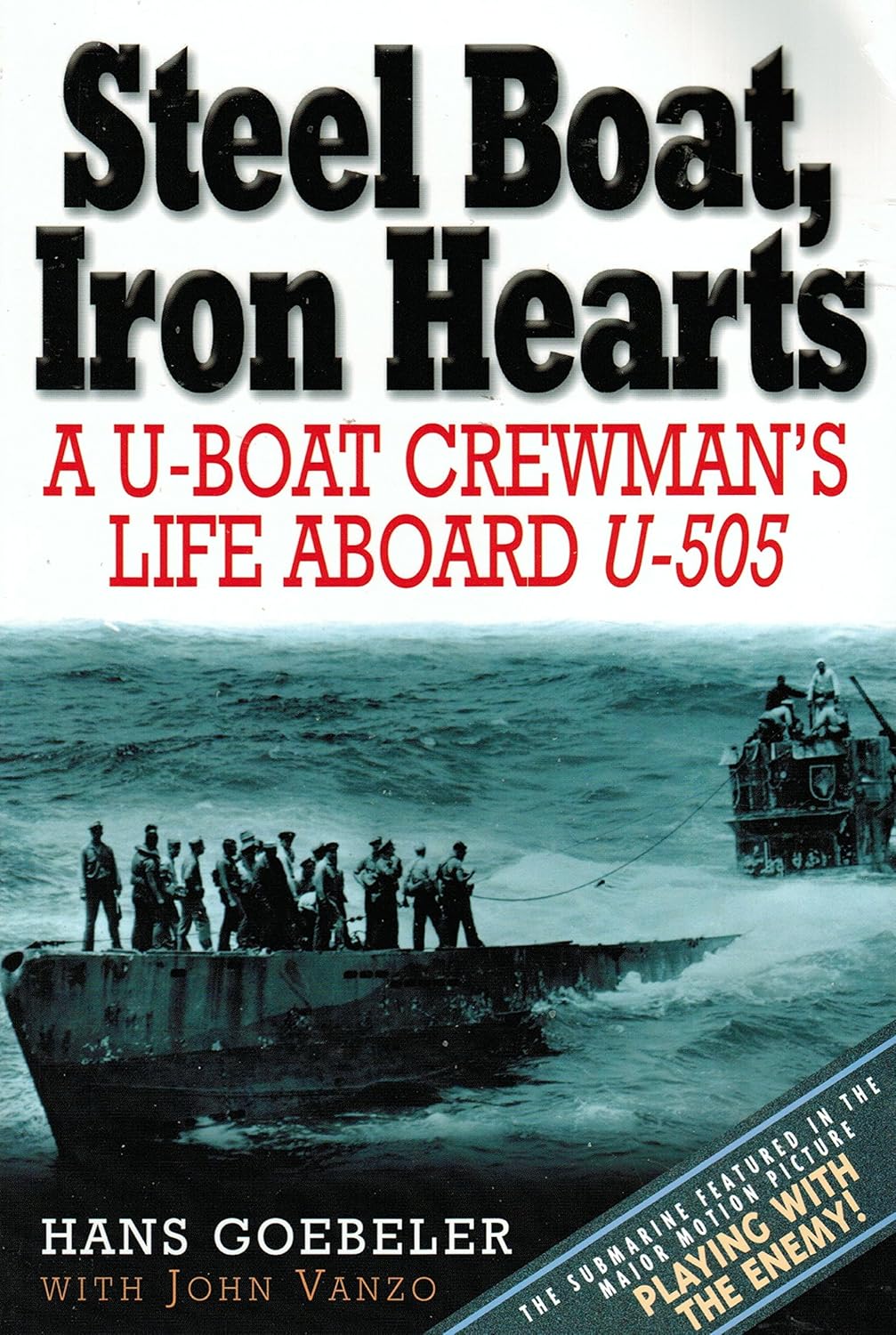
Steel Boat, Iron Hearts A U-Boat Crewman's Life Aboard U-505 |
| Hans Goebeler / John Vanzo | |
| Hans Goebeler is known as the man who 'pulled the plug' on U-505 in 1944 to keep his beloved U-boat out of Allied hands. 'Steel Boat, Iron Hearts' is his no-holds-barred account of service aboard a combat U-boat. It is the only full-length memoir of its kind, and Goebeler was aboard for every one of U-505's war patrols. Using his own experiences, log books, and correspondence with other U-boat crewmen, Goebeler offers rich and very personal details about what life was like in the German Navy under Hitler. Because his first and last posting was to U-505, Goebeler's perspective of the crew, commanders, and war patrols paints a vivid and complete portrait unlike any other to come out of the Kriegsmarine. He witnessed it all: from deadly sabotage efforts that almost sunk the boat to the tragic suicide of the only U-boat commander who took his life during Wwii; from the terror and exhilaration of hunting the enemy, to the seedy brothels of France. The vivid, honest, and smooth-flowing prose calls it like it was and pulls no punches. U-505 was captured by Captain Dan Gallery's Guadalcanal Task Group 22.3 on June 4, 1944. Trapped by this 'Hunter-Killer' group, U-505 was depth-charged to the surface, strafed by machine gun fire, and boarded. It was the first ship captured at sea since the War of 1812! Today, hundreds of thousands of visitors tour U-505 each year at the Chicago Museum of Science and Industry. Included a special Introduction by Keith Gill, Curator of U-505, Museum of Science and Industry. A uthor Hans Jacob Goebeler served as control room mate aboard U-505. He died in 1999, and author John P. Vanzo is a former defense program analyst. He teaches political science and geography at Bainbridge College in Georgia. |
|
|
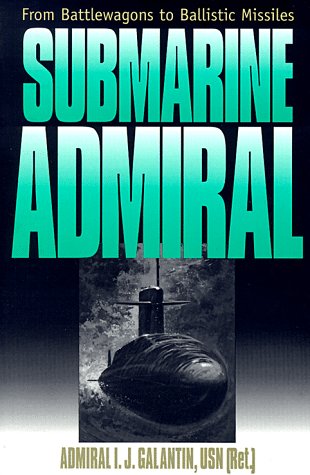
Submarine Admiral From Battlewagons to Ballistic Missiles |
| J.J. Galantin | |
| Presents an account of the development of the ballistic missile submarine, and a lifelong love affair with submarines. Submarine Admiral is a well written, well documented personal narrative of submarine development through times of breath-taking change in war, both hot and cold. Readers of THE SUBMARINE REVIEW will find it fascinating and a key book for their submarine library. |
|
|
Related Pages: The Silent Deep |
|
|
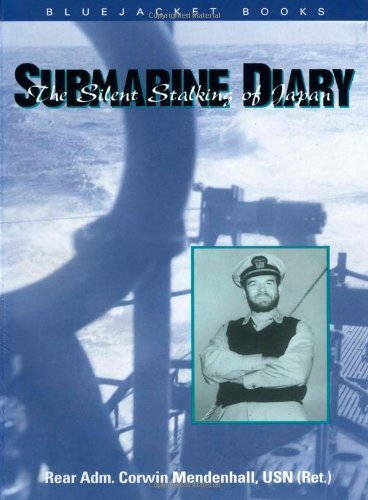
Submarine Diary The Silent Stalking of Japan |
| Corwin Guy Mendenhall Jr | |
| A vividly detailed account of life aboard U.S. submarines in the Pacific during World War II. An understated but absorbing journal from a veteran of 11 underseas missions in the close quarters of a fleet submarine against Japanese shipping during WW II's Pacific campaigns. A 1939 graduate of the US Naval Academy. |
|
|
Related Pages: The Silent Deep |
|

|
Submarine Operations During The Falklands War |
| Lieutenant Commander Steven R. Harper | |
| This paper contains an analysis of submarine operations during the Falklands War. This was done to provide some insight on the importance of submarines in this conflict and to show the usefulness of submarines in any maritime conflict The submarine operations by both belligerents are looked at and compared over the duration of the conflict This is an unclassified study that was researched using published books, magazine articles, unpublished papers, unclassified government documents and interviews with officers involved in the conflict. |
|
|
Related Pages: |
|

|
Submarine Upholder |
| Sydney Hart | |
| The story of HM Submarine Upholder, ordered just days before the Second World War started. Serving with the 10th Submarine Flotilla, she was commanded by David Wanklyn VC. One of the most successful British submarines of World War Two, sinking two destroyers, three submarines, three transports, ten merchant ships, two tankers and one trawler, totalling 128,353 tons of shipping. Upholder sailed out of Grand Harbour, Valetta, in Malta in April 1942, never to be seen again, and is believed sunk off the Lybian coast, near Tripoli. |
|
|
Related Pages: Captain Michael Lindsay Coulton (Tubby) Crawford DSC & Bar Upholder Sank 129,529 Tons Of Axis Ships Lieutenant Commander Malcolm David Wanklyn |
|

|
Submariner The Memoirs of a Submarine Engineer in Peace and War |
| J O Coote | |
| The author relates his experiences as a submarine commander for the British Royal Navy during World War II, describing patrols in the North Sea and the Mediterranean and enemy attacks that made submarine operations the most dangerous of combat services | |
|
Related Pages: Affray - Subsmash Commentary |
|

|
Submariners Real Life Stories from the Deep |
| Keith Hall | |
| The Senior Service has, for a hundred years, had submarines. Originally thought to be Un-English, submarines helped us win two World Wars and have played a great part in Britain's nuclear deterrent for the past thirty years. Originally some of the small subs had crews of less than ten men, unlike today's nuclear behemoths with crews of almost one hundred. Submariners are a breed apart; ask any submariner and they'll tell you they think and act differently from the regular navy. Submariners is the story of the submarine service in the words of the men involved. |
|
|
Related Pages: Biographies & Memoirs Crew In Service People, Places and Things |
|

|
Submariners VC The Mystery of the Missing X5 |
| William Jameson | |
| Describes the personnel and actions that resulted in submariners being awarded the Victoria Cross from 1914 to 1945. | |
|
Related Pages: Lieutenant Donald Cameron. Royal Naval Reserve Lieutenant Ian Edward Fraser, Royal Naval Reserve Lieutenant Norman Douglas Holbrook Temporary Acting Leading Seaman James Joseph Magennis Lieutenant Commander Anthony Cecil Chapel Miers Lieutenant Basil Charles Godfrey Place VC Winners |
|

|
Submariners' News The Peculiar Press of the Underwater Mariner |
| Keith Hall | |
| For many years submariners produced local newspapers, reporting from the deep with a unique take on their unusual lifestyle. Held in much affection by submarine crews, they enjoyed a long period of popularity from the 1970s-1990s for their irreverent and decidedly un-PC approach to underwater living. In this entertaining book, author Keith Hall examines the development of this strange branch of underwater journalism, collating the articles and anecdotes, jokes cartoons and stories that have been published over the years to brighten up the lives of submariners far from home, providing an insight into the bizarre self-contained world of the submariner. |
|
|
Related Pages: |
|

|
Submarines & Deep-Sea Vehicles |
| Jeffrey Tall | |
| The submarine revolutionized naval warfare, progressing from the crude, steam-driven craft of the American Civil War to the silent nuclear machines that can cruise for months underwater without surfacing, only limited by the endurance of their crews, and carry intercontinental missiles mounting multiple nuclear warheads. Submarines and Deep-Sea Vehicles traces the history of these vessels, starting with the earliest submersible craft, to the stealthy nuclear giants of the modern age. Since the end of programs for the exploration and exploitation of space, man has turned his attention to a frontier much closer to home, the ocean. This is a highly illustrated examination of the remarkable technology that has been developed to enable man to explore a hidden world tens of thousands of feet deep, in conditions just as extreme as those found in space. The sea offers man numerous resources and is the medium for a wide range of activities, spawning an equally diverse array of vessels to exploit them. Ranging from the military stealth submarines of the Cold War to biological research vessels, to the latest remotely-operated machines, Submarines and Deep-Sea Vehicles is a stunning guide to man's exploration and exploitation of the fascinating world under the ocean and still our greatest frontier. |
|
|
Related Pages: The Silent Deep |
|

|
Submarines of the Russian and Soviet Navies 1946-2026 |
| Norman Polmar | |
| This is the definitive history of the Russian submarine program since WWII. Submarines emerged as a particularly terrifying weapon after WWII, in no small part through the application of nuclear propulsion and the development of shipborne nuclear missiles. The Soviet Union invested huge funding into a world-class submarine program, producing innovative designs in imposing numbers. Norman Polmar is a best-selling author and recognized authority on the topic. His earlier works on Russian and Soviet subs earned plaudits from high-ranking officers in both the US and Russian navies. This new volume, based on those earlier works, provides readers with the authoritative English-language history of the postwar submarine force of the USSR and Russian Federation. It includes more than 100 photographs and line drawings.|Submarines emerged as a particularly terrifying weapon after WWII, in no small part through the application of nuclear propulsion and the development of shipborne nuclear missiles. The Soviet Union invested huge funding into a world class submarine program, producing innovative designs in imposing numbers. Norman Polmar is a best-selling author and recognized authority on the topic. His earlier works on Russian and Soviet subs earned plaudits from high-ranking officers in both the US and Russian navies. This new volume, based on those earlier works, provides readers with the authoritative English-language history of the postwar submarine force of the USSR and Russian Federation. It includes more than 100 photographs and line drawings. |
|

|
Subsmash The Mysterious Disappearance of HM Submarine Affray |
| Alan Gallop | |
| It was obvious that whatever had caused Affray to sink, and had ended the lives of all those on board, had occurred quickly. Sixty years later, in this compelling maritime investigation, Alan Gallop uses previously top secret documents, interviews with experts and contemporary news sources to explore how and why Affray became the last British submarine lost at sea, and possibly the greatest maritime mystery since the Marie Celeste. |
|
|
Related Pages: Disaster Beneath the Waves Affray Riddle Affray - Subsmash Commentary Chief Stoker Mechanics theory about the loss of the Affray |
|

|
Sunken Ships World War II US Naval Chronology, Including Submarine Losses of the United States, England, Germany, Japan, Italy |
| Karl Heden | |
| Sunken Ships of World War II is truly one of the greatest compendiums of naval history that has ever been put together. Not only does it give an exhaustive chronology of events and actions of the United States Navy, it also contains listings of the Allies (American and English) and of the Axis (Japanese, German and Italian) naval losses wherever they took place. |
|
|
Related Pages: Losses |
|

|
The Admiralty Regrets The disaster in Liverpool Bay |
| C.E.T. Warren / James Benson | |
| The story of the Thetis Submarine Tragedy in 1939, is the definitive account of the whole sorry episode of the Birkenhead built vessel that cost 99 lives; still today the worst submarine disaster in British History. | |
|
Related Pages: Thetis (N 25) Thunderbolt (N 25) The Thetis Disaster Relief Fund The Loss of HMS Thetis |
|

|
The Big Game A non-submarine related Sci-fi novella by the author of this site |
| Ian Hillbeck | |
| Two boys have their game soccer game interrupted by an alien invasion | |
|
Related Pages: About Me |
|

|
The Book of Navy Songs A Miscellany of Maritime Melodies & Memorabilia |
| Trident Society | |
| Collected and edited by Trident Society of the United States Naval Academy at Annapolis, Maryland | |
|
Related Pages: Naval Poetry Song Lyrics |
|
|
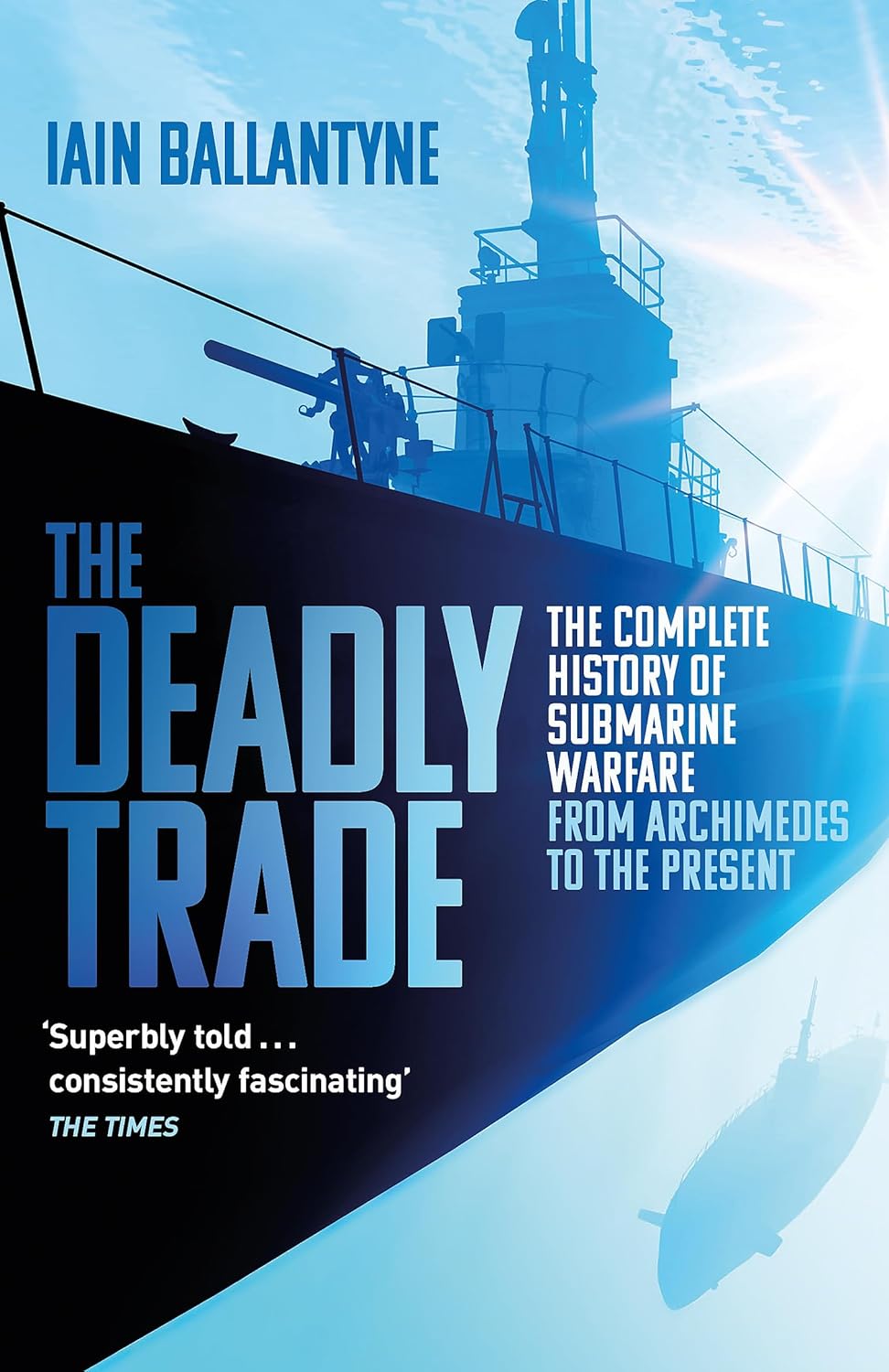
The Deadly Trade The Complete History of Submarine Warfare From Archimedes to the Present |
| Iain Ballantyne | |
| The Deadly Trade takes readers on an epic and enthralling voyage through submarine warfare, including how U-boats in two world wars tried to achieve victory, first for the Kaiser and then 20 years later for Adolf Hitler. It tells the story of how such tiny craft took on mighty battleships, including U-boats sinking HMS Royal Oak and HMS Barham in WW2, along with the incredible exploits of British submariners in the Dardanelles and Baltic during WW1.The action-packed narrative includes bitterly contested Atlantic convoy fights of WW2 and submarines in the clash of battle fleets at Midway. Iain Ballantyne also reveals how the US Navy submarine service brought the Japanese empire to its knees in 1945, even before the atomic bombs were dropped. The Deadly Trade tells the amazing stories of not only pioneers such as Drebbel, Fulton and Holland, but also of legendary submarine captains, including Max Horton and Otto Weddigen in WW1. During WW2 we sail to war with Otto Kretschmer, Gunther Prien, Fritz-Julius Lemp, Malcolm Wanklyn, Dudley Morton, Richard O'Kane and Sam Dealey. We get involved in the famous fights of Britain's ace submarine-killing escort group leaders Frederic 'Johnny' Walker, Donald Macintyre and Peter Gretton. There is a dive into unconventional submarine warfare, including Japanese midget subs in the notorious Pearl Harbor raid plus British X-craft against the Tirpitz in Arctic waters. Iain Ballantyne plunges readers into famous Enigma machine captures that played a key role in deciding the outcome of WW2. He explains what the Nazis were up to at the end of WW2, pursuing Total Underwater Warfare, partly via the revolutionary Type XXI U-boat. Ballantyne reveals the incredible story of a proposed cruise missile attack on New York and considers the likelihood (or otherwise) of Hitler escaping to South America in a U-boat. The Deadly Trade takes us into the post-WW2 face-off between the Soviets and NATO, the sinking of the Indian frigate INS Khukri by Pakistan's PNS Hangor and attack on the Argentine cruiser ARA Belgrano by HMS Conqueror. The Deadly Trade concludes with today's growing submarine arms race and Putin's 'missile boat diplomacy' along with the use of cruise missiles by the British and Americans to try and decapitate rogue regimes. |
|

|
The First Submarines The Beginnings of Underwater Warfare |
| Richard Compton-Hall | |
| This witty and perceptive account of the early years of submarine development contains much new material and the lives of the forgotten pioneers of submarines. It includes many wonderful inventions and even more colourful inventors, but focuses primarily on John Philip Holland, the Irish-American genius who took submarine development out of the hands of lunatics and visionaries and turned it into a deadly weapon of war |
|
|
Related Pages: Story Of The First Dive 1901 - 1913: Holland Class The Man Who Invented The Submarine The First Barrow Submarines Chapter 3: The Spindle Hull Types - Holland, A, B and C Classes |
|

|
The Forgotten Submarine Pioneers |
| Richard M. Jones | |
| When the Royal Navy finally introduced submarines at the turn of the Twentieth Century it was a revolution for the service and its new submariners, but few people know of the many years of struggle by numerous designers and inventors to make this happen. | |
|
Related Pages: Story Of The First Dive 1901 - 1913: Holland Class The Man Who Invented The Submarine The First Barrow Submarines Chapter 3: The Spindle Hull Types - Holland, A, B and C Classes |
|

|
The History of the British U Class Submarine Owners' Workshop Manual |
| Derek Walters | |
| Originally designed in 1934 for anti-submarine training, by the end of the war 72 U-Class subs had been commissioned; 17 were lost to the enemy, and 3 in accidents. Manned by crews from seven nations' navies, they served worldwide, and never more successfully than in the Mediterranean. This book is the definitive study of this class of submarine and the men who serve on them. |
|
|
Related Pages: 1936 - 1958: U Class |
|

|
The Hunting Submarine The Fighting Life of HMS Tally-Ho |
| Ian Trenowden | |
| HMS Tally Ho, captained by Commander L.W.A. Bennington was a T-class submarine which achieved spectacular success in the Second World War. Her name was chosen for her by Winston Churchill and it proved a very suitable one for a hunting submarine. In a single commission, lasting from 15th March 1943 to 26th February 1945, she operated in the Malacca Strait. Here, surrounded by enemy air bases and in badly charted shallow waters, so shallow that many experts considered them unsuitable for submarine operations, she took a heavy toll of enemy warships and supply vessels. The boat, her captain and her crew are all vividly portrayed in this exciting chronicle which is the fruit of wide and detailed research. |
|
|
Related Pages: Baptism By Bell Tally-Ho (P 317) |
|

|
The Man Wants His Boat A novella by the author of this site |
| Ian Hillbeck | |
| Working in a shipyard is hard. Some days it can be fatal. Today was one of those days. | |
|
Related Pages: About Me |
|

|
The Polish Navy 1918-45 From the Polish-Soviet War to World War II |
| Przemyslaw Budzbon | |
| In exile, the Polish Navy operated not only their own ships, but also Royal Navy warships, including a cruiser, destroyers, submarines and motor torpedo boats which fought alongside the Allies in the Battle of the Atlantic, the Arctic Convoys, and at the Normandy landings. This detailed account not only describes the Polish Navy's contribution to the Allied war effort but also the episode of the Polish destroyer Piorun which took on the Bismarck in a lone gun duel leading to the sinking of the great German battleship. |
|
|
Related Pages: 1940 - 1946: The 9th Foltilla When A Wolf And An Eagle Came Up The Tay |
|

|
The Pussers Cook Book Traditional Royal Navy recipes |
| Paul White | |
| Woven between the recipes in this book are true facts and tid-bits about the food, the cooks and general life aboard ship. Along with the recipes, this book aims to preserve a segment of British history, Royal Navy social history, which is fading all too quickly and would otherwise be lost in the grey sea-mists of oblivion. |
|
|
Related Pages: Submariners Recipes |
|

|
The Real X-Men The Heroic Story of the Underwater War 1942-1945 |
| Robert Lyman | |
| The Real X-Men tells the story of the sacrifice and heroism of the individual men, many of them little more than teenagers, who volunteered for this dangerous duty and who crewed both the Chariots and the X-craft without knowing the full extent of the risks entailed, nor indeed the very small chances they had of coming back alive. | |
|
Related Pages: Lieutenant Donald Cameron. Royal Naval Reserve Lieutenant Ian Edward Fraser, Royal Naval Reserve Temporary Acting Leading Seaman James Joseph Magennis Bill Morrison Lieutenant Basil Charles Godfrey Place |
|

|
The Royal Navy Submarine Service |
| Anthony Preston | |
| The year 2001 records the 100th anniversary of the foundation of the Submarine Service, and Antony Preston presents a day-by-day account of life in the service. In 1901, Holland One, the Royal Navy's first submarine, fitted with a single torpedo tube, was born at Vickers-Armstrong amidst great controversy, in an era when the submarine was regarded as the weapon of the weaker power | |
|
Related Pages: 2001 Centenary |
|

|
The Sea Devils Operation Struggle and the Last Great Raid of World War Two |
| Mark Felton | |
| July 1945. Eighteen young British, Australian and New Zealand special forces from a top-secret underwater warfare unit prepare to undertake three audacious missions against the Japanese. Using XE-craft midget submarines, the raiders will creep deep behind Japanese lines to sink two huge warships off Singapore and sever two vitally important undersea communications cables. Success will hasten ultimate victory over Japan; but if any of the men are captured they can expect a gruesome execution. Can the Sea Devils overcome Japanese defences, mechanical failures, oxygen poisoning and submarine disasters to fulfil their missions? Mark Felton tells the true story of a band of young men living on raw courage, nerves and adrenalin as they attempt to pull off what could be the last great raid of World War Two. |
|
|
Related Pages: 1944 - 1952: XE Class |
|

|
The Ship With Two Captains The Story of the Secret Mission Submarine |
| Terence Robertson | |
| Between 1942 and 1944 HMS Seraph was engaged in unusual but vital wartime assignments, including carrying Eisenhower's deputy, General Mark Clark, through the Mediterranean to a hazardous rendezvous with the Free French as a prelude to the North African invasion, as well as the dramatic rescue of General Giraud from Vichy France in rough sea right under the nose of the enemy. Her most famous mission however was Operation Mincemeat where she aided the allies in deceiving their enemy about the invasion of Sicily. Yet what made these missions even more extraordinary was the fact that this 'Secret Mission Submarine' had the unusual distinction of having two captains, Royal Navy Lieutenant Bill Jewell who was in operational control and Captain Jerauld Wright of the United States Navy who commanded for political purposes. Terence Robertson uncovers the history of this extraordinary submarine and how these two captains collaborated to pull off some of the most remarkable operations in the Second World War. |
|
|
Related Pages: Seraph (P 219) Trials with HM Submarine Seraph HMS Seraph: Star of film and books |
|

|
The Silent Deep The Royal Navy Submarine Service Since 1945 |
| James Jinks / Peter Hennessy | |
| In the year that it is published, Russian submarines have once again been detected off the UK's shores. As Britain comes to decide whether to renew its submarine-carried nuclear deterrent, The Silent Deep provides an essential historical perspective. | |
|
Related Pages: The Silent Deep |
|

|
The Silent Service The Inside Story of the Royal Navy's Submarine Heroes |
| John Parker | |
| One of the great untold stories of the British services is that of the Royal Navy Submarine Service which entered the fray in World War I with 100 underwater craft. Through World War II, where submariners' prospects of returning safely from a mission were only 50:50, the Falklands conflict and the sinking of the Belgrano, to present-day elite machines, the Silent Service has played an enormous part in British defence. John Parker's in-depth investigation is very much personality led with diaries from the early part of the century to substantial first-person testimony from survivors of wartime heroics (when many VCs were won). |
|
|
Related Pages: Lieutenant Edward Courtney Boyle Lieutenant Donald Cameron. Royal Naval Reserve Lieutenant Ian Edward Fraser, Royal Naval Reserve Petty Officer Thomas William Gould Lieutenant Commander Geoffrey Saxon White Lieutenant Norman Douglas Holbrook Commander John Wallace Linton Temporary Acting Leading Seaman James Joseph Magennis Lieutenant Commander Anthony Cecil Chapel Miers Lieutenant Commander Martin Eric Nasmith Lieutenant Basil Charles Godfrey Place Lieutenant Peter Scawen Watkinson Roberts Lieutenant Richard Douglas Sandford Lieutenant Commander Malcolm David Wanklyn |
|

|
The Submarine Tales of Invention |
| Richard Spilsbury / Louise Spilsbury | |
| Centuries in the making, the submarine is a formidable military vessel. Readers will be fascinated by this book about the history of this complicated invention, including information on the key players, the setbacks along the way to success, and the moments of discovery | |
|
Related Pages: Story Of The First Dive 1901 - 1913: Holland Class The Man Who Invented The Submarine The First Barrow Submarines Chapter 3: The Spindle Hull Types - Holland, A, B and C Classes |
|

|
The Submarine Alliance Anatomy of the Ship |
| John Lambert / David Hill | |
| Provides a full description of the A Class Royal Navy Submarine Alliance, with particulars of the A Class, with photos & technical diagrams. | |
|
Related Pages: Affray - Subsmash Commentary |
|

|
The Submarine Pioneers The Beginnings of Underwater Warfare |
| Richard Compton-Hall | |
| Richard Compton-Hall has combined research with his own experience as a submariner to provide an insight into the inventions and motivations of the early submarine pioneers. This study explodes a number of popular myths, such as the claim that David Bushnell's one-man Turtle chased the British fleet out of New York Harbour in 1776. The truth about underwater exploration, however, is stranger than the fiction, not least because of its secrets and brotherhoods, duplicity and deception, determination and despair, frequent failure and rare triumph. |
|
|
Related Pages: Story Of The First Dive 1901 - 1913: Holland Class |
|

|
The Submariners Life in British Submarines, 1901-1999 |
| John Winton | |
| Drawn from personal memoirs, official reports, logbooks and private journals, John Winton skilfully weaves together compelling stories of survival and heroism in times of the most intense danger with welcome lighter moments, anecdotes about daily life and domestic arrangements aboard. The Submariners is an authoritative anthology of enterprise, endurance and valour expertly compiled by an author who himself served seven years in the Submarine Service. |
|
|
Related Pages: The Submariners Bond The Demise Of Jack Tar Bombers Lament Submarine Living A Submariners Life |
|

|
The T-Class Submarine The Classic British Design |
| Paul J. Kemp | |
| An evaluation of the predominant submarine of World War II and the post-war years, this book describes each amendment and re-design of the basic structure, and examples are given to portray the vessel in action. | |
|
Related Pages: Origins Of The Amphion Class Submarine The Silent Deep The Five Streamlined T Class Submarines of the early 1950s 1935 - 1970: T Class T Class Conversion |
|

|
The Type XXI U-Boat |
| Fritz Kohl | |
| The design of the Type XXI U-Boat was a radical step in the history of submarine development; indeed, the vessel could be said to have been the prototype of the modern conventionally-powered submarine | |
|
Related Pages: The Silent Deep |
|

|
The Valiant Sailor |
| Roy Palmer | |
| Sea Songs and Ballads and Prose Passages Illustrating Life on the Lower Deck in Nelson's Navy | |
|
Related Pages: Naval Poetry |
|

|
The World Encyclopedia of Submarines A complete history of over 150 underwater vessels from the Hunley and Nautilus to today's nuclear-powered submarines |
| John Parker / Francis Crosby | |
| Charts over a century of submarine development, from the earliest attempts to travel beneath the waves, two World Wars and the Cold War, through to the formidable machines in operation today. Specification boxes provide at-a-glance information about each submarine's country of origin, length, displacement, speed, armament, propulsion and complement. Features more than 700 historical and modern photographs illustrating each type of submarine, plus artworks of selected examples. Includes fascinating quotes from military leaders and a glossary explaining key naval terms and abbreviations. |
|

|
The World's Greatest Submarines An Illustrated History |
| David Ross | |
| Each entry includes a brief description of the submarines development and history, a colour profile view or cutaway, key features and specifications. Packed with more than 200 artworks and photographs. The World s Greatest Submarines is a colourful guide for the military and naval history enthusiasts. |
|

|
Thetis Submarine Disaster |
| David Paul | |
| The true story of loss of His Majesty's Submarine Thetis is still shrouded in mystery. As a result of media coverage at the time, a number of conspiracy theories were spawned, some gaining more credence than others, in light of the inconclusive findings of the official reports. In Thetis: Submarine Disaster, David Paul, having studied the events surrounding the tragedy of HMS Thetis for many years, examines the issues which led to the disaster, and draws some conclusions. |
|
|
Related Pages: Thetis (N 25) Thunderbolt (N 25) The Thetis Disaster Relief Fund The Loss of HMS Thetis |
|

|
Thetis Down The Slow Death of a Submarine |
| Tony Booth | |
| The Slow Death of a Submarine explores in minute detail a more rounded picture of what really happened before, during and after her tragic loss. In doing so Tony Booths book also takes a fresh look at culpability and explores some of the alleged conspiracy theories that surrounded her demise. The result is the first definitive account what happened to HMS Thetis and her men a fitting tribute, as the seventieth anniversary of her loss will be on 1 June 2009. |
|
|
Related Pages: Thetis (N 25) Thunderbolt (N 25) The Thetis Disaster Relief Fund The Loss of HMS Thetis |
|

|
They Were Just Skulls The Naval Career of Fred Henley, Last Survivor of HM Submarine Truculent |
| John Johnson-Allen | |
| This compelling story is the result of many hours spent recording the memories of Fred Henley. His life at sea is at the centre of his being and his own words are at the heart of the book. At the age of 14 Fred worked on a Thames sailing barge, then after his training at HMS Ganges, he joined his first ship which took him from the icy Arctic Ocean to the heat of West Africa where the Bismarck and her support ships were hunted. His experiences included visiting Archangel, sailing on Arctic convoys, capturing German supply ships, the failed attack on Oran, landings in Piraeus, Salonika and the French Riviera and operating with special forces in the Greek Islands. There is inevitably some humour when Fred recounts his encounters with girls. The book then explores the tragic loss of his last submarine, HMS Truculent. In the cold January waters of the Thames Estuary, within sight of Southend, over 60 men were lost in a major disaster, just five years after the end of the war. The voices of the survivors are heard telling how they stood in complete blackness in a sunken submarine, waiting for the water to come in so that they could escape to the surface, only for all but a few to drift away and die in the darkness. The story concludes with happier times with Fred visiting ports in the Mediterranean during peacetime as a married man. |
|
|
Related Pages: Truculent (P 315) The Sinking of the Truculent |
|

|
Twixt the Devil and the Deep Blue Sea The story of HMS Saracen |
| Janet Kinrade Dethick / Anne M. Corke | |
| During her distinguished career, HM Submarine Saracen was responsible for sinking thousands of tons of Axis shipping. But in August 1943 her luck ran out when she was mortally wounded by depth charges from two Italian corvettes, the last Allied submarine to be sunk by the Italians. |
|
|
Related Pages: Captain Michael Lumby Saracen (P 247) RN Submarines scuttled or captured in WWII |
|

|
Type VII U-boats |
| Robert C. Stern | |
| After the narrow defeat of their U-boat fleet in the First World War, the German Navy analyzed their experiences and devised new theories and plans for a future conflict. The principal result of this study was the development of the daring concept of Rudeltaktik, which involved co-ordinated pack attacks on the Allied convoy systems that had proved so successful in defence |
|
|
Related Pages: 1941 - 1944: VIIC Class |
|
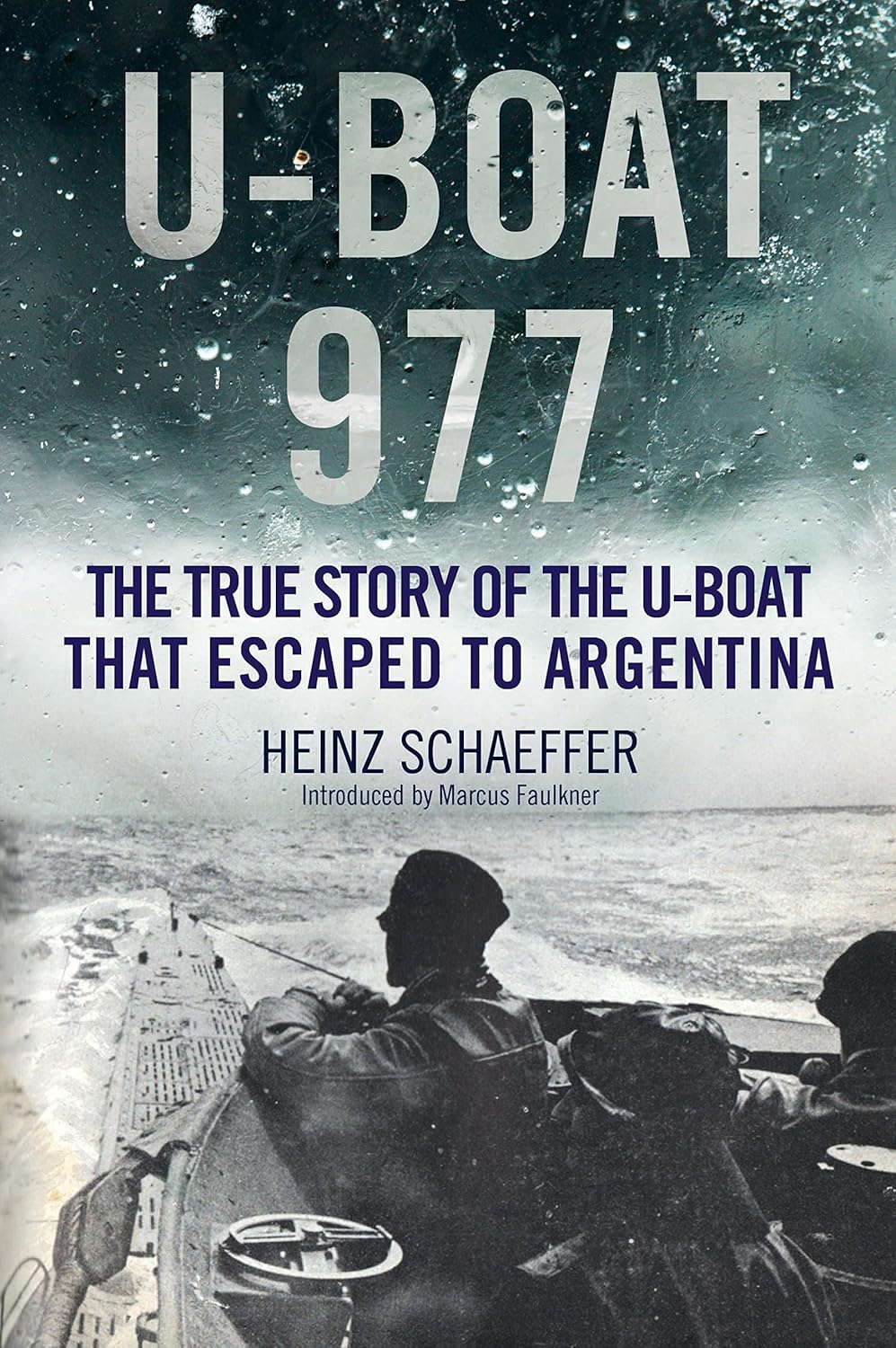
|
U-Boat 977 The True Story of the U-Boat That Escaped to Argentina |
| Heinz Schaeffer | |
| When it was first published in 1953, opinions were sharply divided between those who deplored the apparent extolling of a vicious form of warfare, and this who found in Heinz Schaeffer s account a revealing picture of the German Navys training and methods. U-Boat 977 was the German submarine that escaped to Argentina at the end of World War Two. This epic journey started from Bergen in Norway, where in April 1945 it was temporarily based, and took three and a half months to complete. Because of the continuing Allied naval activity the commander decided to make the first part of the journey underwater. Before surfacing near the west coast of Africa U-977 had spent a remarkable sixty-six days submerged. Heinz Schaeffer, the commander of U-977 wrote a full account of his career that culminated in this last command. It depicts the gruelling aspects of a submariner s life aboard a vessel that was subjected to harsh conditions of the sea and oceans. As an experienced commander Schaeffer took part in many of the decisive U-boat operations in the North Sea and Atlantic Ocean. In the final months of the war, and in common with most surviving U-boat commanders, Schaeffer and his crew came under constant attacks from Allied aircraft and surface ships. The final part of U-Boat 977 is Schaeffer s account of the journey to Argentina and lays to rest some of the more fanciful sorties that followed its arrival. |
|
|
Related Pages: The U-Boats that Surrendered U-Boats in the Royal Navy post May 1945 The Sinking of U-593 U889 a TYPE IXC U-Boat U Boats & Other Navy's 1941 - 1944: VIIC Class |
|

|
U-Boat Manual Owners' Workshop Manual |
| Alan Gallop | |
| An insight into the design, construction and operation of the feared World War 2 German Type VIIC U-boat | |
|
Related Pages: The U-Boats that Surrendered U-Boats in the Royal Navy post May 1945 The Sinking of U-593 U889 a TYPE IXC U-Boat U Boats & Other Navy's 1941 - 1944: VIIC Class |
|

|
U-Boats Beyond Biscay Donitz Looks to New Horizons |
| Bernard Edwards | |
| On the outbreak of war in 1939 Admiral Donitzs U-boat flotillas consisted of some thirty U-boats fully operational, with only six to eight at sea at any one time. Their activities were restricted mainly to the North Sea and British coastal waters. When France fell in the summer of 1940, the ports in the Bay of Biscay gave direct access to the Atlantic, and the ability to extend their reach even to. The Royal Navy was unable to escort convoys much beyond the Western Approaches. In a short time, the Allies were losing 500,000 tons of shipping a month, every month. Donitz now looked over the far horizons, Americas Eastern Seaboard, the coasts of Africa, and the Mediterranean, where Allied merchantmen habitually sailed alone and unprotected. There was a rich harvest to be gathered in by the long range U-boats, the silent hunter-killers, mostly operating alone. This book tells their story. |
|

|
U-Boats Destroyed German Submarine Losses in the World Wars |
| Paul Kemp | |
| Covering U-Boat losses in both World Wars, this reference for naval historians and students provides data on the nature, causes, locations, and results of losses. | |
|
Related Pages: The U-Boats that Surrendered Losses U-Boats in the Royal Navy post May 1945 The Sinking of U-593 U889 a TYPE IXC U-Boat U Boats & Other Navy's 1941 - 1944: VIIC Class |
|

|
Unbroken The Story of a Submarine |
| Alastair Mars | |
| During the bleak, heartbreaking days of early 1942, when beleaguered Malta was reeling under bombardment and blockade and Rommel was making his last desperate thrust towards Egypt, only one British submarine was operating in the western Mediterranean - the tiny, 600-ton Unbroken. In twelve months in the Med, Unbroken sank over 30,000 tons of enemy shipping, took part in four secret operations, three successful gun actions, and survived a total of over 400 depth charges, as well as innumerable air and surface attacks. This account of the 26-year-old Alastair Mars' command of this outstandingly successful submarine embraces her construction, sea trials and voyage to Gibraltar preparatory to her vital role in the Mediterranean. Once there, she was responsible for the destruction of two Italian cruisers and played a pivotal part in Operation Pedestal, the convoy that saved Malta from surrender. Alastair Mars writes simply and without pretension, and his words evoke the claustrophobic yet heroic world of the submariner. |
|
|
Related Pages: Unbroken (P 42) |
|

|
Under Pressure Living Life and Avoiding Death on a Nuclear Submarine |
| Richard Humphreys | |
| A candid, visceral, and incredibly entertaining account of what it's like to live in one of the most extreme environments in the world. Imagine a world without natural light, where you can barely stand up straight for fear of knocking your head, where you have no idea of where in the world you are or what time of day it is, where you sleep in a coffin-sized bunk and sometimes eat a full roast for breakfast. Now imagine sharing that world with 140 other sweaty bodies, crammed into a 430ft x 33ft steel tube, 300ft underwater, for up to 90 days at a time, with no possibility of escape. And to top it off, a sizeable chunk of your living space is taken up by the most formidably destructive nuclear weapons history has ever known. This is the world of the submariner. This is life under pressure. As a restless and adventurous 18-year-old, Richard Humphreys joined the submarine service in 1985 and went on to serve aboard the nuclear deterrent for five years at the end of the Cold War. Nothing could have prepared him for life beneath the waves. Aside from the claustrophobia and disorientation, there were the prolonged periods of boredom, the constant dread of discovery by the Soviets, and the smorgasbord of rank odours that only a group of poorly-washed and flatulent submariners can unleash. But even in this most pressurised of environments, the consolations were unique: where else could you sit peacefully for hours listening to whale song. Based on first-hand experience, Under Pressure is the candid, visceral and incredibly entertaining account of what it's like to live, work, sleep, eat and stay sane in one of the most extreme man-made environments on the planet. |
|

|
Unheard, Unseen Submarine E14 and the Dardanelles |
| David Boyle | |
| New Year 1915. The world is locked in a terrible conflict, and Winston Churchill has conceived of a bold plan. Constantinople would be seized and Turkey knocked out of the war. The key is the Dardanelles. The British submarine E14 approached the portal of the Ottoman Empire, viewing the ominous darkness from its small conning tower, eight feet above the waves. Its commander, Courtney Boyle, had told his superiors he thought the voyage, probably the longest dive ever contemplated in a submarine, was impossible. It would also take him past the wreckage of the submarines that had tried to pass that way in the days before: their dead buried on the beach, their survivors in captivity. The crew had said their goodbyes. They had written their farewell letters and given them into safekeeping, knowing that the chances were now against their survival. This book sets out what happened next and tells the story of the pioneering submarines of the Dardanelles. |
|
|
Related Pages: Lieutenant Edward Courtney Boyle E 14 - The One That Got Away Lieutenant Commander Geoffrey Saxon White |
|

|
Warship Profile 16 HMS Upholder, Royal Navy Submarine |
| DSC RN Capt. M. L. Crawford | |
| These Warship Profiles were published in the early 1970s and are quite rare now. Each takes a Warship and gives a full history, masses of photos, colour profiles and a well written text, often by serving or ex-Naval Officers. Modellers will find this volume very useful indeed! | |
|
Related Pages: Upholder (N 99) Upholder Sank 129,529 Tons Of Axis Ships Lieutenant Commander Malcolm David Wanklyn |
|

|
Who Do You Think You Are Encyclopedia of Genealogy |
| Nick Barratt | |
| The definitive reference guide to tracing your family history. Covering all access levels, from the new beginner to the more experienced researcher, the Encyclopaedia of Genealogy is a comprehensive master class in solving the mysteries of your personal heritage. |
|
|
Related Pages: RN Family History Research |
|

|
Will Not We Fear The story of HM Submarine Seal |
| C.E.T. Warren / James Benson | |
| It was on a difficult and dangerous line-laying mission in the Kattegat that H.M. Submarine Seal was involved in one of the strangest, most frightening, and most heroically stirring episodes of the Second World War. This is the full story, based on eyewitness accounts and official records, and told in dramatic detail by authors who were themselves submariners. |
|
|
Related Pages: Lieutenant-Commander Canon Rupert Lonsdale Seal (N 37) RN Submarines scuttled or captured in WWII |
|

|
Wolf Pack The Story of the U-Boat in World War II |
| Gordon Williamson | |
| Germany's World War II U-Boat fleet represented the elite of their naval personnel. In terms of technology, training, tactics and combat successes, the U-Boat Waffe was far superior to that of any other combatant nation. In this comprehensive book, the wartime development of the U-Boat is traced along with the experiences of typical U-Boat crewmen, from recruitment to combat. The author examines the operational tactics of the U-Boat fleet, as well as describing the massive bunkers that housed them. 'Wolf Pack' contains material taken from Fortress 3: 'U-Boat Bases and Bunkers 1941-45', Warrior 36: 'Grey Wolf: U-Boat Crewman of World War II' and New Vanguards 51 and 55: 'Kriegsmarine U-Boat 1939-45 (1) and (2)', with the addition of a new section on wartime tactics. |
|

|
Wolfpack Inside Hitler's U-Boat War |
| Roger Moorhouse | |
| A landmark history of the U-boat war told through the experiences and recollections of the U-boat crews themselves. Winston Churchill famously remarked that the threat of the German U-Boats was the only thing that had "really frightened" him during World War Two. The U-boats certainly claimed a bitter harvest among Allied shipping: nearly 3,000 ships were sunk, for a total tonnage of over 14 million tonnes, nearly 70% of Allied shipping losses in all theatres of the war. With justification, then, they are an integral part of the traditional narrative of the Battle of the Atlantic: a story of technological brilliance, dramatic sinkings, life and death, and, of course, the sinister, unseen threat of the U-boats themselves. For Allied seamen during the war, the U-boat was a hidden menace, a faceless killer lurking beneath the waves, and the urgent needs of survival afforded them little time or energy to consider the challenges and privations of their enemy. History, however, affords us that time and energy, and any pretence of comprehensiveness demands that we consider what life was like for the crews of those most claustrophobic vessels, packed into a steel hull, at the mercy of the enemy, of the elements, and of basic physics. Germany's U-boat crews posted the highest per-capita losses of any combat arm during World War Two. Some 30,000 German submariners were killed, over 75% of the total number deployed, the vast majority of whom have no grave except the seabed. Using archival sources, unpublished diaries and existing memoir literature, this book will give the U-Boatmen back their voice, allowing their side of the narrative to be aired in a comprehensive manner for the first time. With that testimony, Wolfpack takes the reader from the heady early days of the war, when U-boat crews were buoyed with optimism about their cause, through to the challenges of meeting the Allied counterthreat, to the final horror of defeat, when their submarines were captured by the enemy or scuttled in ignominy. Using the U-boatmen's own voices to punctuate an engaging narrative, it tells their story of courage, certainly, but also of fear, privation and, ultimately, failure. |
|

|
X-Craft Versus Tirpitz The Mystery of the Missing X5 |
| Alf R. Jacobsen | |
| Norwegian investigative journalist Alf Jacobsen relates one of the most incredible tales of the Second World War, in which Royal Navy X-craft midget submarines attacked the German battleship Tirpitz in Norway. A daring plan was hatched by the Admiralty to sink Tirpitz using midget submarines to plant high explosive mines beneath the ship's keel. |
|
|
Related Pages: Lieutenant Donald Cameron. Royal Naval Reserve Lieutenant Basil Charles Godfrey Place |
|

|
X.1 The Royal Navy's Mystery Submarine |
| Roger Branfill-Cook | |
| The 'X' stood for experimental, but it might equally have meant extraordinary, exotic or extravagant, as this giant submarine attracted superlatives. Built in the early 1920s, it was the world's largest, most heavily armed, and deepest diving submersible of the day. A controversial project conceived behind the backs of politicians, X.1 would remain an unwanted stepchild. As British diplomats attempted to outlaw the use of submarines as commerce raiders, the Admiralty was building the world's most powerful corsair submarine, designed to destroy entire convoys of merchant ships. This book explores the historical background of submarine cruisers, the personalities involved in X.1's design and service, the spy drama surrounding her launch, the treason trial of a Royal Navy submarine commander, the ship's checkered career, and her political demise. Despite technical successes, the X.1 became the target of a misinformation campaign aimed at persuading foreign naval powers that the cruiser submarine did not work. While the myth of her failure persists even today, it was ignored by other navies, who went on building submarine cruisers of their own. The book analyses the submarine cruisers built by the US, French, and Japanese navies, as well as the projected German copy of X.1, the Type XI U-Boat. |
|
|
Related Pages: X 1 1921 - 1925: X1 Class |
|

|
X3 to X54 The History of the British Midget Submarine |
| Keith Hall | |
| The X and XE-Class submarines were conceived during the Second World War: around 51ft (16m) long, they were designed to be towed by a mother submarine and use their small size to complete stealth missions, such as attacking harbours and performing reconnaissance. Although they would not begin active service until 1942, the submarine crews achieved quite the record, racking up 167 honours between them, including four Victoria Crosses. | |
|
Related Pages: Building X Craft Submarines 1954 - 1958: Stickleback Class 1942 - 1946: X Class 1944 - 1952: XE Class 1943 - 1946: XT Class |
|

|
Zeebrugge The Greatest Raid of All |
| Christopher Sandford | |
| The combined forces invasion of the Belgian port of Zeebrugge on 23 April 1918 remains one of Britain's most glorious military undertakings; not quite as epic a failure as the charge of the Light Brigade, or as well publicised as the Dam Busters raid, but with many of the same basic ingredients. A force drawn from the Royal Navy and Royal Marines set out on ships and submarines to try to block the key strategic port, in a bold attempt to stem the catastrophic losses being inflicted on British shipping by German submarines. It meant attacking a heavily fortified German naval base. The tide, calm weather and the right wind direction for a smoke screen were crucial to the plan. Judged purely on results, it can only be considered a partial strategic success. Casualties were high and the base only partially blocked. Nonetheless, it came to represent the embodiment of the bulldog spirit, the peculiarly British fighting elan, the belief that anything was possible with enough dash and daring. The essential story of the Zeebrugge mission has been told before, but never through the direct, first-hand accounts of its survivors, including that of Lieutenant Richard Sandford, VC, the acknowledged hero of the day, and the author's great uncle. The fire and bloodshed of the occasion is the book's centrepiece, but there is also room for the family and private lives of the men who volunteered in their hundreds for what they knew effectively to be a suicide mission. Zeebrugge gives a very real sense of the existence of the ordinary British men and women of 100 years ago, made extraordinary by their role in what Winston Churchill called the 'most intrepid and heroic single armed adventure of the Great War.' |
|
|
Related Pages: C 3 (I 33) Lieutenant Richard Douglas Sandford |
|

Television drama starring David Jason. 40 years after a British submarine goes missing at the end of the war, it re-appears, and the British government send the remaining crew member (Jason) with a new crew to trace the sub's last happenings. But the new crew start showing characteristics of the old crew.
12 pages added or updated in the last 1 month
Please help to maintain this site by reporting any Errors, Broken Links, Information or Site Issues on this page using this button

If you find this site useful, please consider supporting my work with a small Donation.
Please Note: Donations made using this option go directly to the site owner and not to the Submariners Association.
Thankyou for your support.
By purchasing from this page you are supporting this site as we receive an associate payment for each completed purchase.
Television drama starring David Jason. 40 years after a British submarine goes missing at the end of the war, it re-appears, and the British government send the remaining crew member (Jason) with a new crew to trace the sub's last happenings. But the new crew start showing characteristics of the old crew.
12 pages added or updated in the last 1 month
Please help to maintain this site by reporting any Errors, Broken Links, Information or Site Issues on this page using this button
If you find this site useful, please consider supporting my work with a small Donation.
Please Note: Donations made using this option go directly to the site owner and not to the Submariners Association.
Thankyou for your support.
