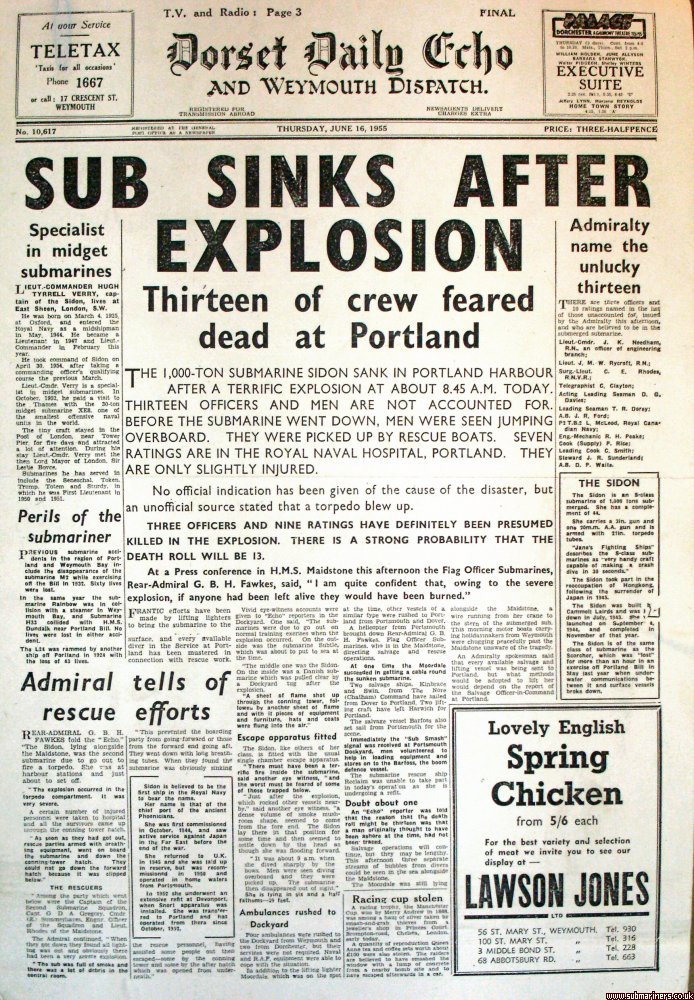
Whilst carrying torpedoes which were fuelled by Hydrogen Peroxide she suffered an explosion whilst alongside in Portland Harbour on the 16th June 1955. Sidon sank twenty minutes after the explosion with the loss of 13 lives.
Expended as an anti-submarine target 14th June 1957.
Whilst carrying torpedoes which were fuelled by Hydrogen Peroxide she suffered an explosion whilst alongside in Portland Harbour on the 16th June 1955. Sidon sank twenty minutes after the explosion with the loss of 13 lives.
While both conducting attack exercises off Inchmarnock on HMS Sardonyx at 1452 hours HMS Turpin and HMS Sidon collided. Both submarines were at periscope depth and both sustained damage. Sidon's stem cutter was turned to starboard by a length of 4 feet.
Having left the Holy Loch in April 1945 for passage to the Far East to join the 8th Submarine Flotilla. She diverted to Fremantle to repair battery defects en-route. Sidon departed Fremantle to commence her 2nd patrol. Soon after departing, one of her engines developed a defect and she called in at Onslow to rectify this. The patrol was mainly for air-sea rescue duties.
Sidon was diverted to search for the crew of an American Liberator which had come down off Siagon, in conjunction with USS Submarine Hammerhead and US aircraft. After 4 days of searching she recovered 2nd Lt Stanley Reed USAAF. He had been adrift for 5 days with little food & water. He had drifted 287 miles from the ditching position. In the words of the patrol report, "The joy on his face when he saw Sidon amply repaid all the fruitless searching and false hopes we had experienced."
Sidon arrived at Subic Bay in the Philippines after completing her patrol. Sidon completed her time in the Far East by being present in Hong Kong harbour when it was reoccupied by the British after the Japanese surrender.
Departed for Exercise SWX 6 during which Sidon touched bottom during phase 3. The exercise had started after leaving Portland and had ended just before arrival at Loch Tarbart on June 20th. Damage was confined to the net cutter immediately below No 5 and 6 torpedo tubes.
Taken in hand for refit and modernisation at Devonport. This included the removal of the 4-inch gun and gun tower and the installation of a snort mast and Type 267MW radar.
Refit completed HMS Sidon re-commissioned into the 2nd Submarine Squadron, based at Portland for submarine and anti-submarine training
In "A Submariner's story" commissioning engineer officer Joel C E Blamey tells how the first trial dive out of the yard ended up with Sidon plunging down with a severe bow down angle striking the shingle bottom at 158 feet. A dockyard modification had caused a complete loss of the telemotor pressure resulting in the loss of control of the main vents and hydroplanes and other equipment. While quite frightening no serious damage was done.
The armament of submarines of this class varied considerably. For example: 23 boats were fitted with the six bow tubes only; 18 vessels, intended to operate in the Far East, had their 3 inch guns replaced by 4 inch guns; whilst, in some boats, the Oerlikon cannon replaced, rather than supplemented, the three machine-guns.
After six years in the Royal Navy, Joel Blamey was conscripted into Britain's submarine service in 1926, aged 22. He went on to serve an unprecedented 28 years as a submariner, surviving peacetime accidents and World War II. At the age of 50, Joe returned to general service.
He served on several submarines and survived several accidents, such as hitting an underwater pinnacle in Sidon and a collision in Seahorse, from which he was transferred before it was lost to enemy action.
While Joel served in Porpoise, it supplied Malta with fuel and ammunition and sank several supply ships. The captured U570 came under his jurisdiction.
Later, he survived almost certain destruction in Strongbow. In all Joel survived more than two hundred depth charges.
These are but a few of the tales related in this book, told in Joel's matter-of-fact engineer's way.
Comments
Comment by: William Bell on July 24th, 2016
My old pal, Bobby Potts was the steward on Sidon. He told me he'd just stepped off the gangway to go inboard on an errand when the explosion occurred. Sadly Bobby died in 1976 from a heart attack.
Best friend ever.
UP SPIRITS
Comment by: Victor on July 10th, 2016
There was a Petty Officer from the Royal Canadian Navy on board, Laverne D McLeod.
Comment by: Victor on July 10th, 2016
12 crew members died, but the 13th was a doctor, Surgeon Lieutenant Charles Rhodes, went on board after the explosion to assist the injured.
Add A Comment(click to open)
This form is for you to comment on, or add additional information to this page. Any questions will be deleted. If you wish to ask a question contact the Branch or the Webmaster using the Contact Us page or ask your question on our Facebook Page
The armament of submarines of this class varied considerably. For example: 23 boats were fitted with the six bow tubes only; 18 vessels, intended to operate in the Far East, had their 3 inch guns replaced by 4 inch guns; whilst, in some boats, the Oerlikon cannon replaced, rather than supplemented, the three machine-guns.
After six years in the Royal Navy, Joel Blamey was conscripted into Britain's submarine service in 1926, aged 22. He went on to serve an unprecedented 28 years as a submariner, surviving peacetime accidents and World War II. At the age of 50, Joe returned to general service.
He served on several submarines and survived several accidents, such as hitting an underwater pinnacle in Sidon and a collision in Seahorse, from which he was transferred before it was lost to enemy action.
While Joel served in Porpoise, it supplied Malta with fuel and ammunition and sank several supply ships. The captured U570 came under his jurisdiction.
Later, he survived almost certain destruction in Strongbow. In all Joel survived more than two hundred depth charges.
These are but a few of the tales related in this book, told in Joel's matter-of-fact engineer's way.






Comments
Comment by: William Bell on July 24th, 2016
My old pal, Bobby Potts was the steward on Sidon. He told me he'd just stepped off the gangway to go inboard on an errand when the explosion occurred. Sadly Bobby died in 1976 from a heart attack.
Best friend ever.
UP SPIRITS
Comment by: Victor on July 10th, 2016
There was a Petty Officer from the Royal Canadian Navy on board, Laverne D McLeod.
Comment by: Victor on July 10th, 2016
12 crew members died, but the 13th was a doctor, Surgeon Lieutenant Charles Rhodes, went on board after the explosion to assist the injured.
This form is for you to comment on, or add additional information to this page. Any questions will be deleted. If you wish to ask a question contact the Branch or the Webmaster using the Contact Us page or ask your question on our Facebook Page