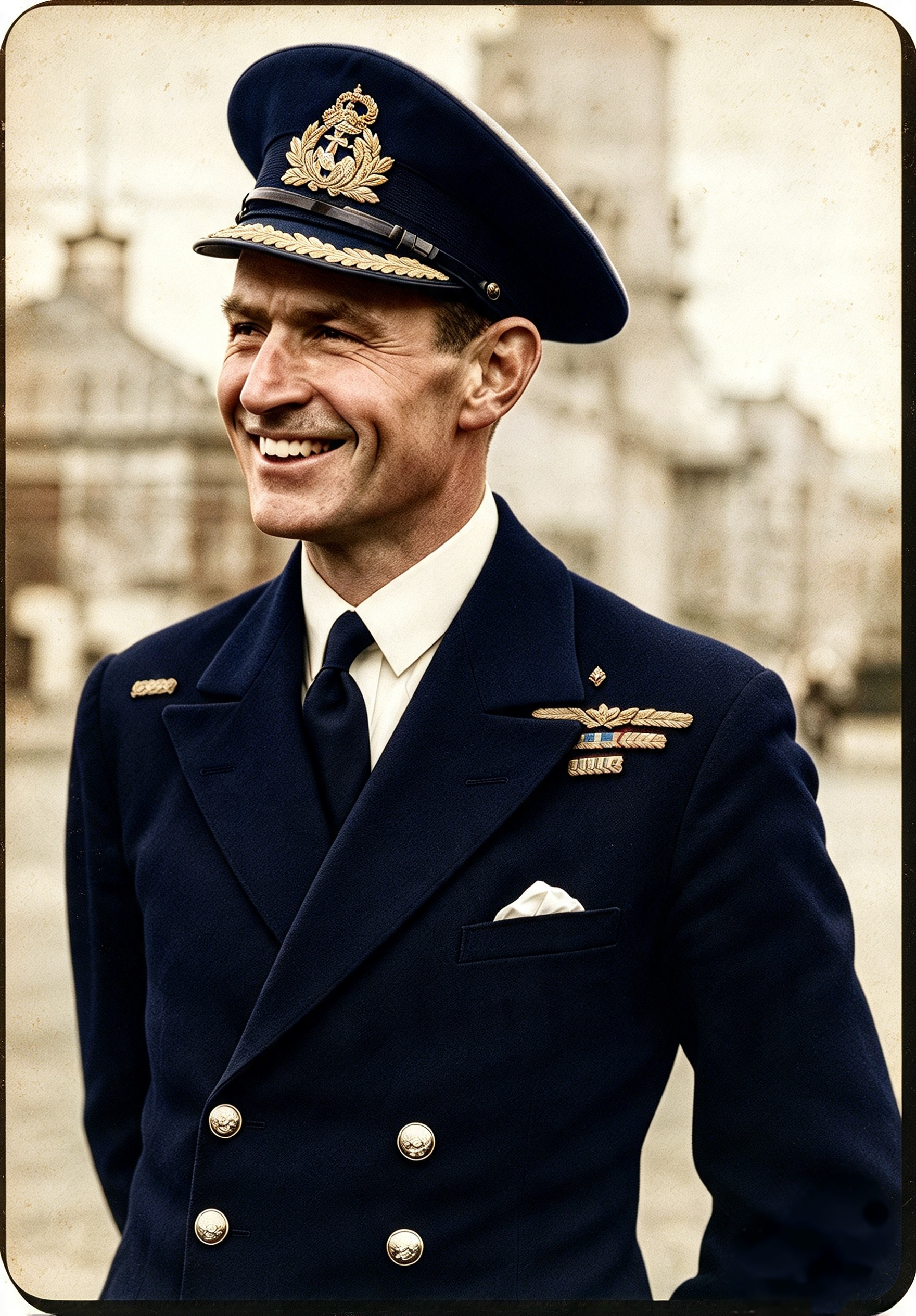
Guy D'Oyly-Hughes was born on 1 August 1891 in Salt Lake City, Utah, to British parents. When he was nine years old, he was sent back to England to complete his education, attending Bedford Modern School and then Tonbridge School. In 1904, at the age of twelve, he joined the Royal Navy as a cadet, setting the course that would define the rest of his life.
He progressed steadily through the ranks: confirmed as Midshipman in 1909, Sub-Lieutenant in 1912, and Lieutenant in September 1913. As Europe moved toward war, D'Oyly-Hughes volunteered for the Submarine Service, a branch that was still new, dangerous, and seen as the elite of the silent service.
When the First World War began, he was appointed First Lieutenant of HMS E11, serving under Lieutenant-Commander Martin Nasmith. In May 1915, E11 slipped through the heavily mined Dardanelles into the Sea of Marmara, striking at Ottoman shipping and supply lines. The submarine sank numerous vessels and shelled targets near Constantinople, earning D'Oyly-Hughes his first decoration, the Distinguished Service Cross, in June 1915.
His most famous act of courage came on the night of 20–21 August 1915. The official despatch from Vice-Admiral de Robeck records:
On the night of 20th–21st August, Lieutenant Guy D'Oyly-Hughes, First Lieutenant of HMS E11, proceeded ashore from the submarine in the Gulf of Izmir, for the purpose of destroying a section of the Constantinople–Baghdad Railway. He swam a distance of nearly a mile to the shore, carrying with him the necessary explosives, and successfully demolished a portion of the line, returning safely to his ship after an absence of several hours. The undertaking was attended with great risk, as the locality was patrolled by the enemy, and the explosion occurred within 150 yards of an armed guard.
London Gazette, 2 November 1915
For this extraordinary feat, he was awarded the Distinguished Service Order, the citation noting his "conspicuous gallantry, determination, and great coolness". He was barely twenty-four.
On 20th of July, 1915. Stoker Henry Mayne was accidentally lost overboard from E11 in the Mediterranean, about 150 miles from Malta. Guy D'Oyly-Hughes, E11's First Lieutenant, jumped in to save him, but Mayne was lost. D'Oyly-Hughes was awarded the Silver Medal of the Royal Humane Society in 1915 for his efforts to save Mayne.
Later in the war, in command of HMS E35, he torpedoed and sank a German U-boat. The Admiralty commendation stated:
On 15th July 1918, while on patrol in the North Sea, HMS E35 under the command of Lieutenant-Commander D'Oyly-Hughes, successfully engaged and sank an enemy submarine. The attack was delivered with great skill and daring, under conditions of extreme difficulty.
London Gazette, 27 August 1918
He received a Bar to the DSO, making him one of the most highly decorated submariners of his generation.
Between the wars, D'Oyly-Hughes continued to hold command at sea. He led submarines including HMS K12 and HMS Oberon, then took charge of the First Submarine Flotilla. Keen to master every dimension of naval warfare, he qualified as a pilot, believing that understanding aviation was essential to modern naval leadership. He was promoted to Captain in 1932.
In the late 1930s, he received an appointment that represented a significant shift: command of the aircraft carrier HMS Glorious. To some, placing a submariner in charge of a carrier was unexpected. His style of command, direct, decisive, uncompromising, did not always sit easily with the naval air personnel under his charge. His wife Gladys, aware of the tensions, wrote to one of his officers shortly before sailing:
I am writing to ask you to be forbearing with Guy. Sometimes he says and does things which seem quite mad, but it is only because he sees things differently from other people. He has the good of the Service at heart always, even when his methods are not the easiest to work with.
Gladys D'Oyly-Hughes, private correspondence, May 1940
He brought to the vessel the same ethos he had formed underwater: clear orders, strict discipline, and personal accountability. One of his early memoranda to the ship's company read:
This ship will be run on the principle that every man aboard has a duty to perform, and he will be held responsible for performing it. There are no passengers in HMS Glorious, every soul is a fighting unit, and every man's work matters.
Ship's Standing Orders, Captain G. D'Oyly-Hughes, 1939
When the Second World War broke out in September 1939, HMS Glorious served in the Mediterranean and the Indian Ocean before being recalled to northern waters to support the Allied campaign in Norway. Through the spring of 1940, the carrier transported and operated Royal Air Force Gladiator and Hurricane fighters, helping to defend allied positions ashore. The Flag Officer's report noted:
HMS Glorious has performed sterling service in transporting aircraft to Norway and maintaining them ashore. The rapid turn-round of squadrons reflects great credit on all concerned.
Admiralty Mediterranean Dispatch, April 1940
By early June, however, the campaign was collapsing, and the order was given to evacuate. On 7 June, D'Oyly-Hughes requested permission to sail independently for Scapa Flow, escorted only by the destroyers HMS Ardent and HMS Acasta. His signal to the Commander-in-Chief read:
Consider it desirable to proceed independently with Ardent and Acasta. Speed of advance will be increased, and I have urgent administrative matters requiring my presence ashore. Weather reports indicate favourable conditions.
Signal from HMS Glorious, 7 June 1940
Permission was granted. The carrier sailed without air patrol aloft, a decision that would become the subject of intense historical scrutiny.
In the afternoon of 8 June, as the ships steamed across the Norwegian Sea, the German battleships Scharnhorst and Gneisenau appeared on the horizon. They had been sent to intercept Allied evacuation forces. The German ships opened fire at long range; their third major salvo struck Glorious, igniting fires in the hangar and on the flight deck. The carrier's aircraft could not be launched in time to counterattack.
One of the few surviving officers later recalled:
The Captain remained on the bridge throughout. He gave the order to abandon ship calmly, as if he were conducting a routine exercise. There was no panic, no shouting. He was the last man I saw on the bridge.
Survivor testimony, Admiralty Inquiry, 1940
D'Oyly-Hughes was killed in action during the engagement, alongside most of his command staff. Glorious sank shortly before 17:00. The two escorting destroyers fought fiercely against the vastly superior enemy, launching torpedoes and laying smoke, before they too were sunk. The German official war diary noted:
In total, more than 1,500 officers and ratings lost their lives that day. Only thirty-nine men survived to be rescued.The enemy destroyers displayed great gallantry, repeatedly closing the range to launch torpedoes under heavy fire. Their resistance was determined and prolonged.
Kriegsmarine Command Diary, 8 June 1940
History has judged Guy D'Oyly-Hughes in conflicting terms, as an exceptionally brave submariner who risked his life repeatedly for his country, and as a carrier commander whose decision to sail without air cover led to disaster. The Admiralty's post-war review concluded:
Captain D'Oyly-Hughes was an officer of great personal courage and long experience in command at sea. His decision to sail independently was made in good faith, but with insufficient appreciation of the risks to which an aircraft carrier is exposed without air protection. The loss of HMS Glorious and her gallant company remains one of the most sorrowful episodes of the war at sea.
Official Admiralty Narrative, 1949
He was a man of strong convictions and decisive action, shaped by years of service in the silent service where the captain's judgment was often the only safeguard against unseen danger. He left behind his wife Gladys and their daughter Bridget. His name is recorded on the Portsmouth Naval Memorial, panel 38, column 2.
He gave his life in the service he had joined as a boy, and he went down with his ship.
Interview with Peter Wadding on a record breaking Submarine Escape

This is a great DVD to get you started in submarines. The DVD initially gives you a brief (15 min) history of submarine development, highlighting all the important mile stones in the early development of the submarine.
The DVD then expands into providing a more detailed explanation of both the technological and historical development of the submarine, thus providing the viewer with a well balanced introductoin to submarines.
13 pages added or updated in the last 2 month
Please help to maintain this site by reporting any Errors, Broken Links, Information or Site Issues on this page using this button

If you find this site useful, please consider supporting my work with a small Donation.
Please Note: Donations made using this option go directly to the site owner and not to the Submariners Association.
Thankyou for your support.
Interview with Peter Wadding on a record breaking Submarine Escape
This is a great DVD to get you started in submarines. The DVD initially gives you a brief (15 min) history of submarine development, highlighting all the important mile stones in the early development of the submarine.
The DVD then expands into providing a more detailed explanation of both the technological and historical development of the submarine, thus providing the viewer with a well balanced introductoin to submarines.
13 pages added or updated in the last 2 month
Please help to maintain this site by reporting any Errors, Broken Links, Information or Site Issues on this page using this button
If you find this site useful, please consider supporting my work with a small Donation.
Please Note: Donations made using this option go directly to the site owner and not to the Submariners Association.
Thankyou for your support.
This form is for you to comment on, or add additional information to this page. Any questions will be deleted. If you wish to ask a question contact the Branch or the Webmaster using the Contact Us page or ask your question on our Facebook Page