

This steam-driven boat was 100 feet long and displaced 160 tons. She was an improved version of an earlier submarine built in Stockholm in 1882 and based on the Resurgam, a submarine designed and developed by an Englishman, The Rev. William Garrett of Liverpool.

In 1887, another Nordenfelt was built at Barrow. This vessel was 125ft long, displaced 230 tons, had a hull form more like that of a conventional ship, and achieved a speed of 14 knots.
The Nordenfelt's were not particularly successful. When operating near the surface they were fast and manageable, but when completely submerged they lacked longitudinal stability.
They were ultimately sold to the Ottoman Empire and Russia. The submarine for Russia never reached her customer, foundering on the Jutland (Danish) coast on her delivery voyage.
The Turkish boat became the Abdul Hamid, which was dismantled for delivery by ship and re-assembled at Taskizak Naval Shipyard along the Golden Horn in Constantinople under the supervision of its English designer, George William Garrett.
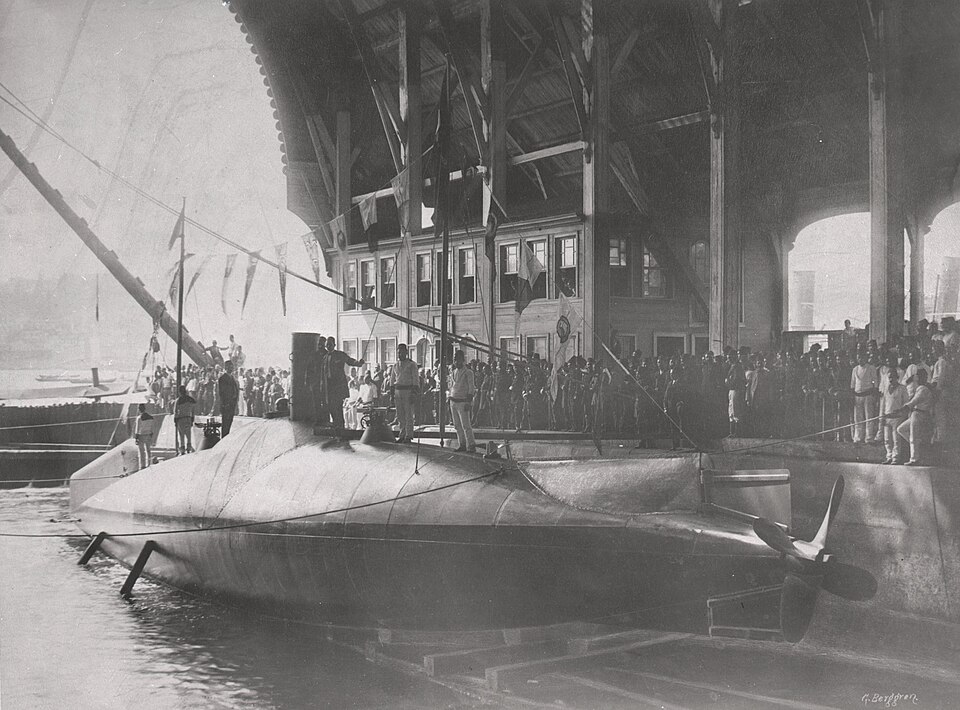
Abdul Hamid was first launched in Turkey on September 6, 1886 in front of many international dignitaries lined along Golden Horn. First diving tests were carried out in February 1887. Three dives were attempted successfully, 20 seconds each, with only the hemispherical navigator cockpit remaining above the water. On another test run in early 1888, the submarine was able to navigate through the strong currents around the Seraglio Point, making up to 10 knots of speed and successfully sank an old target ship with a single torpedo. The first submarine in history to fire a torpedo while submerged. After more tests and trials at Izmit naval base, Abdul Hamid officially joined the Ottoman Navy in a flag ceremony on 24 March 1888.
When the advent of nuclear power put steam propulsion back into submarines, Vickers could surely reflect: 'So what's new? We did it in 1886.'
| Displacement | 100 tons surfaced (160 submerged) |
| Length | 30.5 m (100 ft.) |
| Beam | 6 m (20 ft.) |
| Propulsion | Coal-fired 250 hp Lamm steam engine, 1 boiler, 1 screw |
| Bunkers | 8 tons of coal |
| Crew | 2 gunners, 2 firemen, 1 coxswain, 1 engineer, 1 officer (7) |
| Speed | 6 kn (11 km/h) surfaced (10 on trials) |
| 4 kn (7.4 km/h) | |
| Test depth | 160 ft (49 m) |
| Armament | Two 356 mm torpedo tubes, Schwarzkopf torpedoes |
| Two 35mm Nordenfelt twin machine guns |
The Development of HM Submarines from Holland 1 (1901) to Porpoise (1930)
The Man Who Invented The Submarine
He was a trailblazer for what would become known as the American Century: Isaac Rice was a law professor, magazine publisher, industrial entrepreneur and a hell of a salesman and exactly 100 years ago he sailed to England and pulled off another big deal. He sold the Royal Navy its first submarine.
Further Reading |

|
| The First Submarines |

Richard Compton-Hall This witty and perceptive account of the early years of submarine development contains much new material and the lives of the forgotten pioneers of submarines. |
| The Submarine |

Richard Spilsbury / Louise Spilsbury Centuries in the making, the submarine is a formidable military vessel. Readers will be fascinated by this book about the history of this complicated invention, including information on the key players, the setbacks along the way to success, and the moments of discovery |
| The Forgotten Submarine Pioneers |

Richard M. Jones When the Royal Navy finally introduced submarines at the turn of the Twentieth Century it was a revolution for the service and its new submariners, but few people know of the many years of struggle by numerous designers and inventors to make this happen. |
| Going Deep |

Lawrence Goldstone From Twenty Thousand Leagues Under the Sea to The Hunt for Red October, readers the world over have demonstrated an enduring fascination with travel under the sea. Yet the riveting story behind the invention of the submarine, an epic saga of genius, persistence, ruthlessness, and deceit is almost completely unknown. |

| Class: | 1936 - 1958: U Class |
| Built By: | Vickers (Tyne) |
| Build Group: | U2 |
| Fate: | |
| Scrapped in July 1949 at Newport. | |

It was on a difficult and dangerous line-laying mission in the Kattegat that H.M. Submarine Seal was involved in one of the strangest, most frightening, and most heroically stirring episodes of the Second World War.
This is the full story, based on eyewitness accounts and official records, and told in dramatic detail by authors who were themselves submariners.
12 pages added or updated in the last Array month
Please help to maintain this site by reporting any Errors, Broken Links, Information or Site Issues on this page using this button

If you find this site useful, please consider supporting my work with a small Donation.
Please Note: Donations made using this option go directly to the site owner and not to the Submariners Association.
Thankyou for your support.
| Displacement | 100 tons surfaced (160 submerged) |
| Length | 30.5 m (100 ft.) |
| Beam | 6 m (20 ft.) |
| Propulsion | Coal-fired 250 hp Lamm steam engine, 1 boiler, 1 screw |
| Bunkers | 8 tons of coal |
| Crew | 2 gunners, 2 firemen, 1 coxswain, 1 engineer, 1 officer (7) |
| Speed | 6 kn (11 km/h) surfaced (10 on trials) |
| 4 kn (7.4 km/h) | |
| Test depth | 160 ft (49 m) |
| Armament | Two 356 mm torpedo tubes, Schwarzkopf torpedoes |
| Two 35mm Nordenfelt twin machine guns |
The Development of HM Submarines from Holland 1 (1901) to Porpoise (1930)
The Man Who Invented The Submarine
He was a trailblazer for what would become known as the American Century: Isaac Rice was a law professor, magazine publisher, industrial entrepreneur and a hell of a salesman and exactly 100 years ago he sailed to England and pulled off another big deal. He sold the Royal Navy its first submarine.
Further Reading |
|
| The First Submarines |
|
Richard Compton-Hall This witty and perceptive account of the early years of submarine development contains much new material and the lives of the forgotten pioneers of submarines. |
| The Submarine |
|
Richard Spilsbury / Louise Spilsbury Centuries in the making, the submarine is a formidable military vessel. Readers will be fascinated by this book about the history of this complicated invention, including information on the key players, the setbacks along the way to success, and the moments of discovery |
| The Forgotten Submarine Pioneers |
|
Richard M. Jones When the Royal Navy finally introduced submarines at the turn of the Twentieth Century it was a revolution for the service and its new submariners, but few people know of the many years of struggle by numerous designers and inventors to make this happen. |
| Going Deep |
|
Lawrence Goldstone From Twenty Thousand Leagues Under the Sea to The Hunt for Red October, readers the world over have demonstrated an enduring fascination with travel under the sea. Yet the riveting story behind the invention of the submarine, an epic saga of genius, persistence, ruthlessness, and deceit is almost completely unknown. |
| Class: | 1936 - 1958: U Class |
| Built By: | Vickers (Tyne) |
| Build Group: | U2 |
| Fate: | |
| Scrapped in July 1949 at Newport. | |
It was on a difficult and dangerous line-laying mission in the Kattegat that H.M. Submarine Seal was involved in one of the strangest, most frightening, and most heroically stirring episodes of the Second World War.
This is the full story, based on eyewitness accounts and official records, and told in dramatic detail by authors who were themselves submariners.
12 pages added or updated in the last Array month
Please help to maintain this site by reporting any Errors, Broken Links, Information or Site Issues on this page using this button
If you find this site useful, please consider supporting my work with a small Donation.
Please Note: Donations made using this option go directly to the site owner and not to the Submariners Association.
Thankyou for your support.
This form is for you to comment on, or add additional information to this page. Any questions will be deleted. If you wish to ask a question contact the Branch or the Webmaster using the Contact Us page or ask your question on our Facebook Page