The Royal Navy's long history of seafaring has produced a rich body of superstitions, customs and rituals. Many originated in the age of sail, when sailors faced unpredictable weather, disease, isolation and sudden death with limited scientific understanding. These beliefs mixed practical caution, folklore, Christian influences and classical mythology (especially Neptune, god of the sea). While modern technology has reduced some risks, many traditions persist for reasons of morale, identity and continuity. Submariners "the Trade" have adapted and intensified several of them, reflecting the particular isolation, technical demands and tight-knit culture of underwater service.
Several beliefs remain widely recognised across the surface fleet and submarines. Whistling on board was long discouraged. Sailors feared it would "whistle up a wind" and summon storms; the sound could also be confused with the boatswain's pipe used for orders. The ship's cook was sometimes exempted, on the pragmatic grounds that if he was whistling he was not eating the stores.
Sailing on a Friday was considered unlucky, linked to the crucifixion. A well-known (and almost certainly apocryphal) Royal Navy story tells of an attempt to debunk the superstition by commissioning a ship named HMS Friday, laying her keel on a Friday, launching her on a Friday and sailing on Friday the 13th under a Captain Friday; the vessel was never seen again.
Cats, especially black ones, were traditionally welcomed. They controlled rodents that threatened stores and ropes, and their behaviour was read as a weather omen (they are sensitive to pressure changes). Losing a ship's cat overboard was a bad sign. The Royal Navy eventually restricted animals for hygiene and operational reasons, but the association lingered in folklore.
Other longstanding taboos included starting a voyage on certain dates (such as the first Monday in April), having flowers on board (associated with funeral wreaths), repairing a flag on the quarterdeck, or handing a flag between the rungs of a ladder. Losing a mop or bucket overboard was also regarded as unlucky. Ships are still referred to as "she," a practice with deep linguistic and cultural roots.
Launch and commissioning rites carried heavy symbolism. Coins were sometimes placed under the keel or mast for luck. Breaking a bottle of wine or champagne against the bow remains standard; failure of the bottle to break on the first attempt was once seen as an ill omen. Earlier practices included pouring wine onto the deck or, in more distant history, more bloodthirsty offerings.
The Royal Navy maintains a number of structured customs that blur the line between superstition, discipline and social bonding.
In the wardroom, officers drink the Loyal Toast seated, a privilege traditionally linked to low deckheads in sailing warships and said to have been granted by a monarch who bumped his head. Glasses are not clinked, because the sound recalls the ship's bell tolling for a burial at sea. Daily or weekly toasts follow a set pattern (for example, "Absent friends" on Sundays).
"Splice the mainbrace" was originally a reward of extra rum for a difficult repair aloft. The daily rum ration (the "tot") ended on Black Tot Day in 1970, but the order can still be given on special occasions by royal authority, resulting in a ceremonial issue of spirits.
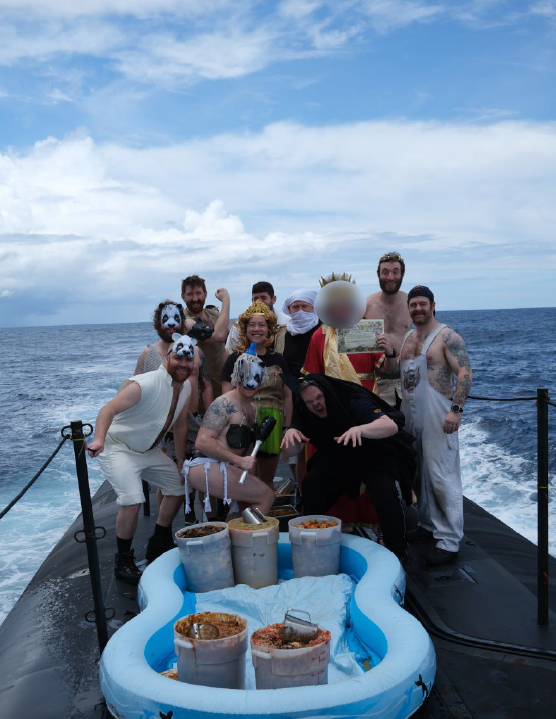
Crossing the Line remains one of the most elaborate rituals. When a ship crosses the equator, those who have never done so ("pollywogs") are initiated by "shellbacks" who have already crossed. King Neptune and his court (including Davy Jones and other characters) hold a mock trial. Initiates may be "shaved," given foul-tasting "medicine," painted and dunked. The ceremony has ancient roots in appeasing sea gods and testing crew fitness for long voyages; today it is largely good-humoured, though it has occasionally been regulated after excesses. Certificates are often issued. Modern Royal Navy ships, including submarines, still mark the occasion.
Burial at sea retained distinctive practices: the body sewn into a hammock or canvas (with the final stitch traditionally through the nose to confirm death), weighted at the feet, covered by the White Ensign, and committed with the words of the service. The last stitch and the careful handling reflected both practicality and a desire to honour the dead while protecting the living from restless spirits.
Other customs include the ship's bell (timekeeping, alarms and ceremonial ringing), Colours and Sunset, manning the side or cheering ship as a mark of respect, and the game of Uckers (a naval form of Ludo).
Submariners developed a particularly strong occupational folklore. Life underwater is confined, hierarchical yet egalitarian in risk, and dependent on absolute competence. Many surface-ship superstitions apply, but several practices are distinctive.
The most iconic is the flying of the Jolly Roger. In 1901 Admiral Sir Arthur Wilson dismissed submarines as "underhanded, unfair and damned un-English" and suggested their crews should be treated as pirates. In September 1914, Lieutenant-Commander Max Horton of HMS E9, returning after sinking the German cruiser SMS Hela, flew a Jolly Roger in defiant reply. The practice spread. Early on, additional flags marked successive successes; later a single large flag was decorated with symbols recording achievements—bars for ships sunk (sometimes coloured by type), daggers for special operations, other devices for aircraft, gun actions, rescues or secret missions. The tradition continued through the Second World War and beyond. HMS Conqueror flew one after the Falklands; later boats have done likewise after successful patrols or operations. Each flag is a unique visual record and a point of pride for the Silent Service.
The Royal Navy Submarine Service has suffered numerous tragedies since submarines first entered British service. Consequently, remembrance is deeply embedded in its culture.
The loss of HMS K13 in 1917 is one example. The submarine sank during sea trials in the Gare Loch, resulting in 32 deaths. The disaster has been commemorated by submariners and veterans for generations. In a 2020 memorial ceremony, the K13 ship's bell was rung 32 times, one ring for each person who died.
This is ritual in its most solemn form. There is no mockery or superstition involved. The repetition of the names, or, in this case, the number represented by the bell, ensures that the dead remain part of the community.
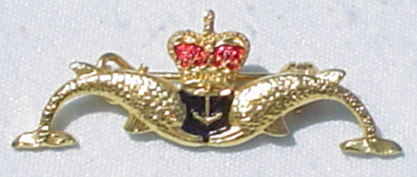
Qualification as a submariner is marked by the "dolphins", the badge showing two dolphins flanking a crown (the current design dates from the early 1970s). After rigorous training and a board that tests knowledge of the boat's systems, the new submariner traditionally receives the badge in a glass of rum (or sometimes beer). The initiate drinks the contents and catches the badge in the teeth. Occasional mishaps (swallowing the badge) have prompted discussion of health and safety adjustments, but the ritual remains a powerful rite of passage into an elite community.
Crossing the Line is observed on submarines as well as surface ships. Even nuclear boats on long deployments have staged the ceremony, with Neptune's court, trials and dunking adapted to the available space. The confined environment intensifies the sense of shared ordeal and subsequent belonging.
Other submarine lore is more informal. One account mentions oxtail soup as unlucky. Historical reluctance to have women aboard submarines was sometimes framed in terms of luck as well as practicality and policy; that has changed with integration. Practical quirks, hot-bunking, strict water discipline, limited personal space, generate their own humour and routines. The community's self-image as slightly apart from the rest of the Navy reinforces distinctive customs.
In an age of nuclear propulsion, advanced sensors and satellite communications, pure superstition has less explanatory power. Yet the rituals serve clear social functions. They mark transitions (first equator crossing, earning dolphins, successful return from patrol). They create shared memory and identity in a high-stress, high-trust environment. They connect modern crews to centuries of naval history and to the specific lineage of the Submarine Service. The Jolly Roger turns an early insult into a badge of distinction; the dolphins ceremony turns technical mastery into a visceral, communal moment.
Many of these customs are now performed with humour and self-awareness rather than literal belief. A bottle still breaks at a launch, Neptune still holds court, and a submarine may still return flying the skull and crossbones. The sea remains an unforgiving environment, and the Royal Navy continues to meet it with a mixture of professionalism, dark humour and the accumulated weight of tradition.
The modern submariner does not need to believe that Neptune controls the sea. But standing inside a submarine that is about to disappear beneath it, surrounded by the traditions of those who made the same journey before, it is easy to understand why sailors have always felt the need to acknowledge forces larger than themselves.
In the Royal Navy's Silent Service, ritual is not necessarily a substitute for reason. It is a way of giving meaning to the extraordinary demands of life beneath the waves.
Fort Blockhouse had its beginnings as a military base in 1431 when Henry VI authorised a tower to be built on the Gosport side of Portsmouth Harbour. The Navy moved into Fort Blockhouse in 1905 for the purpose of establishing a Submarine Boat Station.

Highly under appreciated large scale production. Superb photography, and effects involved in Submarine, Warship, Missile attacks; with well executed choreography for a covert mission to a Russian naval base, to rescue the Russian President, who has been captured by a Russian minister, with his military team, intending to orchestrate a nuclear war between the US and Russia.
Gerard Butler is always worth watching (Den of Thieves, Greenland, The Vanishing, to name three) and the supporting cast are convincing, rather than mainly "set furniture"; although Gary Oldman spends a lot of his screen time just shouting and running across the sets.
14 pages added or updated in the last 1 month
Please help to maintain this site by reporting any Errors, Broken Links, Information or Site Issues on this page using this button

If you find this site useful, please consider supporting my work with a small Donation.
Please Note: Donations made using this option go directly to the site owner and not to the Submariners Association.
Thankyou for your support.
Fort Blockhouse had its beginnings as a military base in 1431 when Henry VI authorised a tower to be built on the Gosport side of Portsmouth Harbour. The Navy moved into Fort Blockhouse in 1905 for the purpose of establishing a Submarine Boat Station.
Highly under appreciated large scale production. Superb photography, and effects involved in Submarine, Warship, Missile attacks; with well executed choreography for a covert mission to a Russian naval base, to rescue the Russian President, who has been captured by a Russian minister, with his military team, intending to orchestrate a nuclear war between the US and Russia.
Gerard Butler is always worth watching (Den of Thieves, Greenland, The Vanishing, to name three) and the supporting cast are convincing, rather than mainly "set furniture"; although Gary Oldman spends a lot of his screen time just shouting and running across the sets.
14 pages added or updated in the last 1 month
Please help to maintain this site by reporting any Errors, Broken Links, Information or Site Issues on this page using this button
If you find this site useful, please consider supporting my work with a small Donation.
Please Note: Donations made using this option go directly to the site owner and not to the Submariners Association.
Thankyou for your support.
This form is for you to comment on, or add additional information to this page. Any questions will be deleted. If you wish to ask a question contact the Branch or the Webmaster using the Contact Us page or ask your question on our Facebook Page