| Built By: | Vickers (Barrow) |
| Build Group: | Amphion |
| Fate: | Scrapped August 1972. |


| 1946: | Lieutenant | L S McIntosh | |
| 1947: | Lieutenant | Warwick Stanley Sherwood | |
| 1953: | Lieutenant Commander | Andrew Thomas Chalmers | DSC MID |
| 06-02-1945 | Laid Down |
| 25-06-1945 | Launched |
| 10-12-1946 | Completed |
| 06-06-1972 | Sold to be broken up for scrap on 6 June 1972. |

|
||
| Official | ||
| Admiralty Approved | 3rd Nov, 1945 | |
| Symbology | From the arms of the Channel Island of the same name. |
|
| Design Notes | A gold lion rampant, ensigned with a royal crown in red, holding in his dexter paw a sprig of oak proper on a green field. | |
|
||
| Unofficial | ||
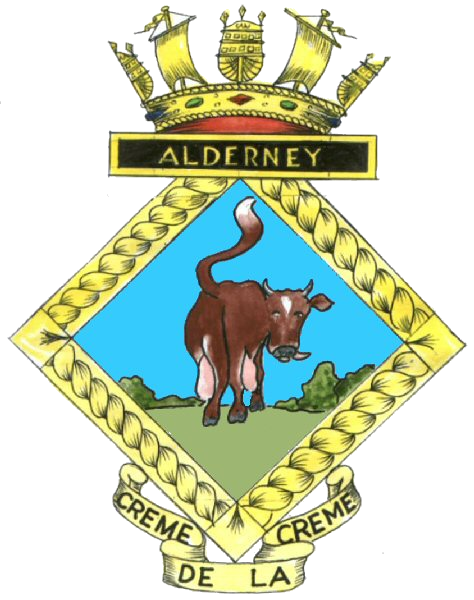
| Motto | Creme De La Creme. | |
| Symbology | The Alderney is an extinct breed of dairy cattle. It originated in, and is named for, the island of Alderney in the Channel Islands. | |
| Design Notes | An Alderney cow, rendered brown with a white-marked face and udders pink, gardant, tail erect on a blue field, on a green mount in base, a landscape scene depicting rolling green hills. | |
| Length overall | 280 ft 6in |
| Beam | 22 ft |
| Depth | 16ft |
| Displacement | 1385 tons (surface) |
| 1620 tons (submerged) | |
| Diving Depth | 350 ft |
| Speed | Surface 18.5 knots (design) |
| Submarged 8 knots (design) | |
| No. of shafts | 2 |
| Armament | 6 x 21 inch bow tubes (2 external) |
| 4 x 21 inch stern tubes (2 external) | |
| 20 torpedoes carried | |
| 1 x 4 inch gun | |
| 1 x 20mm Qerlikon cannon | |
| 3 x 0.303in machine-guns | |
| Endurance | Surface: 10 500 miles at 11 knots (design) |
| Submerged: 16 miles at 8 knots or 90 miles at 3 knots | |
| Complement | 6 Officers and 55 Ratings. |
| 6 Officers and 58 Ratings after modernisation. |
HMS Onyx was on a visit to Plymouth when the summons came. Her Commanding Officer had just arrived at his home nearby when the telephone rang with orders to take his submarine back to Gosport. He would not be back for another 117 days.

On the outbreak of war in 1939 Admiral Donitzs U-boat flotillas consisted of some thirty U-boats fully operational, with only six to eight at sea at any one time. Their activities were restricted mainly to the North Sea and British coastal waters.
When France fell in the summer of 1940, the ports in the Bay of Biscay gave direct access to the Atlantic, and the ability to extend their reach even to. The Royal Navy was unable to escort convoys much beyond the Western Approaches. In a short time, the Allies were losing 500,000 tons of shipping a month, every month.
Donitz now looked over the far horizons, Americas Eastern Seaboard, the coasts of Africa, and the Mediterranean, where Allied merchantmen habitually sailed alone and unprotected. There was a rich harvest to be gathered in by the long range U-boats, the silent hunter-killers, mostly operating alone.
This book tells their story.
11 pages added or updated in the last 14 months
Please help to maintain this site by reporting any Errors, Broken Links, Information or Site Issues on this page using this button

If you find this site useful, please consider supporting my work with a small Donation.
Please Note: Donations made using this option go directly to the site owner and not to the Submariners Association.
Thank you for your support.
|
|
||
| Official | ||
| Admiralty Approved | 3rd Nov, 1945 | |
| Symbology | From the arms of the Channel Island of the same name. |
|
| Design Notes | A gold lion rampant, ensigned with a royal crown in red, holding in his dexter paw a sprig of oak proper on a green field. | |
|
|
||
| Unofficial | ||
| Motto | Creme De La Creme. | |
| Symbology | The Alderney is an extinct breed of dairy cattle. It originated in, and is named for, the island of Alderney in the Channel Islands. | |
| Design Notes | An Alderney cow, rendered brown with a white-marked face and udders pink, gardant, tail erect on a blue field, on a green mount in base, a landscape scene depicting rolling green hills. | |
| Length overall | 280 ft 6in |
| Beam | 22 ft |
| Depth | 16ft |
| Displacement | 1385 tons (surface) |
| 1620 tons (submerged) | |
| Diving Depth | 350 ft |
| Speed | Surface 18.5 knots (design) |
| Submarged 8 knots (design) | |
| No. of shafts | 2 |
| Armament | 6 x 21 inch bow tubes (2 external) |
| 4 x 21 inch stern tubes (2 external) | |
| 20 torpedoes carried | |
| 1 x 4 inch gun | |
| 1 x 20mm Qerlikon cannon | |
| 3 x 0.303in machine-guns | |
| Endurance | Surface: 10 500 miles at 11 knots (design) |
| Submerged: 16 miles at 8 knots or 90 miles at 3 knots | |
| Complement | 6 Officers and 55 Ratings. |
| 6 Officers and 58 Ratings after modernisation. |
HMS Onyx was on a visit to Plymouth when the summons came. Her Commanding Officer had just arrived at his home nearby when the telephone rang with orders to take his submarine back to Gosport. He would not be back for another 117 days.
On the outbreak of war in 1939 Admiral Donitzs U-boat flotillas consisted of some thirty U-boats fully operational, with only six to eight at sea at any one time. Their activities were restricted mainly to the North Sea and British coastal waters.
When France fell in the summer of 1940, the ports in the Bay of Biscay gave direct access to the Atlantic, and the ability to extend their reach even to. The Royal Navy was unable to escort convoys much beyond the Western Approaches. In a short time, the Allies were losing 500,000 tons of shipping a month, every month.
Donitz now looked over the far horizons, Americas Eastern Seaboard, the coasts of Africa, and the Mediterranean, where Allied merchantmen habitually sailed alone and unprotected. There was a rich harvest to be gathered in by the long range U-boats, the silent hunter-killers, mostly operating alone.
This book tells their story.
11 pages added or updated in the last 14 months
Please help to maintain this site by reporting any Errors, Broken Links, Information or Site Issues on this page using this button
If you find this site useful, please consider supporting my work with a small Donation.
Please Note: Donations made using this option go directly to the site owner and not to the Submariners Association.
Thank you for your support.
This form is for you to comment on, or add additional information to this page. Any questions will be deleted. If you wish to ask a question contact the Branch or the Webmaster using the Contact Us page