
| Built By: | Swan Hunter (Tyne) |
| Build Group: | F17 |
| Fate: | Sold to Italian Ship breakers in 1964 and scrapped at La Spezia, |

Commissioned as HMS Artifex in January 1961
| 06-02-1924 | Launched |
| 30-09-1939 | Passenger ship Aurania requisitioned by the Admiralty from the Cunard White Star Ltd, Liverpool for conversion to an armed merchant cruiser. |
| 24-03-1942 | Sold to the Admiralty following damage sustained in an attack by U-123, laid up for some time, but finally converted into a repair ship finished in 1944 |
|
||
| Official | ||
| Admiralty Approved | 13th Jun, 1946 | |
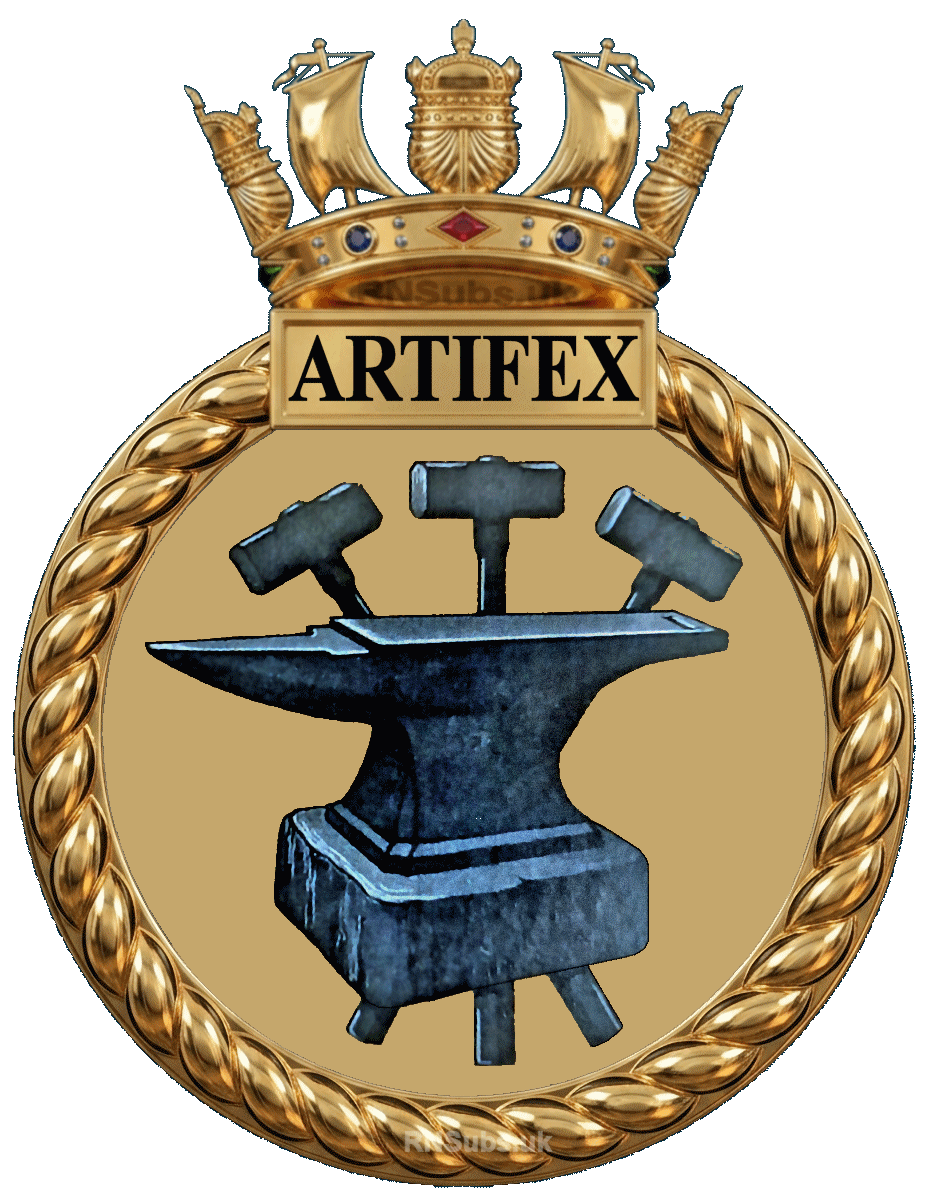
| Symbology | The name is derived from the Latin for "artificer". | |
| Design Notes | Three sledgehammers: one erect, two in saltire, surmounted by a black anvil on a gold background. | |
| Displacement | 19,000 tons |
| Length | 538ft |
| Beam | 65ft 3in |
| Draught | 32ft 4in (max) |
| Speed | 15 knots |
| Armament | Several 20mm AA guns |
| Compliment | 592 |

Terrapin (P 323) |
|
| Class: | 1935 - 1970: T Class |
| Built By: | |
| Build Group: | T 3 |
|
Fate: She was deemed a constructive loss in May 1945 she was scrapped one year later at Troon. |
|

U-571 Stars Matthew McCaughney, Bill Paxton and Jon-Bon Jovi.
A team of US soldiers are sent on a mission to sneak aboard a disabled German U-Boat to steal an encryption device that would give the Allies the edge they need to win the war. What they don't know is... Germans are on their way to answer the SOS as well.
13 pages added or updated in the last 1 month
Please help to maintain this site by reporting any Errors, Broken Links, Information or Site Issues on this page using this button

If you find this site useful, please consider supporting my work with a small Donation.
Please Note: Donations made using this option go directly to the site owner and not to the Submariners Association.
Thankyou for your support.
|
|
||
| Official | ||
| Admiralty Approved | 13th Jun, 1946 | |
| Symbology | The name is derived from the Latin for "artificer". | |
| Design Notes | Three sledgehammers: one erect, two in saltire, surmounted by a black anvil on a gold background. | |
| Displacement | 19,000 tons |
| Length | 538ft |
| Beam | 65ft 3in |
| Draught | 32ft 4in (max) |
| Speed | 15 knots |
| Armament | Several 20mm AA guns |
| Compliment | 592 |
Terrapin (P 323) |
|
| Class: | 1935 - 1970: T Class |
| Built By: | |
| Build Group: | T 3 |
|
Fate: She was deemed a constructive loss in May 1945 she was scrapped one year later at Troon. |
|
U-571 Stars Matthew McCaughney, Bill Paxton and Jon-Bon Jovi.
A team of US soldiers are sent on a mission to sneak aboard a disabled German U-Boat to steal an encryption device that would give the Allies the edge they need to win the war. What they don't know is... Germans are on their way to answer the SOS as well.
13 pages added or updated in the last 1 month
Please help to maintain this site by reporting any Errors, Broken Links, Information or Site Issues on this page using this button
If you find this site useful, please consider supporting my work with a small Donation.
Please Note: Donations made using this option go directly to the site owner and not to the Submariners Association.
Thankyou for your support.
This form is for you to comment on, or add additional information to this page. Any questions will be deleted. If you wish to ask a question contact the Branch or the Webmaster using the Contact Us page or ask your question on our Facebook Page