| Built By: | Scotts (Clyde) |
| Build Group: | O2a |
| Fate: | Otus is now on display in Germany having been purchased from Pounds. |


| 01-02-1962 | Laid Down |
| 17-10-1962 | Launched |
|
||
| Official | ||
| Admiralty Approved | 28th Jun, 1928 | |
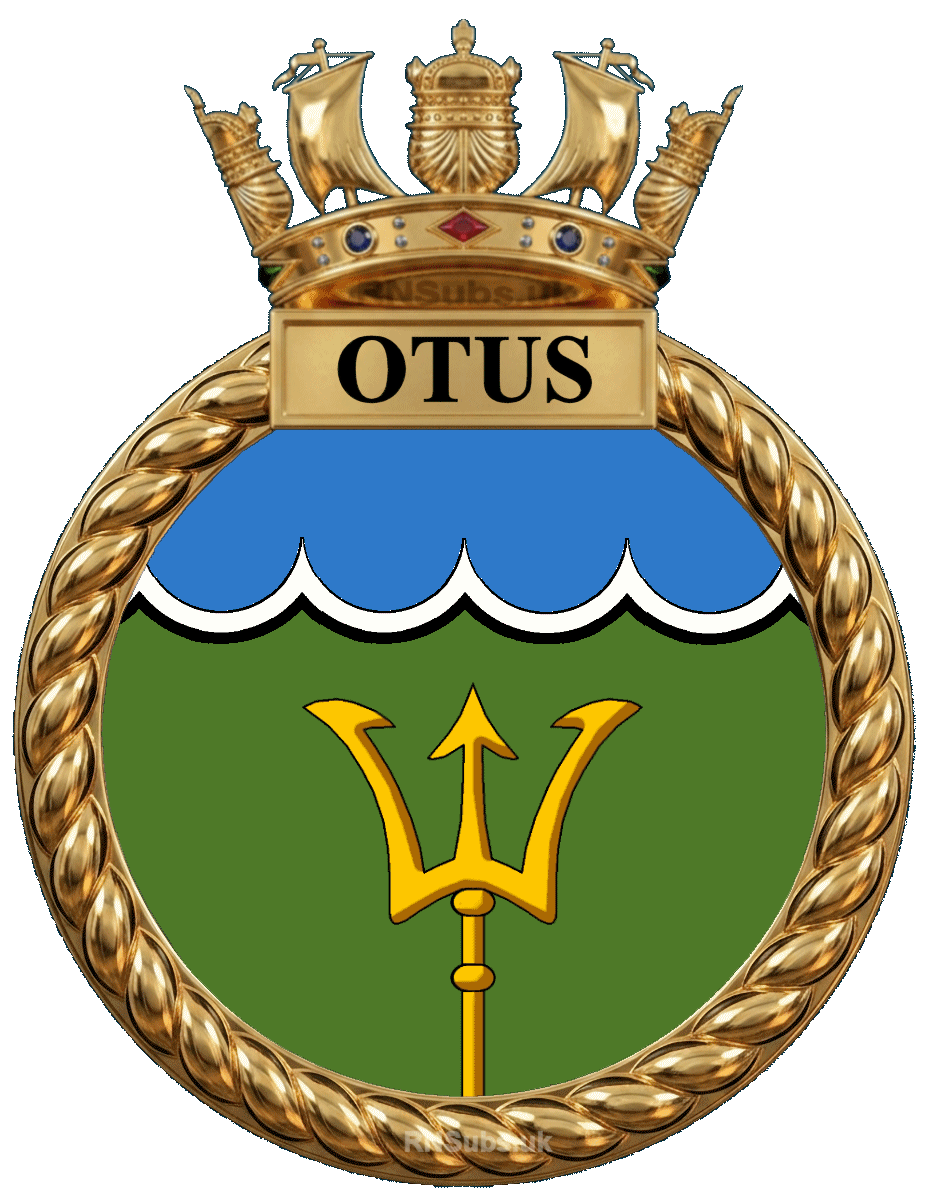
| Symbology | Otus is a giant demigod son of the sea god Poseidon and the mortal woman Iphimedeia. In Greek mythology, Otus was one of the Aloadae, a pair of gigantic twin brothers known for their immense size, extreme hubris, and audacious attempt to storm Mount Olympus. | |
| Design Notes | A fesswise bar of silver over a gold trident. On a field per fess engrailed and invected blue and green. | |
| Length overall | 295 ft 3 inch |
| Beam | 26 ft 6 inch |
| Depth | 15 ft |
| Displacement | 2030 tons (surface) |
| 2410 tons (submerged) | |
| Speed | 12 knots (surface) |
| 17 knots (submerged) | |
| No. of shafts | 2 |
| Armament | 6 x 21 inch bow tubes |
| 2 x 21 inch stern tubes | |
| (i) (30 torpedoes) | |
| Complement | 6 Officers and 62 Others |
| Note | (i) Mines can be carried in lieu of torpedoes |
The name of Her Majesty's Submarine Upholder is inseparably linked to the name of her Commanding Officer, Lieutenant Commander W. D. Wanklyn VC DSO and 2 Bars RN. Upholder, under Wanklyn's command, was perhaps the most successful British submarine of the Second World War Lt. Cdr. Wanklyn was Upholder's captain throughout the whole of her short life, from her completion at Barrow in 1940 until she was lost on April 14, 1942.

New Year 1915. The world is locked in a terrible conflict, and Winston Churchill has conceived of a bold plan. Constantinople would be seized and Turkey knocked out of the war. The key is the Dardanelles.
The British submarine E14 approached the portal of the Ottoman Empire, viewing the ominous darkness from its small conning tower, eight feet above the waves. Its commander, Courtney Boyle, had told his superiors he thought the voyage, probably the longest dive ever contemplated in a submarine, was impossible. It would also take him past the wreckage of the submarines that had tried to pass that way in the days before: their dead buried on the beach, their survivors in captivity.
The crew had said their goodbyes. They had written their farewell letters and given them into safekeeping, knowing that the chances were now against their survival. This book sets out what happened next and tells the story of the pioneering submarines of the Dardanelles.
14 pages added or updated in the last Array month
Please help to maintain this site by reporting any Errors, Broken Links, Information or Site Issues on this page using this button

If you find this site useful, please consider supporting my work with a small Donation.
Please Note: Donations made using this option go directly to the site owner and not to the Submariners Association.
Thankyou for your support.
|
|
||
| Official | ||
| Admiralty Approved | 28th Jun, 1928 | |
| Symbology | Otus is a giant demigod son of the sea god Poseidon and the mortal woman Iphimedeia. In Greek mythology, Otus was one of the Aloadae, a pair of gigantic twin brothers known for their immense size, extreme hubris, and audacious attempt to storm Mount Olympus. | |
| Design Notes | A fesswise bar of silver over a gold trident. On a field per fess engrailed and invected blue and green. | |
| Length overall | 295 ft 3 inch |
| Beam | 26 ft 6 inch |
| Depth | 15 ft |
| Displacement | 2030 tons (surface) |
| 2410 tons (submerged) | |
| Speed | 12 knots (surface) |
| 17 knots (submerged) | |
| No. of shafts | 2 |
| Armament | 6 x 21 inch bow tubes |
| 2 x 21 inch stern tubes | |
| (i) (30 torpedoes) | |
| Complement | 6 Officers and 62 Others |
| Note | (i) Mines can be carried in lieu of torpedoes |
The name of Her Majesty's Submarine Upholder is inseparably linked to the name of her Commanding Officer, Lieutenant Commander W. D. Wanklyn VC DSO and 2 Bars RN. Upholder, under Wanklyn's command, was perhaps the most successful British submarine of the Second World War Lt. Cdr. Wanklyn was Upholder's captain throughout the whole of her short life, from her completion at Barrow in 1940 until she was lost on April 14, 1942.
New Year 1915. The world is locked in a terrible conflict, and Winston Churchill has conceived of a bold plan. Constantinople would be seized and Turkey knocked out of the war. The key is the Dardanelles.
The British submarine E14 approached the portal of the Ottoman Empire, viewing the ominous darkness from its small conning tower, eight feet above the waves. Its commander, Courtney Boyle, had told his superiors he thought the voyage, probably the longest dive ever contemplated in a submarine, was impossible. It would also take him past the wreckage of the submarines that had tried to pass that way in the days before: their dead buried on the beach, their survivors in captivity.
The crew had said their goodbyes. They had written their farewell letters and given them into safekeeping, knowing that the chances were now against their survival. This book sets out what happened next and tells the story of the pioneering submarines of the Dardanelles.
14 pages added or updated in the last Array month
Please help to maintain this site by reporting any Errors, Broken Links, Information or Site Issues on this page using this button
If you find this site useful, please consider supporting my work with a small Donation.
Please Note: Donations made using this option go directly to the site owner and not to the Submariners Association.
Thankyou for your support.
This form is for you to comment on, or add additional information to this page. Any questions will be deleted. If you wish to ask a question contact the Branch or the Webmaster using the Contact Us page or ask your question on our Facebook Page