| Built By: | Vickers (Barrow) |
| Build Group: | T 3 |
| Fate: | Scrapped on 17th July 1959 at Troon. |


| 1943: | Lieutenant | Denis John Beckley | DSO MID |
| 1944: | Lieutenant | Thomas Graeme Ridgeway | |
| 1945: | Lieutenant | Thomas Graeme Ridgeway |
| 28-12-1941 | Laid Down |
| 15-02-1943 | Completed |
| 27-01-1944 | The Japanese light cruiser Kitakami was torpedoed and damaged by two torpedoes from HMS Templar in the Malacca Strait south west off Penang. |
| 29-05-1944 | HMS Templar torpedoes and sinks the Japanese merchant cargo ship Tyokai Maru in Strait of Malacca. |
| 04-06-1944 | HMS Templar lays mines in the Strait of Malacca. |
| 16-07-1944 | HMS Templar misses the German submarine U-1062 with torpedoes in the Malacca Strait. |
| 17-07-1959 | Scrapped at Troon. |

|
||
| Official | ||
| Admiralty Approved | 12th Jun, 1944 | |
| Symbology | The site between Fleet Street and the Thames, formerly used by students and practitioners of law, is known as 'The Temple' and was occupied by the Knights Templar circa 1160-1312. Charges in the badge are from the Inns of Court, Middle Temple, Shield and Inner Temple, Pegasus. | |
| Design Notes | A gold demi-Pegasus erased wings addorsed, holding between the forelegs a white escutcheon charged with a red cross on a field of blue. | |
|
||
| Unofficial | ||
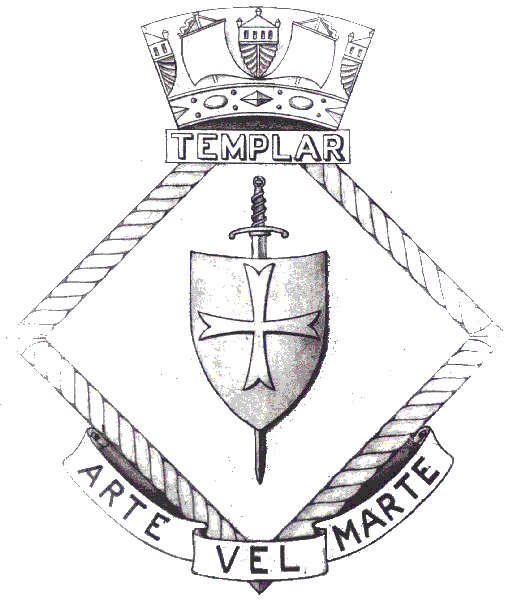
| Motto | Arte vel marte (By skill or by valour). | |
| Symbology | The Knights Templar, officially known as the Poor Fellow-Soldiers of Christ and of the Temple of Solomon, were a wealthy and powerful Catholic military order founded in 1119 during the Crusades. Members wore distinctive white mantles featuring a red cross and combined strict monastic discipline with elite military capabilities. | |
| Design Notes | A sword erect, pointed in pale, proper. The sword is charged upon its blade with a cross, which is the classic symbol of the Knights Templar. Colours unknown. | |
| Length overall | 273 ft 6 inch |
| Beam | 26 ft 6 inch |
| Depth | 14 ft 3 inch |
| Displacement | 1422 tons (surface) |
| 1571 tons (submerged) | |
| Diving Depth | (i) 300 ft |
| Speed | Surface 15.25 knots (design) |
| Surface 15.25 knots (service) | |
| Submerged 9 knots (design) | |
| Submerged 8.75 knots (service) | |
| No. of shafts | 2 |
| Endurance | Surface: 7500 miles at 15.25 knots (design) |
| (ii) Surface: 8000 miles at 10 knots (service) | |
| Submerged: 80 miles at 4 knots (design) | |
| Submerged: 80 miles at 4 knots (service) | |
| Armament | 8 x 21 inch bow tubes (2 external) |
| 2 x 21 inch amidship tubes | |
| (17 torpedoes carried) | |
| 1 x 4 inch gun | |
| 1 x 20mm Oerlikon cannon | |
| 3 x 0.303 inch machine-guns | |
| Complement | (peacetime) 5 Officers and 51 Ratings |
| (wartime) 6 Officers and 56 Ratings | |
| Notes | (i) This was increased to 350 feet in the all-welded boats. |
| (ii) T Class submarines serving in the Far East were modified to carry extra fuel, which increased endurance to 11 000 miles at 10 knots. |
From the inception of the Submarine Service in 1901 all the way through to the early years of WW1 the standard method of teaching embryonic submarine commanding officers, and maintaining commanding officers' skill levels, was for submarines to practice attacking surface ships at sea. This was costly in terms of ships, submarines, manpower and, of course, fuel - coal first then oil. The expansion of the Submarine Service with the war increased the demand for the services. At the same time, however, boats were away on patrol and time between patrols was necessary for maintenance. Moreover, there were very few German ships at sea and so commanding officers were not getting the practice they needed in their attacking skills. The resolution was an attack teacher

An evaluation of the predominant submarine of World War II and the post-war years, this book describes each amendment and re-design of the basic structure, and examples are given to portray the vessel in action.
15 pages added or updated in the last 3 months
Please help to maintain this site by reporting any Errors, Broken Links, Information or Site Issues on this page using this button

If you find this site useful, please consider supporting my work with a small Donation.
Please Note: Donations made using this option go directly to the site owner and not to the Submariners Association.
Thankyou for your support.
|
|
||
| Official | ||
| Admiralty Approved | 12th Jun, 1944 | |
| Symbology | The site between Fleet Street and the Thames, formerly used by students and practitioners of law, is known as 'The Temple' and was occupied by the Knights Templar circa 1160-1312. Charges in the badge are from the Inns of Court, Middle Temple, Shield and Inner Temple, Pegasus. | |
| Design Notes | A gold demi-Pegasus erased wings addorsed, holding between the forelegs a white escutcheon charged with a red cross on a field of blue. | |
|
|
||
| Unofficial | ||
| Motto | Arte vel marte (By skill or by valour). | |
| Symbology | The Knights Templar, officially known as the Poor Fellow-Soldiers of Christ and of the Temple of Solomon, were a wealthy and powerful Catholic military order founded in 1119 during the Crusades. Members wore distinctive white mantles featuring a red cross and combined strict monastic discipline with elite military capabilities. | |
| Design Notes | A sword erect, pointed in pale, proper. The sword is charged upon its blade with a cross, which is the classic symbol of the Knights Templar. Colours unknown. | |
| Length overall | 273 ft 6 inch |
| Beam | 26 ft 6 inch |
| Depth | 14 ft 3 inch |
| Displacement | 1422 tons (surface) |
| 1571 tons (submerged) | |
| Diving Depth | (i) 300 ft |
| Speed | Surface 15.25 knots (design) |
| Surface 15.25 knots (service) | |
| Submerged 9 knots (design) | |
| Submerged 8.75 knots (service) | |
| No. of shafts | 2 |
| Endurance | Surface: 7500 miles at 15.25 knots (design) |
| (ii) Surface: 8000 miles at 10 knots (service) | |
| Submerged: 80 miles at 4 knots (design) | |
| Submerged: 80 miles at 4 knots (service) | |
| Armament | 8 x 21 inch bow tubes (2 external) |
| 2 x 21 inch amidship tubes | |
| (17 torpedoes carried) | |
| 1 x 4 inch gun | |
| 1 x 20mm Oerlikon cannon | |
| 3 x 0.303 inch machine-guns | |
| Complement | (peacetime) 5 Officers and 51 Ratings |
| (wartime) 6 Officers and 56 Ratings | |
| Notes | (i) This was increased to 350 feet in the all-welded boats. |
| (ii) T Class submarines serving in the Far East were modified to carry extra fuel, which increased endurance to 11 000 miles at 10 knots. |
From the inception of the Submarine Service in 1901 all the way through to the early years of WW1 the standard method of teaching embryonic submarine commanding officers, and maintaining commanding officers' skill levels, was for submarines to practice attacking surface ships at sea. This was costly in terms of ships, submarines, manpower and, of course, fuel - coal first then oil. The expansion of the Submarine Service with the war increased the demand for the services. At the same time, however, boats were away on patrol and time between patrols was necessary for maintenance. Moreover, there were very few German ships at sea and so commanding officers were not getting the practice they needed in their attacking skills. The resolution was an attack teacher
An evaluation of the predominant submarine of World War II and the post-war years, this book describes each amendment and re-design of the basic structure, and examples are given to portray the vessel in action.
15 pages added or updated in the last 3 months
Please help to maintain this site by reporting any Errors, Broken Links, Information or Site Issues on this page using this button
If you find this site useful, please consider supporting my work with a small Donation.
Please Note: Donations made using this option go directly to the site owner and not to the Submariners Association.
Thankyou for your support.
This form is for you to comment on, or add additional information to this page. Any questions will be deleted. If you wish to ask a question contact the Branch or the Webmaster using the Contact Us page