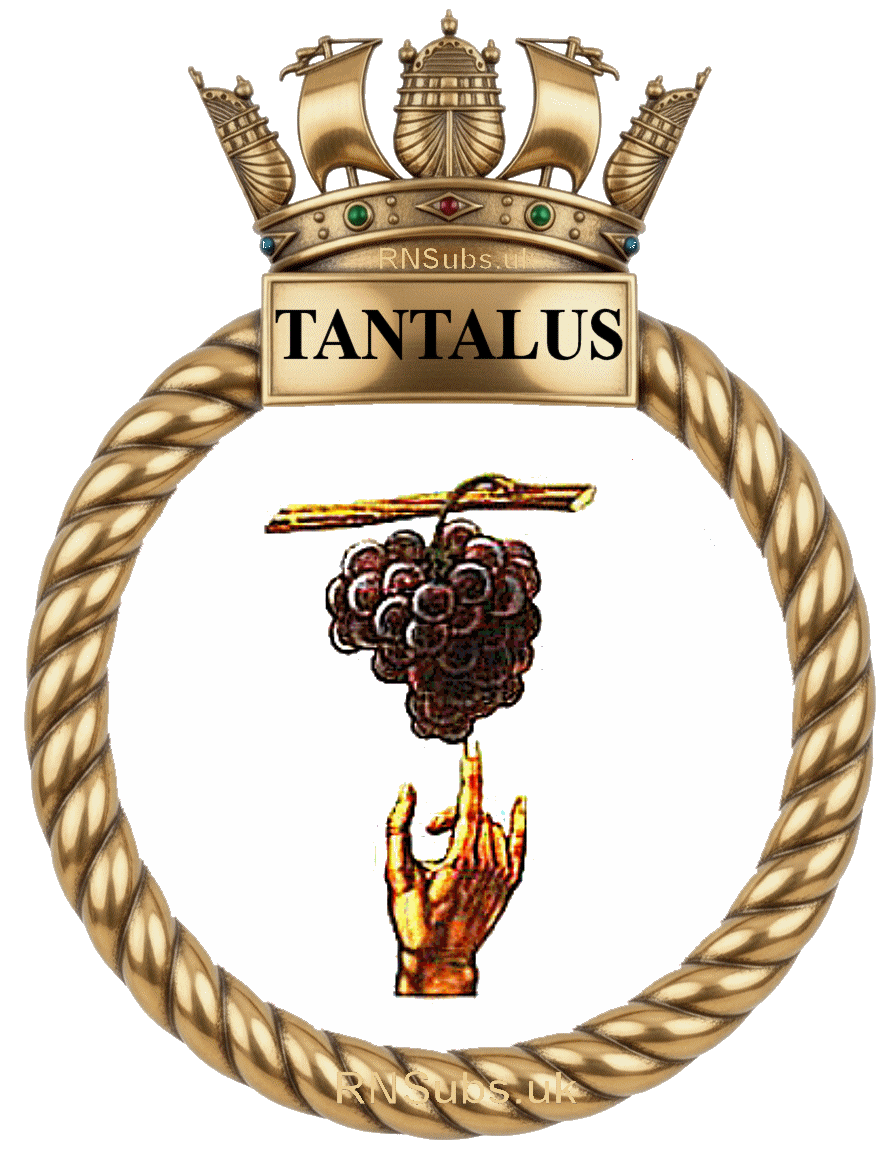
| Built By: | Vickers (Barrow)/ Scotts (Clyde) |
| Build Group: | T 3 |
| Fate: | Cancelled in 1945 |
Ordered 18 Apr 1942. Originally to be built by Vickers but building contract transferred to Scotts
Was to be namd Talent
| Length overall | 273 ft 6 inch |
| Beam | 26 ft 6 inch |
| Depth | 14 ft 3 inch |
| Displacement | 1422 tons (surface) |
| 1571 tons (submerged) | |
| Diving Depth | (i) 300 ft |
| Speed | Surface 15.25 knots (design) |
| Surface 15.25 knots (service) | |
| Submerged 9 knots (design) | |
| Submerged 8.75 knots (service) | |
| No. of shafts | 2 |
| Endurance | Surface: 7500 miles at 15.25 knots (design) |
| (ii) Surface: 8000 miles at 10 knots (service) | |
| Submerged: 80 miles at 4 knots (design) | |
| Submerged: 80 miles at 4 knots (service) | |
| Armament | 8 x 21 inch bow tubes (2 external) |
| 2 x 21 inch amidship tubes | |
| (17 torpedoes carried) | |
| 1 x 4 inch gun | |
| 1 x 20mm Oerlikon cannon | |
| 3 x 0.303 inch machine-guns | |
| Complement | (peacetime) 5 Officers and 51 Ratings |
| (wartime) 6 Officers and 56 Ratings | |
| Notes | (i) This was increased to 350 feet in the all-welded boats. |
| (ii) T Class submarines serving in the Far East were modified to carry extra fuel, which increased endurance to 11 000 miles at 10 knots. |
Proteus (N 29) |
|
| Class: | 1927 - 1946: Parthian Class |
| Built By: | |
| Build Group: | P |
|
Fate: Scrapped by West of Scotland Shipbreaking at Troon 26 February 1946. |
|
The Royal Navy's Submarine Command Course, or 'Perisher', is a unique course, training, assessing and qualifying officers for submarine command which is, itself, unique, challenging and demanding; the epitome of mission command, with no succour, referral or support in a continuously threatening environment. It is therefore essential that those 'in command' are proven to be worthy and capable of their appointment.
The evolution of 'Perisher' is in recognisable periods: the earliest days, following the submarine's introduction into the Royal Navy, was an autodidactic existence with COs learning from their peers and by experimentation.
By 1917 circumstances had conflated to create the Periscope School and the Periscope Course to train and qualify COs whose characteristics were now fully formed. The interwar period was a difficult time, but it produced new submarines and technological innovations just in time for the Second World War and the most intense evolutionary period for 'Perisher'.
Post-1945 to 1969 experienced two evolutions: Commander Sandy Woodward's codification of the art of attacking and a shift in emphasis from purely 'periscope eye' attacking toward the development of safety and tactical prowess in students. In the 1970s-1980s, two parallel courses satisfied the demand for COs from an expanding diesel-nuclear submarine fleet using SSKs and then in 1989, an SSN.
The final period, 1990-2017 continues today with an all-nuclear Perisher and a curriculum to meet a changing battlespace, new weapons and tactics. Throughout its history, 'Perisher' has shaped the submarine commanding officer and he, in return, has shaped 'Perisher'.
20 pages added or updated in the last 2 month
Please help to maintain this site by reporting any Errors, Broken Links, Information or Site Issues on this page using this button

If you find this site useful, please consider supporting my work with a small Donation.
Please Note: Donations made using this option go directly to the site owner and not to the Submariners Association.
Thankyou for your support.
| Length overall | 273 ft 6 inch |
| Beam | 26 ft 6 inch |
| Depth | 14 ft 3 inch |
| Displacement | 1422 tons (surface) |
| 1571 tons (submerged) | |
| Diving Depth | (i) 300 ft |
| Speed | Surface 15.25 knots (design) |
| Surface 15.25 knots (service) | |
| Submerged 9 knots (design) | |
| Submerged 8.75 knots (service) | |
| No. of shafts | 2 |
| Endurance | Surface: 7500 miles at 15.25 knots (design) |
| (ii) Surface: 8000 miles at 10 knots (service) | |
| Submerged: 80 miles at 4 knots (design) | |
| Submerged: 80 miles at 4 knots (service) | |
| Armament | 8 x 21 inch bow tubes (2 external) |
| 2 x 21 inch amidship tubes | |
| (17 torpedoes carried) | |
| 1 x 4 inch gun | |
| 1 x 20mm Oerlikon cannon | |
| 3 x 0.303 inch machine-guns | |
| Complement | (peacetime) 5 Officers and 51 Ratings |
| (wartime) 6 Officers and 56 Ratings | |
| Notes | (i) This was increased to 350 feet in the all-welded boats. |
| (ii) T Class submarines serving in the Far East were modified to carry extra fuel, which increased endurance to 11 000 miles at 10 knots. |
Proteus (N 29) |
|
| Class: | 1927 - 1946: Parthian Class |
| Built By: | |
| Build Group: | P |
|
Fate: Scrapped by West of Scotland Shipbreaking at Troon 26 February 1946. |
|
The Royal Navy's Submarine Command Course, or 'Perisher', is a unique course, training, assessing and qualifying officers for submarine command which is, itself, unique, challenging and demanding; the epitome of mission command, with no succour, referral or support in a continuously threatening environment. It is therefore essential that those 'in command' are proven to be worthy and capable of their appointment.
The evolution of 'Perisher' is in recognisable periods: the earliest days, following the submarine's introduction into the Royal Navy, was an autodidactic existence with COs learning from their peers and by experimentation.
By 1917 circumstances had conflated to create the Periscope School and the Periscope Course to train and qualify COs whose characteristics were now fully formed. The interwar period was a difficult time, but it produced new submarines and technological innovations just in time for the Second World War and the most intense evolutionary period for 'Perisher'.
Post-1945 to 1969 experienced two evolutions: Commander Sandy Woodward's codification of the art of attacking and a shift in emphasis from purely 'periscope eye' attacking toward the development of safety and tactical prowess in students. In the 1970s-1980s, two parallel courses satisfied the demand for COs from an expanding diesel-nuclear submarine fleet using SSKs and then in 1989, an SSN.
The final period, 1990-2017 continues today with an all-nuclear Perisher and a curriculum to meet a changing battlespace, new weapons and tactics. Throughout its history, 'Perisher' has shaped the submarine commanding officer and he, in return, has shaped 'Perisher'.
20 pages added or updated in the last 2 month
Please help to maintain this site by reporting any Errors, Broken Links, Information or Site Issues on this page using this button
If you find this site useful, please consider supporting my work with a small Donation.
Please Note: Donations made using this option go directly to the site owner and not to the Submariners Association.
Thankyou for your support.

This form is for you to comment on, or add additional information to this page. Any questions will be deleted. If you wish to ask a question contact the Branch or the Webmaster using the Contact Us page or ask your question on our Facebook Page