
My lifetime ambition as a young schoolboy, I wanted to be a captain of a Royal Navy destroyer (described as greyhounds of the sea). But I was born on the wrong side of the track. One needed tradition, money, good family background, education, Oxford or Cambridge schooling, but I didn't qualify on any of those counts. I left school at age 14 to work in an engineering company. Three years later World War II started and I was 17 years of age.
War clouds were beginning to form in the year 1939. Nazi Germans were becoming very militant. Daily news reports told of the threat of war and also of possible peace negotiations. The German war machine insidiously began to wind itself up, being intent to show the world how powerful it was.
My thoughts concluded that war was inevitable. As a mere 17 year old with a simple education, I could sense, however, the game plan being propounded by the German propaganda machine. They were toying with the allies and waiting for an excuse to attack, any excuse, but at the same time, pretending otherwise.
Personally, I confess at this time my thoughts were;
Stop all this passive nonsense. Let's get stuck into the Germans right now!.
I was craving the excitement that war would bring, but "Hold on", I thought; "I'm not in the armed forces. How can I be part of this scenario?" The answer was to join up. "But which service?" I conjectured. My mind began to deliberate on the possibilities open to me.
The army, the slaughter of soldiers in World War I as they fought in muddy trenches, that's not for me.
The Air Force, I didn't like heights.
The Navy, Um! That's for me.
I fronted up at a recruiting station near where I lived, but I was only 17 years of age. They didn't want me, so I was knocked back. It was a big disappointment. My address was taken and I would be informed at a later date. Soon a buff coloured envelope addressed to me was left in the letterbox. I was instructed to call in to see a recruiting Petty Officer. I thought he must be a Captain: his peak cap gave me that initial impression. "We can accept you as a cook2, he informed me. "A cook!" I reacted. "I want to be a sailor", I replied in an indignant tone. "Ah well" the Petty Officer replied "you could pass a higher examination and join as a Telegraphist, Radio Operator". I shuddered. "Higher education" I intoned. My education was minimal standard. I couldn't pass an examination. My hesitancy prompted the Petty Officer to point out a further course of action I could take. "As you are under 18, you could be accepted as a boy Seaman. That means that you must sign up as a boy entrant for a 12 year commitment and your time will not count until you reach the age of 18". I accepted these conditions. Before long I was admiring myself in the mirror. The sailor's uniform suited me, I thought as I tilted the round hat well back on my head at a rakish angle.
On conclusion of seamanship training, I was drafted to join HMS Locust, a ship designed specifically for river operations such as Chinese rivers and shallow waters, a river gunboat, a sort of a guard ship. We were stationed in Sheerness in Kent, at the mouth of the River Thames.
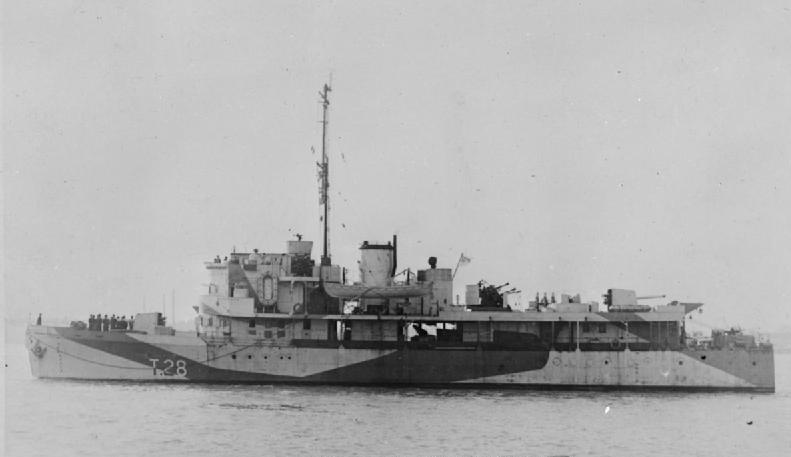
Our job was to guard the shipping lanes, where merchant shipping assembled, from attacks by German torpedo boats. It was during the bitterly cold icy morning watch at 4am to 8am, the type I dislike so much, that the attacks happened, just when the morning sky began to lighten.
Around about 6am, those on duty watch on deck were found work to do, such as mopping up the wet decks or scupper channels where water had collected. Most of us Ordinary Seamen found ourselves in these bitterly cold icy conditions down on our hands and knees, soaking up the very cold water. Our fingers were frozen stiff from squeezing the cloths out into a bucket. (At that particular time I was thinking "Should I have taken the job of cook?" It would have meant I would have been cooking breakfast in the small but hot galley). There was a sailor standing behind me who would wait for the bucket to be filled. I noticed he was wearing gloves. I enquired from my shipmate, who was also down on his hands and knees beside me "Who's that chap?," "Oh him!", said my equal, "he is an Able Seaman waiting for the bucket to be filled so he can throw the contents over the ship's side".
Promotion filled my mind. His job was to watch over the Ordinary Seamen. Watching over the Ordinary Seamen, wouldn't mind that job, I thought.
I am now a Leading Seaman, standing behind and watching Able Seamen watching the Ordinary Seamen. I was content for a while. But who are the chaps in peak caps? They were Petty Officers and were to be respected. The sailors fell in for inspection. A report was made from the Leading Seaman to the Petty Officer who, in turn, reported to the Duty Officer. Within minutes of this after-breakfast inspection, the peak capped Petty Officers disappeared below decks. Where had they gone? I discovered they had gone down for a second breakfast. That sort of job would suit me, a second breakfast, promotion filled my mind.
After a few months I had qualified, having passed the stiff seamanship examinations for Petty Officer. I thought the studies I had subjected myself to were worth it. As a Petty Officer, I could go below to the Petty Officers' mess and be waited on by the stewards who served a second breakfast on a starched white tablecloth.

H 31 |
|
| Class: | 1917 - 1945: H Class |
| Built By: | |
| Build Group: | H21 |
|
Fate: At the time that the German Battle Cruisers Scharnhorst and Prinz Eugen were expected to leave Breast, H31 was sent to form part of a circle of submarines around the French Port. H31 was escorted as far as the Wolfe Rock and left her escort on 19th December 1941. Nothing more was seen or heard of H31 which was presumed lost in the Atlantic along the Northwest Coast of Spain. There were no survivors. |
|

Before Harrison Ford assumed the mantle of playing Tom Clancy's Jack Ryan hero in Patriot Games, Alec Baldwin took a swing at the character in this John McTiernan film and hit one to the fence. If less instantly sympathetic than Ford, Baldwin is in some respects more interesting and nuanced as Ryan, and drawing comparisons between both actors' performances can make for some interesting post-movie discussion.
That aside, The Hunt for Red October stands alone as a uniquely exciting adventure with a fantastic co-star: Sean Connery as a Russian nuclear submarine captain attempting to defect to the West on his ship. Ryan must figure out his true motives for approaching the US.
McTiernan (Predator, Die Hard) made an exceptionally handsome movie here with action sequences that really do take one's breath away.
13 pages added or updated in the last Array month
Please help to maintain this site by reporting any Errors, Broken Links, Information or Site Issues on this page using this button

If you find this site useful, please consider supporting my work with a small Donation.
Please Note: Donations made using this option go directly to the site owner and not to the Submariners Association.
Thankyou for your support.
H 31 |
|
| Class: | 1917 - 1945: H Class |
| Built By: | |
| Build Group: | H21 |
|
Fate: At the time that the German Battle Cruisers Scharnhorst and Prinz Eugen were expected to leave Breast, H31 was sent to form part of a circle of submarines around the French Port. H31 was escorted as far as the Wolfe Rock and left her escort on 19th December 1941. Nothing more was seen or heard of H31 which was presumed lost in the Atlantic along the Northwest Coast of Spain. There were no survivors. |
|
Before Harrison Ford assumed the mantle of playing Tom Clancy's Jack Ryan hero in Patriot Games, Alec Baldwin took a swing at the character in this John McTiernan film and hit one to the fence. If less instantly sympathetic than Ford, Baldwin is in some respects more interesting and nuanced as Ryan, and drawing comparisons between both actors' performances can make for some interesting post-movie discussion.
That aside, The Hunt for Red October stands alone as a uniquely exciting adventure with a fantastic co-star: Sean Connery as a Russian nuclear submarine captain attempting to defect to the West on his ship. Ryan must figure out his true motives for approaching the US.
McTiernan (Predator, Die Hard) made an exceptionally handsome movie here with action sequences that really do take one's breath away.
13 pages added or updated in the last Array month
Please help to maintain this site by reporting any Errors, Broken Links, Information or Site Issues on this page using this button
If you find this site useful, please consider supporting my work with a small Donation.
Please Note: Donations made using this option go directly to the site owner and not to the Submariners Association.
Thankyou for your support.
This form is for you to comment on, or add additional information to this page. Any questions will be deleted. If you wish to ask a question contact the Branch or the Webmaster using the Contact Us page or ask your question on our Facebook Page