In this instance, the "click" referred to is the sound caused by a detonator becoming active within a depth charge.
This detonator, about the size of a man's thumb, is embedded in a depth charge. Pressure of water builds up as the depth charge reaches its set depth that is required for either a shallow or deep explosion. The initial explosion, immediately before the main charge, can be likened to a pencil being broken in half. This was the sound that chilled the spine of wartime submariners.
There were times when a few torpedoes were fired after the submarine's attack on ships of the enemies' convoy, that were guarded by destroyers. It would be necessary to take evasive action by altering course or going deep. The enemy destroyer would seek out the offending submarine by the use of its listening devices, seeking its prey by eavesdropping on the propeller noises of the submarine. Conversely, the submarine would be also listening for the attacker's transmission noise that could reveal the plan of attack intended.
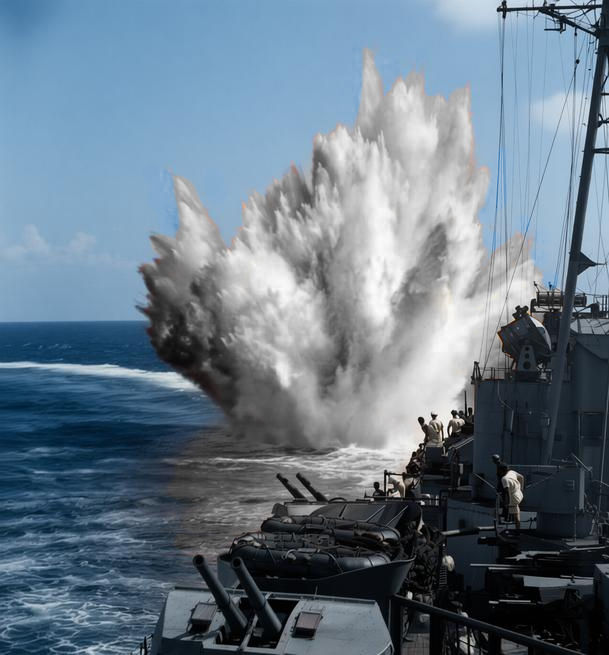
Sounds underwater are very distinct and clear; even the softest of noises from miles away seem to be amplified in those circumstances.
As depth charges exploded, some unpleasantly close, one could hear the distinct click of the detonator prior to the subsequent main charge explosion. Luckily, many times, the depth charges were a few hundred yards away from the submarine, but we could still hear that click of the detonator, sometimes rather faintly, but we heard it just the same.
Another pattern of depth-charges would follow. As the attackers were getting closer, the detonator "click" would be more pronounced. Quick glances were often exchanged. Most of the submarine's crew sat silently just thinking and waiting. Would this be life coming to a close?
That dreaded "click". Would the next depth-charge tear open the submarine's hull? Our imaginations worked overtime.
The click of death!
That would have been the last sound many submariners heard.
No history of submarine warfare in World War Two could be complete without a mention of the

Directed by William Fairchild, The Silent Enemy is a newly restored 1958 war film based on the real Lionel 'Buster' Crabb who vanished during a reconnaissance mission for the MI6, played by Laurence Harvey.
In 1941, Britain was sustaining enormous losses fighting a war on three fronts against an ever increasing Axis power. To add to their problems, the Italians have recently created a new form of warfare - Frogmen - an intrepid band of men who travel astride small torpedo-type vessels, and attach explosive charges to the hulls of enemy ships, below their waterline.
A young Naval Lieutenant, 'Buster' Crabb, an expert in mine and bomb disposal, is sent to Gibraltar to try and combat this new threat. Never having dived before, he sets to work to master the technique of underwater operations, and soon he and his team are able to locate many of the frogmen's charges and render them harmless. But with an invasion of North Africa imminent, time is not on the Allies' side.
13 pages added or updated in the last Array month
Please help to maintain this site by reporting any Errors, Broken Links, Information or Site Issues on this page using this button

If you find this site useful, please consider supporting my work with a small Donation.
Please Note: Donations made using this option go directly to the site owner and not to the Submariners Association.
Thankyou for your support.
No history of submarine warfare in World War Two could be complete without a mention of the
Directed by William Fairchild, The Silent Enemy is a newly restored 1958 war film based on the real Lionel 'Buster' Crabb who vanished during a reconnaissance mission for the MI6, played by Laurence Harvey.
In 1941, Britain was sustaining enormous losses fighting a war on three fronts against an ever increasing Axis power. To add to their problems, the Italians have recently created a new form of warfare - Frogmen - an intrepid band of men who travel astride small torpedo-type vessels, and attach explosive charges to the hulls of enemy ships, below their waterline.
A young Naval Lieutenant, 'Buster' Crabb, an expert in mine and bomb disposal, is sent to Gibraltar to try and combat this new threat. Never having dived before, he sets to work to master the technique of underwater operations, and soon he and his team are able to locate many of the frogmen's charges and render them harmless. But with an invasion of North Africa imminent, time is not on the Allies' side.
13 pages added or updated in the last Array month
Please help to maintain this site by reporting any Errors, Broken Links, Information or Site Issues on this page using this button
If you find this site useful, please consider supporting my work with a small Donation.
Please Note: Donations made using this option go directly to the site owner and not to the Submariners Association.
Thankyou for your support.
This form is for you to comment on, or add additional information to this page. Any questions will be deleted. If you wish to ask a question contact the Branch or the Webmaster using the Contact Us page or ask your question on our Facebook Page