
Sickle left Algiers to conduct a 21 day patrol in the Aegean. On completion we were directed to proceed to Beirut.

It was whilst on patrol outside an enemy harbour at periscope depth, we saw the superstructure of two enemy destroyers above the harbour wall. We had them under observation. We would lay in wait for them to come out of their protective shield. The submarine made constant sweeps outside the harbour at periscope depth. It is most likely that we may have been detected, either by sighting of our periscope or sounds of our propeller being picked up by shore listening devices (probably the latter). In due course, they came out to us. It seemed they were in a hurry to get to us, as they were approaching at a very fast speed.
Our Captain decided to attack the destroyers but realised the situation we were in. We were in shallow water, and couldn't attack and go deep to avoid any repercussions that would certainly come our way. I can recall in my mind the actual words spoken by the Captain. They were: "Down periscope; discretion is the better part of valour". We then altered course for deeper waters.
The enemy destroyers came towards us; their listening equipment locking in to our propeller noise kept them in touch with our submarine. We made our way to deeper water where it would be more advantageous to us in this hide-and-seek situation. It wasn't long before dozens of depth charges came raining down on us as we hurried to find deeper waters at full speed, our propeller noise shouting out, as it were, "Here we are". More depth charges followed, some much too close for comfort.
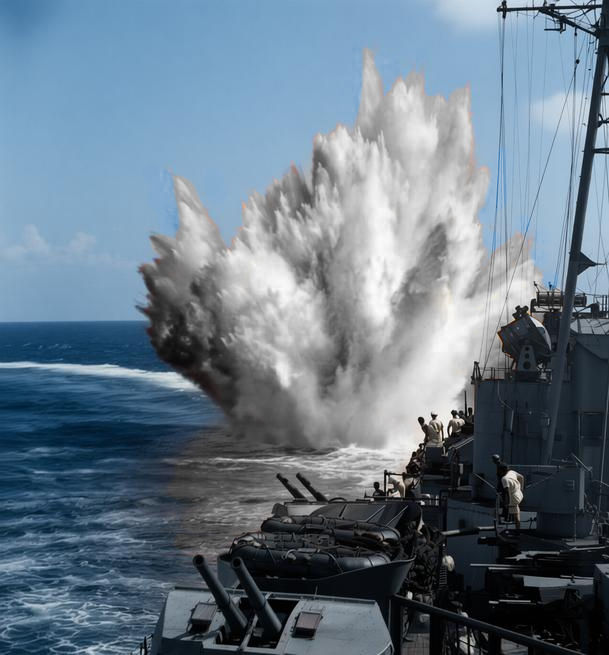
There was a lull in the proceedings before we were attacked again, and more depth charges were bestowed upon us. I was in the control room at my diving station and had chalked up the number of depth charges which had been presented to us. The attacking destroyers had picked up our propeller noise again and they moved in for the kill. We had by now found deeper water.
In our haste, a slight miscalculation had been made of the depth of the seabed under us. We thought there was room to dive deeper, but the next thing we felt and heard was a terrific thud as the submarine ploughed bow down into the muddy bottom (thankfully not rocks). The propellers were racing away, driving us deeper into the mud. We were stuck. The Captain, realising our position, ordered the electric motor driving the propellers to stop.
There was absolute silence now; the submarine was now in silent routine, switching off all fans, fridge and pumps. The crew would just sit down wherever they could. The enemy must have been puzzled because normally a submarine would have the propeller going. Without it there was not any control. But on this occasion we were stuck in the mud at a rather steep angle. One had to hold on to fittings to remain semi-upright. The enemy destroyers probably couldn't believe they had lost us and we were safe, or were we? In any case, they departed the scene.
I'll divert here for a moment to paint the picture as it was. A see-saw analogy may clarify the situation. Weight on the end bow stuck in the mud, the other end high in the water with the propeller at the end.
We now simply had to start up the electric motor power to the propeller full power into reverse and withdraw the submarine from its embedded position in the muddy bottom.
We tried going astern at full blast. We were stuck. We didn't budge. We tried again but did not move. The battery power was being rapidly exhausted. We must conserve this power or it could be fatal for us. We also must conserve our high pressure air or it could also be fatal for us.
High pressure air was injected into the ballast tanks, high pressure was designed to blow the water out of the saddle tanks, thus making the submarine lighter. We were stuck. Our batteries low, our high-pressure air low. Our next step had to be determined by our oldish Captain. Wasn't he nearly 29 years old? Most of us crew were nearly 20 years old.
Back to our predicament. A pessimist would declare we are stuck and could do nothing about it, we are doomed. But our Captain wasn't a pessimist. He proclaimed, "We have one last chance. If my idea doesn't work it really is night, night, nurse".
The plan put forward was that every available man would clamber as high as he could in the darkened submarine up the other end of our see-saw analogy towards the propeller high in the water. Then the maximum power from the battery to turn the propeller at full speed astern and the maximum high-pressure air to our tanks to blow as much water out as possible to give hopefully positive buoyancy.
Our very last chance to survive. If it didn't work, then last prayers to be said and we would remain on the seabed.
The order is given. Propellers are going full blast. High-pressure air is blowing water out of the saddle tanks, making the submarine lighter, giving us positive buoyancy. The depth gauges quiver, then stop, then move again. We were going up to the surface and survival.
It was what could be called a Terrifying Moment.
The Quest For Higher Submerged Speed & Greater Underwater Propulsion Power

An Angry Crowd swarms around a small prison. Inside General Sajid Khan stares stoically at his captors. Responsible for genocide and the mass murder of thousands of people, the deposed Warlord is being held unil trial.
The guards scramble but Khan remains calm. One week later Naval Headquarters are told that there's an explosion on an Australian Cruise Ship. This is the second attack and no one knows who is responsible, although Kahn goes missing.
Captain Will Hanley discovers that Kahn has spent his considerable fortune on a renovated Russian Submarine, complete with nuclear missiles which he plans to launch at a city untouched by terrorism, Los Angeles.
Hanley manages to find Khan but the action culmintes in an explosive battle alongside a dangerous reef, where failure will have an unbearable cost.
20 pages added or updated in the last Array month
Please help to maintain this site by reporting any Errors, Broken Links, Information or Site Issues on this page using this button

If you find this site useful, please consider supporting my work with a small Donation.
Please Note: Donations made using this option go directly to the site owner and not to the Submariners Association.
Thankyou for your support.
The Quest For Higher Submerged Speed & Greater Underwater Propulsion Power
An Angry Crowd swarms around a small prison. Inside General Sajid Khan stares stoically at his captors. Responsible for genocide and the mass murder of thousands of people, the deposed Warlord is being held unil trial.
The guards scramble but Khan remains calm. One week later Naval Headquarters are told that there's an explosion on an Australian Cruise Ship. This is the second attack and no one knows who is responsible, although Kahn goes missing.
Captain Will Hanley discovers that Kahn has spent his considerable fortune on a renovated Russian Submarine, complete with nuclear missiles which he plans to launch at a city untouched by terrorism, Los Angeles.
Hanley manages to find Khan but the action culmintes in an explosive battle alongside a dangerous reef, where failure will have an unbearable cost.
20 pages added or updated in the last Array month
Please help to maintain this site by reporting any Errors, Broken Links, Information or Site Issues on this page using this button
If you find this site useful, please consider supporting my work with a small Donation.
Please Note: Donations made using this option go directly to the site owner and not to the Submariners Association.
Thankyou for your support.
This form is for you to comment on, or add additional information to this page. Any questions will be deleted. If you wish to ask a question contact the Branch or the Webmaster using the Contact Us page or ask your question on our Facebook Page