| Built By: | Markham and Co (Derbyshire) |
| Build Group: | XE |
| Fate: | Went to Australia 1952 |
Unofficially named Excitable
| 07-12-1944 | Completed |
|
||
| Official | ||
| Admiralty Approved | 22nd Nov, 1955 | |
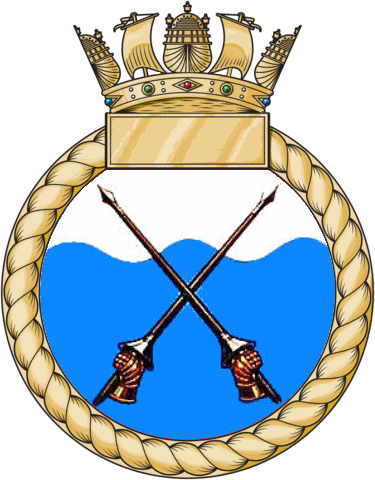
| Symbology | These manned craft strike from under the water. | |
| Design Notes | In chief, wavy white overall, two tilting spears in saltire proper, each grasped by a gold gauntlet. | |
| Additional Notes | This is a 'Type' badge assigned to all X-Craft. | |

|
||
| Unofficial | ||
| Motto | Inter Scyllam et Charybdim. (Between Scylla and Charybdis.) | |
| Symbology | Navigating dangerous and exciting waters. | |
| Design Notes | An octopus, adorned with its eight tentacles spread out and undulating, encompassing the central area of the shield. Two of the upper tentacles are curled inward, while the others extend downwards and to the sides. Positioned centrally between the lower tentacles is a terrestrial globe. | |
| Additional Notes | In Greek mythology, Scylla and Charybdis were a monster and a whirlpool, respectively, located on opposite sides of a narrow strait (the Strait of Messina). | |
| Length overall | 51 ft 7 inch |
| Beam | 8 ft 6 inch (with charges) |
| 5 ft 9 1/2 inch (without charges) | |
| Displacement | Without Charges: 27 tons (surface) |
| Without Charges: 29 1/2 tons (submerged) | |
| Diving Depth | 300 ft |
| Speed | With Charges: 6.5 knots (surface) |
| With Charges: 5 knots (submerged) | |
| No. of shafts | 1 |
| Armament | 2 x 2-ton side charges, Limpet mines |
| Endurance | Surface: 1320 miles at 4 knots (with charges) |
| Surface 1860 miles at 4 knots (without charges) | |
| Submerged: 80 miles at 2 knots (with charges) | |
| Complement | 4 |
The relatives and the author are not the only ones who would like this mystery solved and I am sure so would the many who served at the time or later, on the sister ships of the Affray, but I don't want to know at the cost of bringing indignity to the remains of these men have no doubt that others with better technical qualifications and easy access to the archives would be able to more comprehensively review the loss of the Affray , but this is simply a commentary by a former submariner of the time on a recently published book about the loss

A highly illustrated history of the Cold War operations of the submarines of the Royal Navy from 1948 to 1990.
The Cold War was a period of intense activity for submarines of the Royal Navy, with many hair-raising incidents involving Soviet vessels. They were engaged in frequent hazardous surveillance patrols investigating Soviet submarines and surface warships and their operational tactics, and trailing Soviet strategic submarines (SSBNs), as well as conducting British deterrent SSBN patrols and protecting those patrols using attack submarines (SSNs).
There were also dangerous patrols which trialled submarine operation under the Arctic ice-cap. In addition to these activities there were operations in other conflicts and war theatres including the Falklands War, the Suez campaign, the Northern Ireland Troubles, and the Indonesian confrontation.
11 pages added or updated in the last 1 months
Please help to maintain this site by reporting any Errors, Broken Links, Information or Site Issues on this page using this button

If you find this site useful, please consider supporting my work with a small Donation.
Please Note: Donations made using this option go directly to the site owner and not to the Submariners Association.
Thankyou for your support.
|
|
||
| Official | ||
| Admiralty Approved | 22nd Nov, 1955 | |
| Symbology | These manned craft strike from under the water. | |
| Design Notes | In chief, wavy white overall, two tilting spears in saltire proper, each grasped by a gold gauntlet. | |
| Additional Notes | This is a 'Type' badge assigned to all X-Craft. | |
|
|
||
| Unofficial | ||
| Motto | Inter Scyllam et Charybdim. (Between Scylla and Charybdis.) | |
| Symbology | Navigating dangerous and exciting waters. | |
| Design Notes | An octopus, adorned with its eight tentacles spread out and undulating, encompassing the central area of the shield. Two of the upper tentacles are curled inward, while the others extend downwards and to the sides. Positioned centrally between the lower tentacles is a terrestrial globe. | |
| Additional Notes | In Greek mythology, Scylla and Charybdis were a monster and a whirlpool, respectively, located on opposite sides of a narrow strait (the Strait of Messina). | |
| Length overall | 51 ft 7 inch |
| Beam | 8 ft 6 inch (with charges) |
| 5 ft 9 1/2 inch (without charges) | |
| Displacement | Without Charges: 27 tons (surface) |
| Without Charges: 29 1/2 tons (submerged) | |
| Diving Depth | 300 ft |
| Speed | With Charges: 6.5 knots (surface) |
| With Charges: 5 knots (submerged) | |
| No. of shafts | 1 |
| Armament | 2 x 2-ton side charges, Limpet mines |
| Endurance | Surface: 1320 miles at 4 knots (with charges) |
| Surface 1860 miles at 4 knots (without charges) | |
| Submerged: 80 miles at 2 knots (with charges) | |
| Complement | 4 |
The relatives and the author are not the only ones who would like this mystery solved and I am sure so would the many who served at the time or later, on the sister ships of the Affray, but I don't want to know at the cost of bringing indignity to the remains of these men have no doubt that others with better technical qualifications and easy access to the archives would be able to more comprehensively review the loss of the Affray , but this is simply a commentary by a former submariner of the time on a recently published book about the loss
A highly illustrated history of the Cold War operations of the submarines of the Royal Navy from 1948 to 1990.
The Cold War was a period of intense activity for submarines of the Royal Navy, with many hair-raising incidents involving Soviet vessels. They were engaged in frequent hazardous surveillance patrols investigating Soviet submarines and surface warships and their operational tactics, and trailing Soviet strategic submarines (SSBNs), as well as conducting British deterrent SSBN patrols and protecting those patrols using attack submarines (SSNs).
There were also dangerous patrols which trialled submarine operation under the Arctic ice-cap. In addition to these activities there were operations in other conflicts and war theatres including the Falklands War, the Suez campaign, the Northern Ireland Troubles, and the Indonesian confrontation.
11 pages added or updated in the last 1 months
Please help to maintain this site by reporting any Errors, Broken Links, Information or Site Issues on this page using this button
If you find this site useful, please consider supporting my work with a small Donation.
Please Note: Donations made using this option go directly to the site owner and not to the Submariners Association.
Thankyou for your support.
This form is for you to comment on, or add additional information to this page. Any questions will be deleted. If you wish to ask a question contact the Branch or the Webmaster using the Contact Us page