| Built By: | Vickers (Barrow) |
| Build Group: | SSN 5 |


| 13-11-2011 | Keel laid by Gerald Howarth MP, Parliamentary Under Secretary of State for the Ministry of Defence |
| 11-12-2020 | Anson was officially been named in a virtual ceremony (due to the Covid1-19 pandemic) at BAE Systems Barrow-in-Furness shipyard. |
| 19-04-2021 | Anson emerged from the Devonshire Dock Hall at Barrow Shipyard and entered the water for the first time. Steve Timms, managing director of BAE Systems Submarines business, says the launch of the fifth Astute-class submarine brought a sense of pride to the shipyard. |
| 31-08-2022 | Commissioned into the Royal Navy during a ceremony in Barrow-in-Furness, Cumbria. Wednesday's traditional naval ceremony was attended by a number of dignitaries, including the submarine's Lady Sponsor, Julie Weale, the Australian Deputy Prime Minister Richard Marles and UK Defence Secretary Ben Wallace. Mr Wallace highlighted the "significant milestone" that this commission is in the UK and for Australia's preparation to "confront growing threats to the liberal democratic order, especially in the Indo Pacific". |
| 19-02-2023 | HMS Anson, the fifth Astute Class submarine, sailed from Barrow-in-Furness to begin her journey to His Majesty’s Naval Base Clyde. |
|
||
| Official | ||
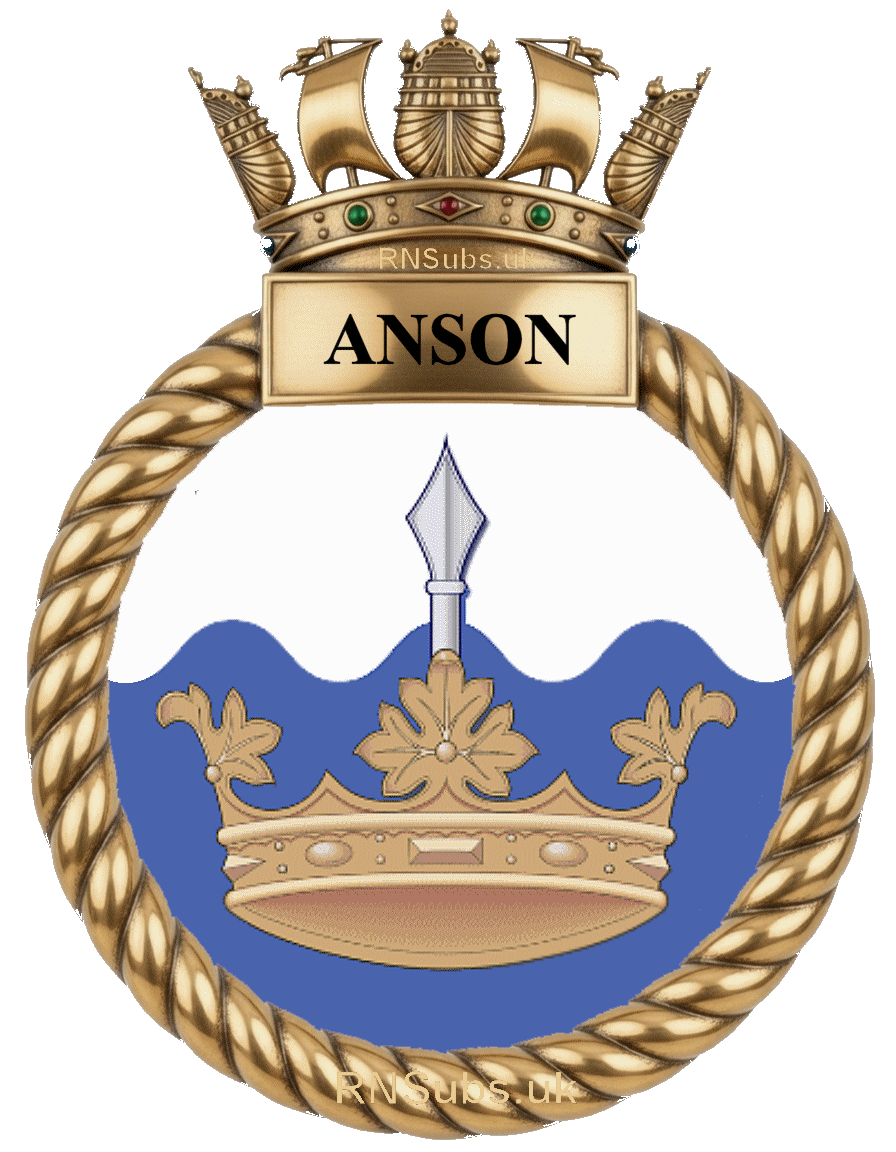
| Motto | Nil desperandum. (Despair of nothing.) | |
| Symbology | From the Arms of A of F Baron Anson of Soberton (1697-1762), who circumnavigated the world in the Centurion in 1741-1743. He was the last Sea Lord to fight at sea. | |
| Design Notes | Out of a ducal coronet of gold, a spearhead and shaft proper. Per fess wavy white and blue background. | |
| Additional Notes | Exact date badge passed not known as Pattern has been lost but was in 1940. | |
| Length | 280 ft |
| Displacement | 5,300 tonnes, submerged |
| 7000 to 7400 tonnes, surfaced | |
| Beam | 37 ft 1 inch |
| Draught | 32 ft 10 inch |
| Propulsion | 1 x Rolls Royce PWR2 nuclear reactor |
| MTU 600kw Deisel Generators | |
| 2 x GEC steam turbines | |
| 2 x Paxman diesel alternators 2,800 shp | |
| 1 x motor for emergency drive | |
| 1 x auxiliary retractable prop | |
| Speed | Up to 32 knots, submerged |
| Test Depth | Over 300m |
| Electronic warfare | 2 x SSE Mk8 launchers for Type 2066 and Type 2071 torpedo decoys |
| Armament | 6 x 21 inch torpedo tubes with stowage for up to 38 weapons |
| Tomahawk Block IV cruise missiles | |
| Spearfish heavyweight torpedoes | |
| Complement | 98 (109 capacity) |
The traditional British sailor was not defined by his looks, he was defined by his attitude, his name was Jack Tar, he was a happy-go-lucky sort of bloke. He took the good times with the bad. He didn't cry victimisation, bastardisation, discrimination, for his mum for his often self destructive actions. He loved to laugh at anything or anybody rank, race, gender, creed or behaviour, it didn't matter to Jack, he would take the micky out of anyone, including himself, and if someone took it out of him he didn't get offended, it was a natural part of life.

The atom bombs dropped on Japan at the end of the Second World War opened the door to the nuclear age. Seeing the potential for developing nuclear energy for the US Navy, Captain Hyman Rickover initiated a research programme that culminated in the launch of USS Nautilus, the world's first nuclear-powered submarine.
Meanwhile, ballistic missile technology was developing fast but was still reliant on complex liquid fuels. The US Navy partnered with the army to develop a ballistic missile for both services but withdrew when solid fuels became a practical proposition.
Under the leadership of Rear Admiral William Raborn, the US Navy set up its own project: the Polaris weapon system. In 1960, the first missile-armed nuclear-powered submarine left on patrol, with forty more to follow in subsequent years.
Two years later, when Britain's Blue Streak and Skybolt plans were cancelled, Harold Macmillan and John F Kennedy agreed for Polaris to be supplied to the Royal Navy.
At a time of intensive re-examination of the NATO alliance, the 'special relationship' between the UK and USA, and Britain's role as a nuclear power, this is the first comprehensive history of Polaris.
It brings together technical aspects, the key characters, and the full stories of the American and British programmes.
20 pages added or updated in the last 5 month
Please help to maintain this site by reporting any Errors, Broken Links, Information or Site Issues on this page using this button

If you find this site useful, please consider supporting my work with a small Donation.
Please Note: Donations made using this option go directly to the site owner and not to the Submariners Association.
Thankyou for your support.
|
|
||
| Official | ||
| Motto | Nil desperandum. (Despair of nothing.) | |
| Symbology | From the Arms of A of F Baron Anson of Soberton (1697-1762), who circumnavigated the world in the Centurion in 1741-1743. He was the last Sea Lord to fight at sea. | |
| Design Notes | Out of a ducal coronet of gold, a spearhead and shaft proper. Per fess wavy white and blue background. | |
| Additional Notes | Exact date badge passed not known as Pattern has been lost but was in 1940. | |
| Length | 280 ft |
| Displacement | 5,300 tonnes, submerged |
| 7000 to 7400 tonnes, surfaced | |
| Beam | 37 ft 1 inch |
| Draught | 32 ft 10 inch |
| Propulsion | 1 x Rolls Royce PWR2 nuclear reactor |
| MTU 600kw Deisel Generators | |
| 2 x GEC steam turbines | |
| 2 x Paxman diesel alternators 2,800 shp | |
| 1 x motor for emergency drive | |
| 1 x auxiliary retractable prop | |
| Speed | Up to 32 knots, submerged |
| Test Depth | Over 300m |
| Electronic warfare | 2 x SSE Mk8 launchers for Type 2066 and Type 2071 torpedo decoys |
| Armament | 6 x 21 inch torpedo tubes with stowage for up to 38 weapons |
| Tomahawk Block IV cruise missiles | |
| Spearfish heavyweight torpedoes | |
| Complement | 98 (109 capacity) |
The traditional British sailor was not defined by his looks, he was defined by his attitude, his name was Jack Tar, he was a happy-go-lucky sort of bloke. He took the good times with the bad. He didn't cry victimisation, bastardisation, discrimination, for his mum for his often self destructive actions. He loved to laugh at anything or anybody rank, race, gender, creed or behaviour, it didn't matter to Jack, he would take the micky out of anyone, including himself, and if someone took it out of him he didn't get offended, it was a natural part of life.
The atom bombs dropped on Japan at the end of the Second World War opened the door to the nuclear age. Seeing the potential for developing nuclear energy for the US Navy, Captain Hyman Rickover initiated a research programme that culminated in the launch of USS Nautilus, the world's first nuclear-powered submarine.
Meanwhile, ballistic missile technology was developing fast but was still reliant on complex liquid fuels. The US Navy partnered with the army to develop a ballistic missile for both services but withdrew when solid fuels became a practical proposition.
Under the leadership of Rear Admiral William Raborn, the US Navy set up its own project: the Polaris weapon system. In 1960, the first missile-armed nuclear-powered submarine left on patrol, with forty more to follow in subsequent years.
Two years later, when Britain's Blue Streak and Skybolt plans were cancelled, Harold Macmillan and John F Kennedy agreed for Polaris to be supplied to the Royal Navy.
At a time of intensive re-examination of the NATO alliance, the 'special relationship' between the UK and USA, and Britain's role as a nuclear power, this is the first comprehensive history of Polaris.
It brings together technical aspects, the key characters, and the full stories of the American and British programmes.
20 pages added or updated in the last 5 month
Please help to maintain this site by reporting any Errors, Broken Links, Information or Site Issues on this page using this button
If you find this site useful, please consider supporting my work with a small Donation.
Please Note: Donations made using this option go directly to the site owner and not to the Submariners Association.
Thankyou for your support.
This form is for you to comment on, or add additional information to this page. Any questions will be deleted. If you wish to ask a question contact the Branch or the Webmaster using the Contact Us page or ask your question on our Facebook Page