| Built By: | Vickers (Barrow) |
| Build Group: | P |
| Fate: | Scrapped by West of Scotland Shipbreaking at Troon 26 February 1946. |

| 1932: | Lieutenant | Henry Leslie Spofforth Baker | |
| 1940: | Lieutenant Commander | R T Gordon-Duff | |
| 1940: | Lieutenant Commander | Lawrence St George Rich | |
| 1941: | Lieutenant | John Symons Huddart | |
| 1941: | Lieutenant Commander | Philip Stewart Francis | |
| 1942: | Lieutenant | Robert Love Alexander | |
| 1942: | Lieutenant | Peter Minet Staveley | |
| 1943: | Lieutenant | Henry Denys Verschoyle | DSC MID |
| 1943: | Lieutenant | Anthony Robert Profit | DSC MID |
| 1944: | Lieutenant | George Edward Lynton Foster Edsell | |
| 1944: | Acting Lieutenant | Percy Samuel Parmenter (RNR) |
1940 - 1st Flotilla: HMS Medway, Alexandria
One of the 'Magic Carpet' boats. This boat was the most successful of its class.
Proteus engaged and sank 17 German and Italian merchant ships, troopships, tankers and torpedo boats during her service in the Mediterranean in the Second World War. Her attack on the troop transport ship Ithaka is thought to be the first radar guided submarine attack.
HMS Proteus was the longest surviving Parthian-class submarine and the only Parthian class submarine to survive the war.
HMS Proteus Launch
Roll of Honour |
1
|
| Goodwin, Keith John |
|
|||||
| Stoker 1st Class | ||||||
| The son of John Henry Goodwin and Edith Lillian Goodwin. He died from Asthenia (general weakness) and acute encephalitis. However, according to the Naval BMD Record he was attached to HMS Brontosaurus, the Combined Operations Base in Argyll when he died. |
||||||
| 18-07-1928 | Laid Down |
| 23-07-1929 | Launched |
| 17-06-1930 | Completed |
| 02-11-1941 | HMS Proteus made the first successful radar attack by a submarine as she damaged the Italian tanker Tampico off Andros, 50 miles southeast of Athens, Greece. Italian torpedo boats Monzambano and Castelfidardo counterattacked and chased off the British submarine. |
|
||
| Official | ||
| Admiralty Approved | 13th Oct, 1928 | |
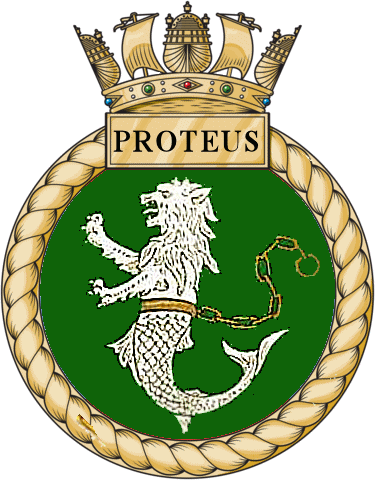
| Motto | Mutare sperno. (I scorn to change.) | |
| Symbology | Depending on the myth, Proteus was either a son or a subject of the primary sea god, Poseidon. His specific task was to serve as the herdsman of Poseidon's flocks of seals and other sea beasts. Proteus possessed the ability to change his shape at will. To evade questioners, he would rapidly metamorphose into a wild array of forms, including a lion, a serpent, a leopard, a tree, fire, or rushing water. To force him to speak, a seeker had to ambush him during his midday nap among his seals and bind him with chains or hold him fast. | |
| Design Notes | An erect silver sea lion chained in gold on a green field. | |
| Length overall | 289 ft 2 inch |
| Beam | 28 ft |
| Draught | 13 ft 8 inch |
| Displacement | 1760 tons (surface) |
| 2040 tons (submerged) | |
| Diving Depth | 500 ft |
| Speed | Surface 17 to 17.5 knots (design) |
| Surface 17.5 knots (service) | |
| Submerged 9 knots (design) | |
| Submerged 8.5 knots (service) | |
| No. of shafts | 2 |
| Propeller | 3 blades, 6 ft 5 inch dia |
| Endurance | Surface: 11400 miles at 8 knots (design) |
| Surface: 10750 miles at 8 knots (service) | |
| Submerged: 60 miles at 4 knots (design) | |
| Submerged: 8.5 miles at 8.5 knots or 70 miles at 4 knots (service) | |
| Armament | 6 x 21 inch bow tubes |
| 2 x 21 inch stern tubes | |
| (14 torpedoes carried) | |
| 1 x 4 inch gun | |
| Complement | 53 |

P311 (Tutankhamen) |
|
| Class: | 1935 - 1970: T Class |
| Built By: | |
| Build Group: | T 3 |
|
Fate: Submarine P311 took part in an operation to take Chariots to attack Italian shipping at the port of La Maddalena. Submarine P311 was allocated three chariots for this task and completed the passage through the Sicilian Channel. No further reports were received from the submarine, and P311 was presumed lost in a minefield near La Maddelena on (or about) 2nd January 1943. There were no survivors from the crew of the submarine. Also lost were the three Chariots (Nos. X, XVIII and ***), the three Chariot Crews (six personnel in all) and the team of four Dressers. |
|

This book explores the many engineering and architectural aspects of submarine design and how they relate to each other and the operational performance required of the vessel.
Concepts of hydrodynamics, structure, powering and dynamics are explained, in addition to architectural considerations which bear on the submarine design process.
17 pages added or updated in the last 1 month
Please help to maintain this site by reporting any Errors, Broken Links, Information or Site Issues on this page using this button

If you find this site useful, please consider supporting my work with a small Donation.
Please Note: Donations made using this option go directly to the site owner and not to the Submariners Association.
Thankyou for your support.
|
|
||
| Official | ||
| Admiralty Approved | 13th Oct, 1928 | |
| Motto | Mutare sperno. (I scorn to change.) | |
| Symbology | Depending on the myth, Proteus was either a son or a subject of the primary sea god, Poseidon. His specific task was to serve as the herdsman of Poseidon's flocks of seals and other sea beasts. Proteus possessed the ability to change his shape at will. To evade questioners, he would rapidly metamorphose into a wild array of forms, including a lion, a serpent, a leopard, a tree, fire, or rushing water. To force him to speak, a seeker had to ambush him during his midday nap among his seals and bind him with chains or hold him fast. | |
| Design Notes | An erect silver sea lion chained in gold on a green field. | |
| Length overall | 289 ft 2 inch |
| Beam | 28 ft |
| Draught | 13 ft 8 inch |
| Displacement | 1760 tons (surface) |
| 2040 tons (submerged) | |
| Diving Depth | 500 ft |
| Speed | Surface 17 to 17.5 knots (design) |
| Surface 17.5 knots (service) | |
| Submerged 9 knots (design) | |
| Submerged 8.5 knots (service) | |
| No. of shafts | 2 |
| Propeller | 3 blades, 6 ft 5 inch dia |
| Endurance | Surface: 11400 miles at 8 knots (design) |
| Surface: 10750 miles at 8 knots (service) | |
| Submerged: 60 miles at 4 knots (design) | |
| Submerged: 8.5 miles at 8.5 knots or 70 miles at 4 knots (service) | |
| Armament | 6 x 21 inch bow tubes |
| 2 x 21 inch stern tubes | |
| (14 torpedoes carried) | |
| 1 x 4 inch gun | |
| Complement | 53 |
P311 (Tutankhamen) |
|
| Class: | 1935 - 1970: T Class |
| Built By: | |
| Build Group: | T 3 |
|
Fate: Submarine P311 took part in an operation to take Chariots to attack Italian shipping at the port of La Maddalena. Submarine P311 was allocated three chariots for this task and completed the passage through the Sicilian Channel. No further reports were received from the submarine, and P311 was presumed lost in a minefield near La Maddelena on (or about) 2nd January 1943. There were no survivors from the crew of the submarine. Also lost were the three Chariots (Nos. X, XVIII and ***), the three Chariot Crews (six personnel in all) and the team of four Dressers. |
|
This book explores the many engineering and architectural aspects of submarine design and how they relate to each other and the operational performance required of the vessel.
Concepts of hydrodynamics, structure, powering and dynamics are explained, in addition to architectural considerations which bear on the submarine design process.
17 pages added or updated in the last 1 month
Please help to maintain this site by reporting any Errors, Broken Links, Information or Site Issues on this page using this button
If you find this site useful, please consider supporting my work with a small Donation.
Please Note: Donations made using this option go directly to the site owner and not to the Submariners Association.
Thankyou for your support.
This form is for you to comment on, or add additional information to this page. Any questions will be deleted. If you wish to ask a question contact the Branch or the Webmaster using the Contact Us page or ask your question on our Facebook Page