During 1943 and 1944, Vickers built six XT-craft submarines for training purposes. Having an endurance of only 500 miles at 4 knots, the XT-boats were a simplified X5 class submarine without the side cargo-release gear, night periscope or automatic helmsman. In addition, their day periscope, projector compass and air-induction trunk were fixed in the 'up' position.

Twelve more vessels, ordered in 1943 from Broadbents of Huddersfield, were cancelled before completion. The six Barrow-boats were scrapped at the end of the war.
My first glimpse of a Midget Submarine was about August 1942 when my then foreman in the Submarine Dock sent me to have my photograph taken to form a special pass to enter a secure area set in the North Shop (formerly the Gun Shop and now the Nuclear Build Shop) to work on a special project. I had no idea what the project was and doubted whether anyone else in working in my area did either.
Bill's prime Cause Celebre has resulted in his being included in the Guinness Book of Records as having made the deepest unaided ascent from a sunken submarine. He has other claims worthy of recognition, he was among those officers and men who trained many of the crews who joined the Twelfth Submarine Flotilla during WW2. This Flotilla consisted of X Craft and Two Man Chariots. It was based at Port Bannantyne on the Isle of Bute. The HQ was known as HMS Varbel.
Further Reading |

|
| X3 to X54 |

Keith Hall The X and XE-Class submarines were conceived during the Second World War: around 51ft (16m) long, they were designed to be towed by a mother submarine and use their small size to complete stealth missions, such as attacking harbours and performing reconnaissance. Although they would not begin active service until 1942, the submarine crews achieved quite the record, racking up 167 honours between them, including four Victoria Crosses. |
| Above Us the Waves |

C.E.T. Warren / James Benson It was the Italians who pioneered the use of two-man human torpedoes or 'chariots', and their attacks on ships of the Royal Navy in Alexandria Harbour in 1941 caused Winston Churchill to write to the Chief of Staffs committee to enquire what was being done to emulate these daring attacks. |

Turbulent (N 98) |
|
| Class: | 1935 - 1970: T Class |
| Built By: | |
| Build Group: | T 2 |
|
Fate: HMS Turbulent was presumed to have mined off Sardinia on or about 14 March 1943. The Submarine had sailed from Algiers on 24th February 1943 for what was to be her last patrol in the Mediterranean before returning home. A signal was sent to Turbulent on 20th March giving a route back to Algiers. No reply was received concerning this signal. It is thought that there were two likely reasons for the loss of Turbulent . These were a depth charge attack by a Ju88 and the Italian Destroyer Ardito on 6th March 1943 in the Bay of Naples or striking a mine in the minefields north and east of Sardinia between 12th and 14th March 1943 The entire crew of sixty-two Officers and Ratings was lost. |
|
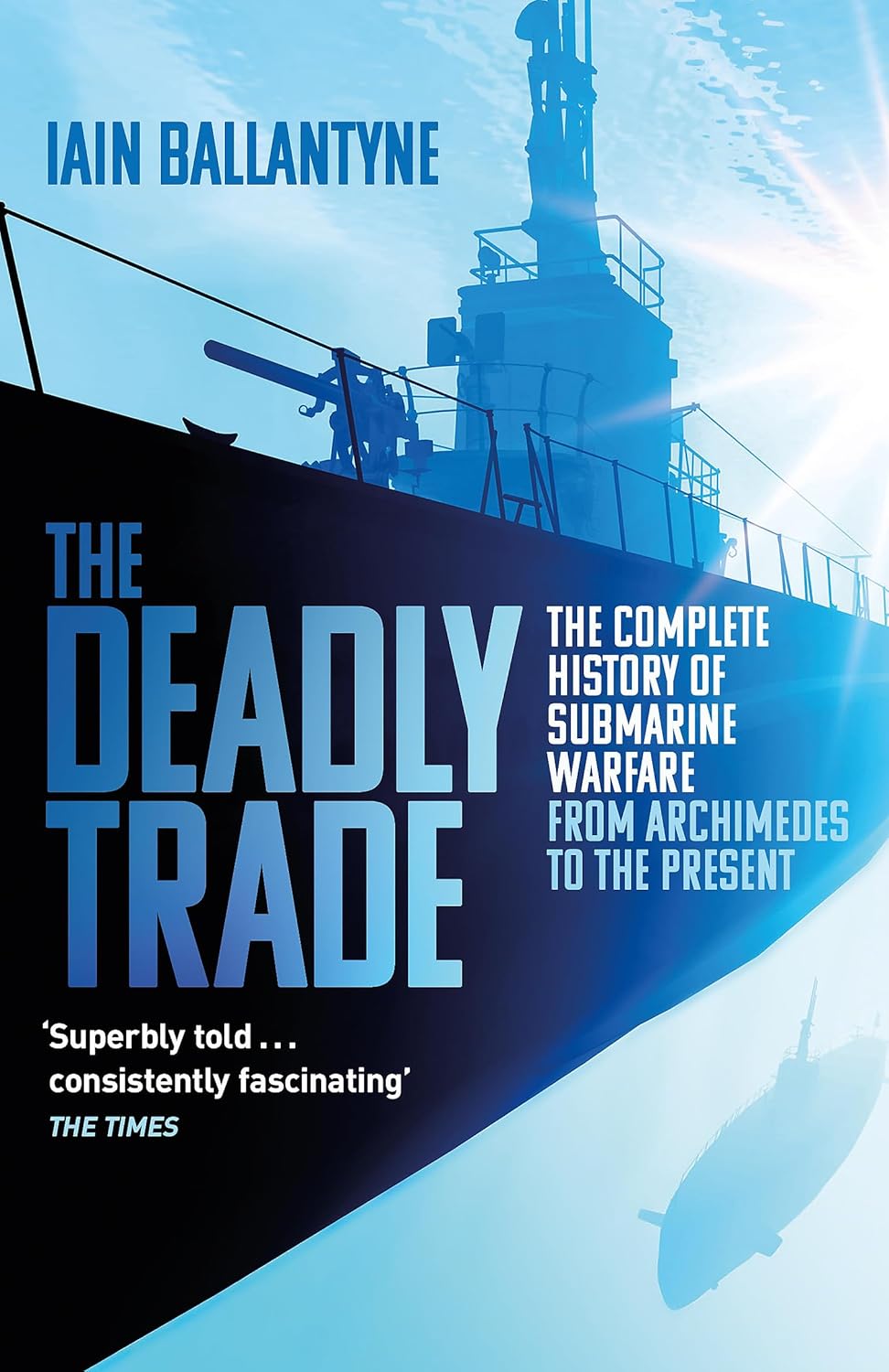
The Deadly Trade takes readers on an epic and enthralling voyage through submarine warfare, including how U-boats in two world wars tried to achieve victory, first for the Kaiser and then 20 years later for Adolf Hitler.
It tells the story of how such tiny craft took on mighty battleships, including U-boats sinking HMS Royal Oak and HMS Barham in WW2, along with the incredible exploits of British submariners in the Dardanelles and Baltic during WW1.The action-packed narrative includes bitterly contested Atlantic convoy fights of WW2 and submarines in the clash of battle fleets at Midway. Iain Ballantyne also reveals how the US Navy submarine service brought the Japanese empire to its knees in 1945, even before the atomic bombs were dropped.
The Deadly Trade tells the amazing stories of not only pioneers such as Drebbel, Fulton and Holland, but also of legendary submarine captains, including Max Horton and Otto Weddigen in WW1. During WW2 we sail to war with Otto Kretschmer, Gunther Prien, Fritz-Julius Lemp, Malcolm Wanklyn, Dudley Morton, Richard O'Kane and Sam Dealey. We get involved in the famous fights of Britain's ace submarine-killing escort group leaders Frederic 'Johnny' Walker, Donald Macintyre and Peter Gretton.
There is a dive into unconventional submarine warfare, including Japanese midget subs in the notorious Pearl Harbor raid plus British X-craft against the Tirpitz in Arctic waters.
Iain Ballantyne plunges readers into famous Enigma machine captures that played a key role in deciding the outcome of WW2. He explains what the Nazis were up to at the end of WW2, pursuing Total Underwater Warfare, partly via the revolutionary Type XXI U-boat. Ballantyne reveals the incredible story of a proposed cruise missile attack on New York and considers the likelihood (or otherwise) of Hitler escaping to South America in a U-boat.
The Deadly Trade takes us into the post-WW2 face-off between the Soviets and NATO, the sinking of the Indian frigate INS Khukri by Pakistan's PNS Hangor and attack on the Argentine cruiser ARA Belgrano by HMS Conqueror. The Deadly Trade concludes with today's growing submarine arms race and Putin's 'missile boat diplomacy' along with the use of cruise missiles by the British and Americans to try and decapitate rogue regimes.
13 pages added or updated in the last Array month
Please help to maintain this site by reporting any Errors, Broken Links, Information or Site Issues on this page using this button

If you find this site useful, please consider supporting my work with a small Donation.
Please Note: Donations made using this option go directly to the site owner and not to the Submariners Association.
Thankyou for your support.
My first glimpse of a Midget Submarine was about August 1942 when my then foreman in the Submarine Dock sent me to have my photograph taken to form a special pass to enter a secure area set in the North Shop (formerly the Gun Shop and now the Nuclear Build Shop) to work on a special project. I had no idea what the project was and doubted whether anyone else in working in my area did either.
Bill's prime Cause Celebre has resulted in his being included in the Guinness Book of Records as having made the deepest unaided ascent from a sunken submarine. He has other claims worthy of recognition, he was among those officers and men who trained many of the crews who joined the Twelfth Submarine Flotilla during WW2. This Flotilla consisted of X Craft and Two Man Chariots. It was based at Port Bannantyne on the Isle of Bute. The HQ was known as HMS Varbel.
Further Reading |
|
| X3 to X54 |
|
Keith Hall The X and XE-Class submarines were conceived during the Second World War: around 51ft (16m) long, they were designed to be towed by a mother submarine and use their small size to complete stealth missions, such as attacking harbours and performing reconnaissance. Although they would not begin active service until 1942, the submarine crews achieved quite the record, racking up 167 honours between them, including four Victoria Crosses. |
| Above Us the Waves |
|
C.E.T. Warren / James Benson It was the Italians who pioneered the use of two-man human torpedoes or 'chariots', and their attacks on ships of the Royal Navy in Alexandria Harbour in 1941 caused Winston Churchill to write to the Chief of Staffs committee to enquire what was being done to emulate these daring attacks. |
Turbulent (N 98) |
|
| Class: | 1935 - 1970: T Class |
| Built By: | |
| Build Group: | T 2 |
|
Fate: HMS Turbulent was presumed to have mined off Sardinia on or about 14 March 1943. The Submarine had sailed from Algiers on 24th February 1943 for what was to be her last patrol in the Mediterranean before returning home. A signal was sent to Turbulent on 20th March giving a route back to Algiers. No reply was received concerning this signal. It is thought that there were two likely reasons for the loss of Turbulent . These were a depth charge attack by a Ju88 and the Italian Destroyer Ardito on 6th March 1943 in the Bay of Naples or striking a mine in the minefields north and east of Sardinia between 12th and 14th March 1943 The entire crew of sixty-two Officers and Ratings was lost. |
|
The Deadly Trade takes readers on an epic and enthralling voyage through submarine warfare, including how U-boats in two world wars tried to achieve victory, first for the Kaiser and then 20 years later for Adolf Hitler.
It tells the story of how such tiny craft took on mighty battleships, including U-boats sinking HMS Royal Oak and HMS Barham in WW2, along with the incredible exploits of British submariners in the Dardanelles and Baltic during WW1.The action-packed narrative includes bitterly contested Atlantic convoy fights of WW2 and submarines in the clash of battle fleets at Midway. Iain Ballantyne also reveals how the US Navy submarine service brought the Japanese empire to its knees in 1945, even before the atomic bombs were dropped.
The Deadly Trade tells the amazing stories of not only pioneers such as Drebbel, Fulton and Holland, but also of legendary submarine captains, including Max Horton and Otto Weddigen in WW1. During WW2 we sail to war with Otto Kretschmer, Gunther Prien, Fritz-Julius Lemp, Malcolm Wanklyn, Dudley Morton, Richard O'Kane and Sam Dealey. We get involved in the famous fights of Britain's ace submarine-killing escort group leaders Frederic 'Johnny' Walker, Donald Macintyre and Peter Gretton.
There is a dive into unconventional submarine warfare, including Japanese midget subs in the notorious Pearl Harbor raid plus British X-craft against the Tirpitz in Arctic waters.
Iain Ballantyne plunges readers into famous Enigma machine captures that played a key role in deciding the outcome of WW2. He explains what the Nazis were up to at the end of WW2, pursuing Total Underwater Warfare, partly via the revolutionary Type XXI U-boat. Ballantyne reveals the incredible story of a proposed cruise missile attack on New York and considers the likelihood (or otherwise) of Hitler escaping to South America in a U-boat.
The Deadly Trade takes us into the post-WW2 face-off between the Soviets and NATO, the sinking of the Indian frigate INS Khukri by Pakistan's PNS Hangor and attack on the Argentine cruiser ARA Belgrano by HMS Conqueror. The Deadly Trade concludes with today's growing submarine arms race and Putin's 'missile boat diplomacy' along with the use of cruise missiles by the British and Americans to try and decapitate rogue regimes.
13 pages added or updated in the last Array month
Please help to maintain this site by reporting any Errors, Broken Links, Information or Site Issues on this page using this button
If you find this site useful, please consider supporting my work with a small Donation.
Please Note: Donations made using this option go directly to the site owner and not to the Submariners Association.
Thankyou for your support.
This form is for you to comment on, or add additional information to this page. Any questions will be deleted. If you wish to ask a question contact the Branch or the Webmaster using the Contact Us page or ask your question on our Facebook Page