| Built By: | Cammell Laird (Mersey) |
| Build Group: | O2a |
| Fate: | Decommissioned in 1998 |

| TBA: | Commander | James Michel Ewan (RCN) | |
| 1965: | Commander | Ronald Charles Frederick Perks (RCN) |
Laid down as Onyx but bought on stocks by Canada 1963 and renamed Ojibwa Spent most of service life in the Atlantic, but for part of 1977 was on the coast of British Columbia.
| 27-09-1962 | Laid Down |
| 15-02-1964 | HMS Onyx renamed HMCS Ojibwa while under construction |
| 29-02-1964 | Launched |
| 23-09-1965 | Completed |
| 21-05-1998 | HMCS Ojibwa was paid off to alongside training |
|
||
| Official | ||
| Admiralty Approved | 1964 | |
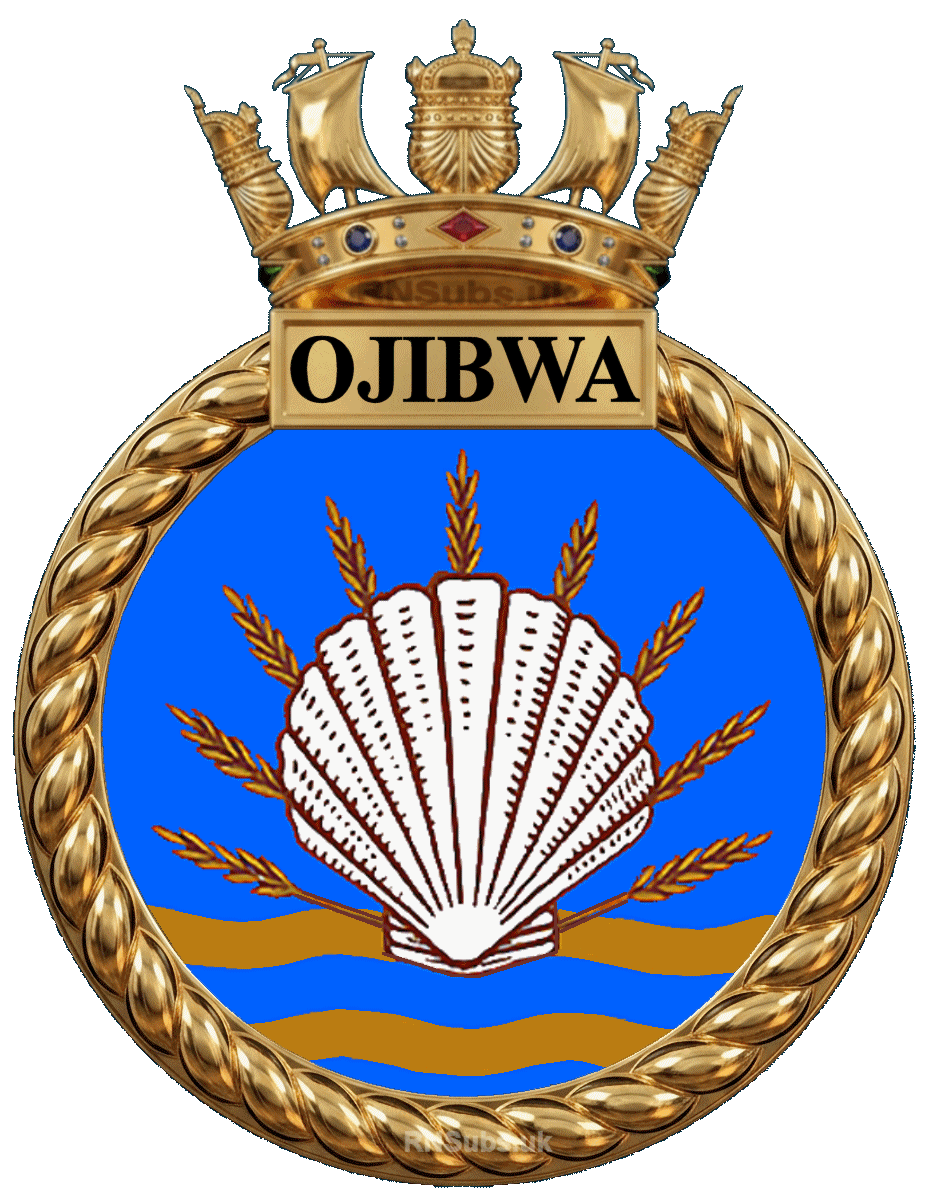
| Motto | Ne ke che dah. (Dia) (Let us be prepared.) | |
| Symbology | A North American tribe from the Great Lakes area. The imagery draws on an ancient Ojibwa myth about the great seashell (the Megis) rising from the ocean to reflect the sun's light, which brought warmth, prosperity, and guidance to the people. The golden wild rice represents the abundance of this staple found in Ontario, the historic and present home of the Ojibwa people. |
|
| Design Notes | A white escallop reversed and irradiated by nine awns of gold, wild rice issuant from two barrulets wavy in base gold on a field of blue. | |
| Length overall | 295 ft 3 inch |
| Beam | 26 ft 6 inch |
| Depth | 15 ft |
| Displacement | 2030 tons (surface) |
| 2410 tons (submerged) | |
| Speed | 12 knots (surface) |
| 17 knots (submerged) | |
| No. of shafts | 2 |
| Armament | 6 x 21 inch bow tubes |
| 2 x 21 inch stern tubes | |
| (i) (30 torpedoes) | |
| Complement | 6 Officers and 62 Others |
| Note | (i) Mines can be carried in lieu of torpedoes |
A5's refueling was completed at 0805. Approximately two hours later an explosion occurred inside A5 toward the stern, a second explosion some thirty minutes later followed this. The second explosion was located in the conning tower area. So great was the force of the explosions that members of the crew were actually blown out of the boat through the main hatch into the water. Subsequently two crew members were picked up by a tug.

It was obvious that whatever had caused Affray to sink, and had ended the lives of all those on board, had occurred quickly.
Sixty years later, in this compelling maritime investigation, Alan Gallop uses previously top secret documents, interviews with experts and contemporary news sources to explore how and why Affray became the last British submarine lost at sea, and possibly the greatest maritime mystery since the Marie Celeste.
12 pages added or updated in the last 1 months
Please help to maintain this site by reporting any Errors, Broken Links, Information or Site Issues on this page using this button

If you find this site useful, please consider supporting my work with a small Donation.
Please Note: Donations made using this option go directly to the site owner and not to the Submariners Association.
Thankyou for your support.
|
|
||
| Official | ||
| Admiralty Approved | 1964 | |
| Motto | Ne ke che dah. (Dia) (Let us be prepared.) | |
| Symbology | A North American tribe from the Great Lakes area. The imagery draws on an ancient Ojibwa myth about the great seashell (the Megis) rising from the ocean to reflect the sun's light, which brought warmth, prosperity, and guidance to the people. The golden wild rice represents the abundance of this staple found in Ontario, the historic and present home of the Ojibwa people. |
|
| Design Notes | A white escallop reversed and irradiated by nine awns of gold, wild rice issuant from two barrulets wavy in base gold on a field of blue. | |
| Length overall | 295 ft 3 inch |
| Beam | 26 ft 6 inch |
| Depth | 15 ft |
| Displacement | 2030 tons (surface) |
| 2410 tons (submerged) | |
| Speed | 12 knots (surface) |
| 17 knots (submerged) | |
| No. of shafts | 2 |
| Armament | 6 x 21 inch bow tubes |
| 2 x 21 inch stern tubes | |
| (i) (30 torpedoes) | |
| Complement | 6 Officers and 62 Others |
| Note | (i) Mines can be carried in lieu of torpedoes |
A5's refueling was completed at 0805. Approximately two hours later an explosion occurred inside A5 toward the stern, a second explosion some thirty minutes later followed this. The second explosion was located in the conning tower area. So great was the force of the explosions that members of the crew were actually blown out of the boat through the main hatch into the water. Subsequently two crew members were picked up by a tug.
It was obvious that whatever had caused Affray to sink, and had ended the lives of all those on board, had occurred quickly.
Sixty years later, in this compelling maritime investigation, Alan Gallop uses previously top secret documents, interviews with experts and contemporary news sources to explore how and why Affray became the last British submarine lost at sea, and possibly the greatest maritime mystery since the Marie Celeste.
12 pages added or updated in the last 1 months
Please help to maintain this site by reporting any Errors, Broken Links, Information or Site Issues on this page using this button
If you find this site useful, please consider supporting my work with a small Donation.
Please Note: Donations made using this option go directly to the site owner and not to the Submariners Association.
Thankyou for your support.
This form is for you to comment on, or add additional information to this page. Any questions will be deleted. If you wish to ask a question contact the Branch or the Webmaster using the Contact Us page