Based on the K Class. design, K26 was intended to eliminate or at least reduce the known defects of that class. Although the general layout in K26 was practically the same as the K Class, the introduction of six 21-inch bow torpedo tubes in lieu of four 18-inch bow tubes was responsible for an overall increase in length of 12 feet.

The main machinery of K26 was the same as that fitted in the K Class, but her design surface speed of 23.5 knots was 0.5 knots slower. At the time the loss in speed was blamed on the repositioned after hydroplanes being in the wake of the propellers and the increased draught. The increased displacement was the reason. K26 had a displacement of 2140 tons with 300 tons of oil fuel. The 24 knots for the K Class. was achieved at 1980 tons displacement carrying the normal load of 197 tons of oil fuel.
A great advance was made in K26 by the introduction of battery compartments - which became standard in the designs of the 1920s. K26 could submerge more rapidly than previous steam submarines, and her diving depth was increased to 250 feet - although there is no apparent reason for the 50 feet increase over that of the K Class.
| Class: | 1935 - 1970: Improved S Class |
| Built By: | Cammell Laird (Mersey) |
| Build Group: | S3 |
| Fate: | |
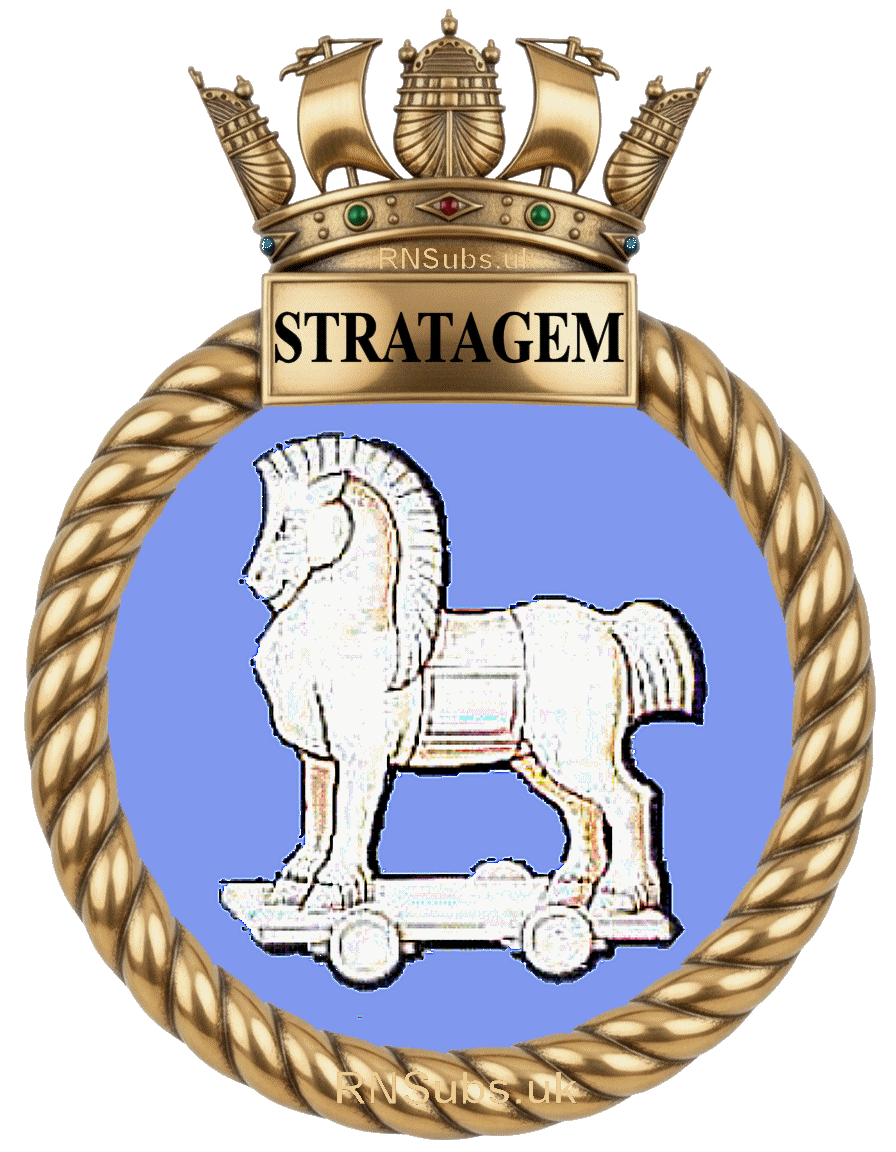
| HMS Stratagem sailed from Trincomalee on 10th November 1944 with orders to patrol in the vicinity of Malacca where it was believed the Japanese were loading ships with bauxite ore. On the afternoon of the 18th Stratagem attacked and sank the tanker Nichinan Maru. On 22nd November a Japanese aircraft spotted the submarine and directed a destroyer to where it had dived. Just after midday the destroyer attacked, the first depth charge causing the submarine's bow to strike the bottom. The submarine was plunged into darkness and the forward part began to flood. Attempts to shut the watertight door to the forward compartment failed and the crew were forced to make their escape. Ten crew managed to escape, of which eight were taken Prisoner of War. Only three of these (who were taken to Japan) survived captivity. The other five were executed in Singapore by the Japanese. | |

The British submarine, K13, was due to leave the Fairfield yard in Govan on the River Clyde, for her final acceptance trials at 0800 on Monday, 29th January 1917. On board were 80 men, both naval personnel and civilian contractors. A problem with one of the mooring wires caused a delay, and she had only travelled a mile down the river when the submarine ran aground at Whiteinch,
Despite this, she reached the Gareloch by 11:30 and carried out various tests that were required as part of the acceptance program. After the diving trial, her engineer, Lieutenant Arthur Lane, reported that there was a small leak in the boiler room. He suggested a further short dive to determine the source of the leak
As the submarine dived, the aft compartments of the submarine flooded, and it sank. 32 crew members and contractors lost their lives, and 48 were saved. It is the worst ever British submarine accident; conversely, despite the loss of life, it remains the most successful submarine rescue ever
The Board of Inquiry laid the blame for the accident solely on Lt Arthur Lane, the vessel's engineer. The book will provide an in-depth analysis of the sinking of the K 13 in the Gare Loch. It will offer a different perspective on the accident, a view that calls into question the legitimacy and accuracy of the Board of Inquiry's findings and verdict. The investigations and conclusions that lead to this interpretation are based on detailed examination of archived records, personal accounts and in-depth analysis of the evidence.
12 pages added or updated in the last Array month
Please help to maintain this site by reporting any Errors, Broken Links, Information or Site Issues on this page using this button

If you find this site useful, please consider supporting my work with a small Donation.
Please Note: Donations made using this option go directly to the site owner and not to the Submariners Association.
Thankyou for your support.
| Class: | 1935 - 1970: Improved S Class |
| Built By: | Cammell Laird (Mersey) |
| Build Group: | S3 |
| Fate: | |
| HMS Stratagem sailed from Trincomalee on 10th November 1944 with orders to patrol in the vicinity of Malacca where it was believed the Japanese were loading ships with bauxite ore. On the afternoon of the 18th Stratagem attacked and sank the tanker Nichinan Maru. On 22nd November a Japanese aircraft spotted the submarine and directed a destroyer to where it had dived. Just after midday the destroyer attacked, the first depth charge causing the submarine's bow to strike the bottom. The submarine was plunged into darkness and the forward part began to flood. Attempts to shut the watertight door to the forward compartment failed and the crew were forced to make their escape. Ten crew managed to escape, of which eight were taken Prisoner of War. Only three of these (who were taken to Japan) survived captivity. The other five were executed in Singapore by the Japanese. | |
The British submarine, K13, was due to leave the Fairfield yard in Govan on the River Clyde, for her final acceptance trials at 0800 on Monday, 29th January 1917. On board were 80 men, both naval personnel and civilian contractors. A problem with one of the mooring wires caused a delay, and she had only travelled a mile down the river when the submarine ran aground at Whiteinch,
Despite this, she reached the Gareloch by 11:30 and carried out various tests that were required as part of the acceptance program. After the diving trial, her engineer, Lieutenant Arthur Lane, reported that there was a small leak in the boiler room. He suggested a further short dive to determine the source of the leak
As the submarine dived, the aft compartments of the submarine flooded, and it sank. 32 crew members and contractors lost their lives, and 48 were saved. It is the worst ever British submarine accident; conversely, despite the loss of life, it remains the most successful submarine rescue ever
The Board of Inquiry laid the blame for the accident solely on Lt Arthur Lane, the vessel's engineer. The book will provide an in-depth analysis of the sinking of the K 13 in the Gare Loch. It will offer a different perspective on the accident, a view that calls into question the legitimacy and accuracy of the Board of Inquiry's findings and verdict. The investigations and conclusions that lead to this interpretation are based on detailed examination of archived records, personal accounts and in-depth analysis of the evidence.
12 pages added or updated in the last Array month
Please help to maintain this site by reporting any Errors, Broken Links, Information or Site Issues on this page using this button
If you find this site useful, please consider supporting my work with a small Donation.
Please Note: Donations made using this option go directly to the site owner and not to the Submariners Association.
Thankyou for your support.
This form is for you to comment on, or add additional information to this page. Any questions will be deleted. If you wish to ask a question contact the Branch or the Webmaster using the Contact Us page or ask your question on our Facebook Page