| Built By: | Cammell Laird (Mersey) |
| Build Group: | S3 |
| Fate: | Scrapped Grays 4th July 1950 |

| 1943: | Lieutenant | Anthony Walter Langridge | |
| 1944: | Lieutenant | Anthony Arthur Catlow | |
| 1944: | Lieutenant | Anthony Walter Langridge | |
| 1945: | Lieutenant | Richard Thomas Sallis | DSC |
1944: Indian Ocean
1945: Indian Ocean
1945: Pacific
| 27-10-1942 | Laid Down |
| 20-07-1943 | Launched |
| 25-10-1943 | Completed |
| 09-07-1944 | HMS Spirit claims to have damaged a small Japanese oiler with gunfire to the north of Sumatra. |
| 14-09-1944 | HMS Spirit sinks three Siamese sailing vessels with gunfire off the west coast of Siam. |
| 19-09-1944 | HMS Spirit sinks a Siamese sailing vessel with gunfire north of Sumatra. |
| 22-01-1945 | HMS Spirit sinks the Japanese Ryushin Maru with gunfire in the Java Sea. She also sinks another enemy vessel. |
| 14-03-1945 | HMS Spirit sinks the Japanese coaster Ryuho Maru with gunfire off Massalambo Island in the Java Sea. |
|
||
| Official | ||
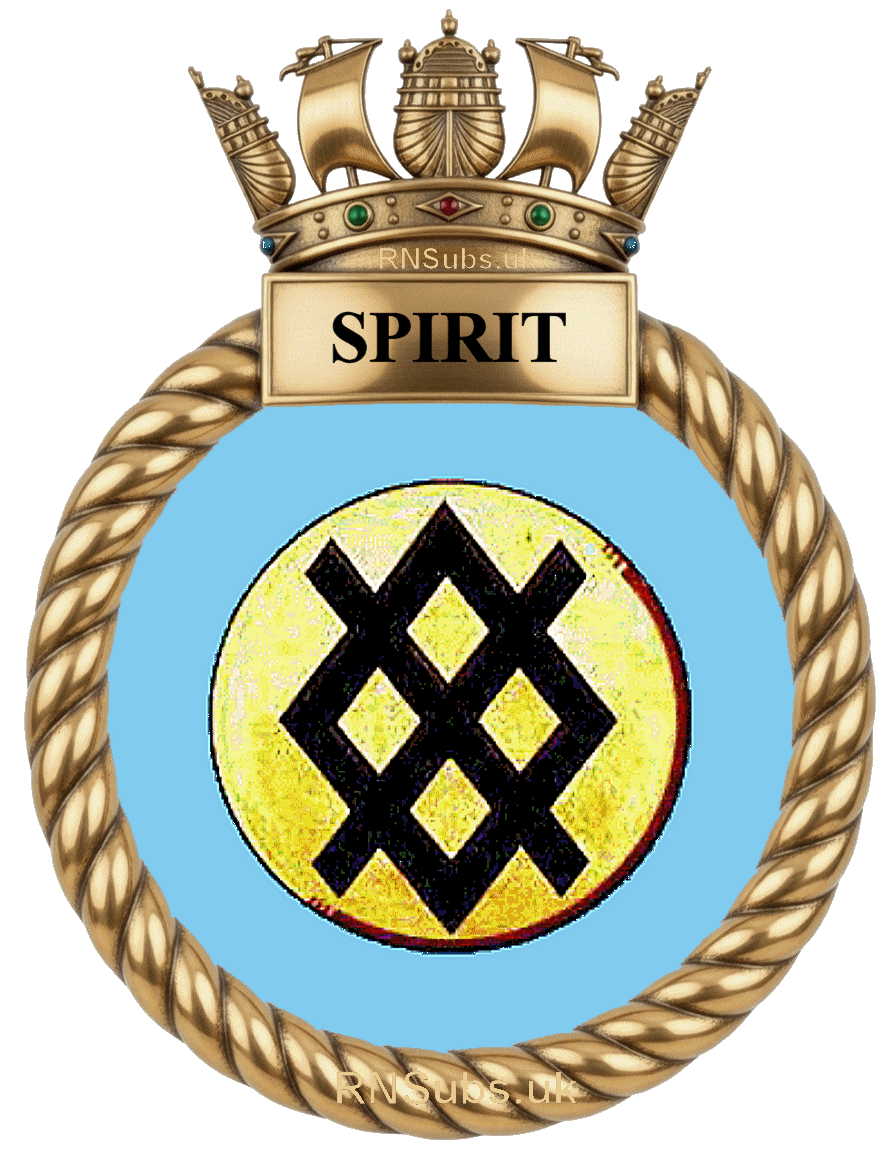
| Admiralty Approved | 12th Jun, 1944 | |
| Symbology | Admiral Sir George Vernon (1684-1757), nicknamed 'Old Grog', introduced rum into the Royal Navy. It was only withdrawn as a daily 'tot' issue in 1970. The Vernon Arms feature a black fret on a gold field. | |
| Design Notes | A bezant charged with a black fret on a blue field. | |
|
||
| Unofficial | ||
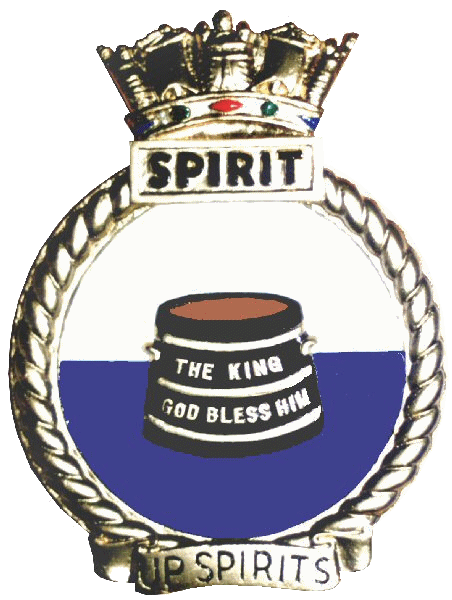
| Symbology | "Up Spirits". The spoken order associated with the dispensing of the rum ration. | |
| Design Notes | A grog tub proper on a per fess white and blue field. | |
| Additional Notes | The "Grog Tub" was the rum pot from which the daily tot was dispensed until 1970. | |
| Length overall | 217 ft |
| Beam | 23 ft 6 inch |
| Depth | 11 ft |
| Diving Depth | 350 ft |
| Speed | Surface 15 knots (design) |
| Surface 14.75 knots (service) | |
| Submerged 10 knots (design) | |
| Submerged 9 knots (service) | |
| No. of shafts | 2 |
| Endurance | Surface: 6000 miles at 10 knots (design) |
| Armament (i) | 6 x 21 inch bow tubes |
| 1 21 inch stern tube | |
| (13 torpedoes carried) | |
| 1 x 3 inch gun | |
| 3 x 0.303 inch machine-guns | |
| 1 x 20mm Oerlikon cannon | |
| Complement | 5 Officers and 43 Ratings |
| Note | The armament of submarines of this class varied considerably. For example: 23 boats were fitted with the six bow tubes only; 18 vessels, intended to operate in the Far East, had their 3 inch guns replaced by 4 inch guns; whilst, in some boats, the Oerlikon cannon replaced, rather than supplemented, the three machine-guns. |
| Class: | 1936 - 1958: U Class |
| Built By: | Vickers (Barrow) |
| Build Group: | U1 |
| Fate: | |
| Mistaken for a U boat by anti submarine trawler Peter Hendriks off the Wash and rammed on 19 July 1941 | |

Germany's World War II U-Boat fleet represented the elite of their naval personnel. In terms of technology, training, tactics and combat successes, the U-Boat Waffe was far superior to that of any other combatant nation. In this comprehensive book, the wartime development of the U-Boat is traced along with the experiences of typical U-Boat crewmen, from recruitment to combat.
The author examines the operational tactics of the U-Boat fleet, as well as describing the massive bunkers that housed them. 'Wolf Pack' contains material taken from Fortress 3: 'U-Boat Bases and Bunkers 1941-45', Warrior 36: 'Grey Wolf: U-Boat Crewman of World War II' and New Vanguards 51 and 55: 'Kriegsmarine U-Boat 1939-45 (1) and (2)', with the addition of a new section on wartime tactics.
14 pages added or updated in the last 1 month
Please help to maintain this site by reporting any Errors, Broken Links, Information or Site Issues on this page using this button

If you find this site useful, please consider supporting my work with a small Donation.
Please Note: Donations made using this option go directly to the site owner and not to the Submariners Association.
Thankyou for your support.
|
|
||
| Official | ||
| Admiralty Approved | 12th Jun, 1944 | |
| Symbology | Admiral Sir George Vernon (1684-1757), nicknamed 'Old Grog', introduced rum into the Royal Navy. It was only withdrawn as a daily 'tot' issue in 1970. The Vernon Arms feature a black fret on a gold field. | |
| Design Notes | A bezant charged with a black fret on a blue field. | |
|
|
||
| Unofficial | ||
| Symbology | "Up Spirits". The spoken order associated with the dispensing of the rum ration. | |
| Design Notes | A grog tub proper on a per fess white and blue field. | |
| Additional Notes | The "Grog Tub" was the rum pot from which the daily tot was dispensed until 1970. | |
| Length overall | 217 ft |
| Beam | 23 ft 6 inch |
| Depth | 11 ft |
| Diving Depth | 350 ft |
| Speed | Surface 15 knots (design) |
| Surface 14.75 knots (service) | |
| Submerged 10 knots (design) | |
| Submerged 9 knots (service) | |
| No. of shafts | 2 |
| Endurance | Surface: 6000 miles at 10 knots (design) |
| Armament (i) | 6 x 21 inch bow tubes |
| 1 21 inch stern tube | |
| (13 torpedoes carried) | |
| 1 x 3 inch gun | |
| 3 x 0.303 inch machine-guns | |
| 1 x 20mm Oerlikon cannon | |
| Complement | 5 Officers and 43 Ratings |
| Note | The armament of submarines of this class varied considerably. For example: 23 boats were fitted with the six bow tubes only; 18 vessels, intended to operate in the Far East, had their 3 inch guns replaced by 4 inch guns; whilst, in some boats, the Oerlikon cannon replaced, rather than supplemented, the three machine-guns. |
| Class: | 1936 - 1958: U Class |
| Built By: | Vickers (Barrow) |
| Build Group: | U1 |
| Fate: | |
| Mistaken for a U boat by anti submarine trawler Peter Hendriks off the Wash and rammed on 19 July 1941 | |
Germany's World War II U-Boat fleet represented the elite of their naval personnel. In terms of technology, training, tactics and combat successes, the U-Boat Waffe was far superior to that of any other combatant nation. In this comprehensive book, the wartime development of the U-Boat is traced along with the experiences of typical U-Boat crewmen, from recruitment to combat.
The author examines the operational tactics of the U-Boat fleet, as well as describing the massive bunkers that housed them. 'Wolf Pack' contains material taken from Fortress 3: 'U-Boat Bases and Bunkers 1941-45', Warrior 36: 'Grey Wolf: U-Boat Crewman of World War II' and New Vanguards 51 and 55: 'Kriegsmarine U-Boat 1939-45 (1) and (2)', with the addition of a new section on wartime tactics.
14 pages added or updated in the last 1 month
Please help to maintain this site by reporting any Errors, Broken Links, Information or Site Issues on this page using this button
If you find this site useful, please consider supporting my work with a small Donation.
Please Note: Donations made using this option go directly to the site owner and not to the Submariners Association.
Thankyou for your support.
This form is for you to comment on, or add additional information to this page. Any questions will be deleted. If you wish to ask a question contact the Branch or the Webmaster using the Contact Us page or ask your question on our Facebook Page