
| Built By: | Broadbent (Huddersfield) |
| Build Group: | X |
Unofficially named Exemplar
Prior to the D-Day landings X20 spent four days off the French coast performing periscope reconnaissance of the shoreline and echo-soundings during daytime.
Each night X20 would approach the beach and 2 divers would swim ashore. Soil samples were collected in condoms. The divers went ashore on two nights to survey the beaches at Vierville-sur-Mer, Moulins St Laurent and Colleville-sur-Mer in what became the American Omaha Beach. On the third night, they were due to go ashore off the Orne Estuary (Sword Beach), but by this stage fatigue (the crew and divers had been living on little more than benzedrine tablets) and the worsening weather caused Hudspeth to shorten the operation, returning to Dolphin on 21 Jan 1944.
Hudspeth received a bar to his DSC Acted as lightship to help the D-Day invasion fleet land on the correct beaches
| 15-12-1944 | Completed |
|
||
| Official | ||
| Admiralty Approved | 22nd Nov, 1955 | |
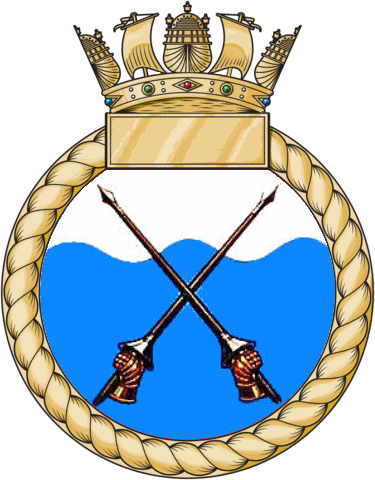
| Symbology | These manned craft strike from under the water. | |
| Design Notes | In chief, wavy white overall, two tilting spears in saltire proper, each grasped by a gold gauntlet. | |
| Additional Notes | This is a 'Type' badge assigned to all X-Craft. | |

|
||
| Unofficial | ||
| Motto | Nil nisi bonum. (Nothing but good.) | |
| Symbology | A person, object, or concept that serves as an excellent model or typical representation of a specific quality or idea. | |
| Design Notes | A harpy is depicted standing upon a rocky mount or crag issuant from the sea in base. She is facing the dexter, with her wings elevated and addorsed. In her dexter talon, she holds a small object, possibly a scroll or a piece of prey. Above her head is a celestial crown or nimbus of stars. The field is depicted with horizontal lines representing the sea and sky. | |
| Length overall | 51 ft 7 inch |
| Beam | 8 ft 6 inch (with charges) |
| 5 ft 9 1/2 inch (without charges) | |
| Displacement | Without Charges: 27 tons (surface) |
| 29 1/2 tons (submerged) | |
| Diving Depth | 300 ft |
| Speed | With Charges: 6.5 knots (surface) |
| With Charges: 5 knots (submerged) | |
| No. of shafts | 1 |
| Armament | 2 x 2-ton side charges |
| Limpet mines | |
| Endurance | Surface: 1320 miles at 4 knots (with charges) |
| Surface: 1860 miles at 4 knots (without charges) | |
| Submerged: 80 miles at 2 knots (with charges) | |
| Complement | 4 |

Unswerving (P 63) |
|
| Class: | 1936 - 1958: U Class |
| Built By: | |
| Build Group: | U2 |
|
Fate: Scrapped in July 1949 at Newport. |
|
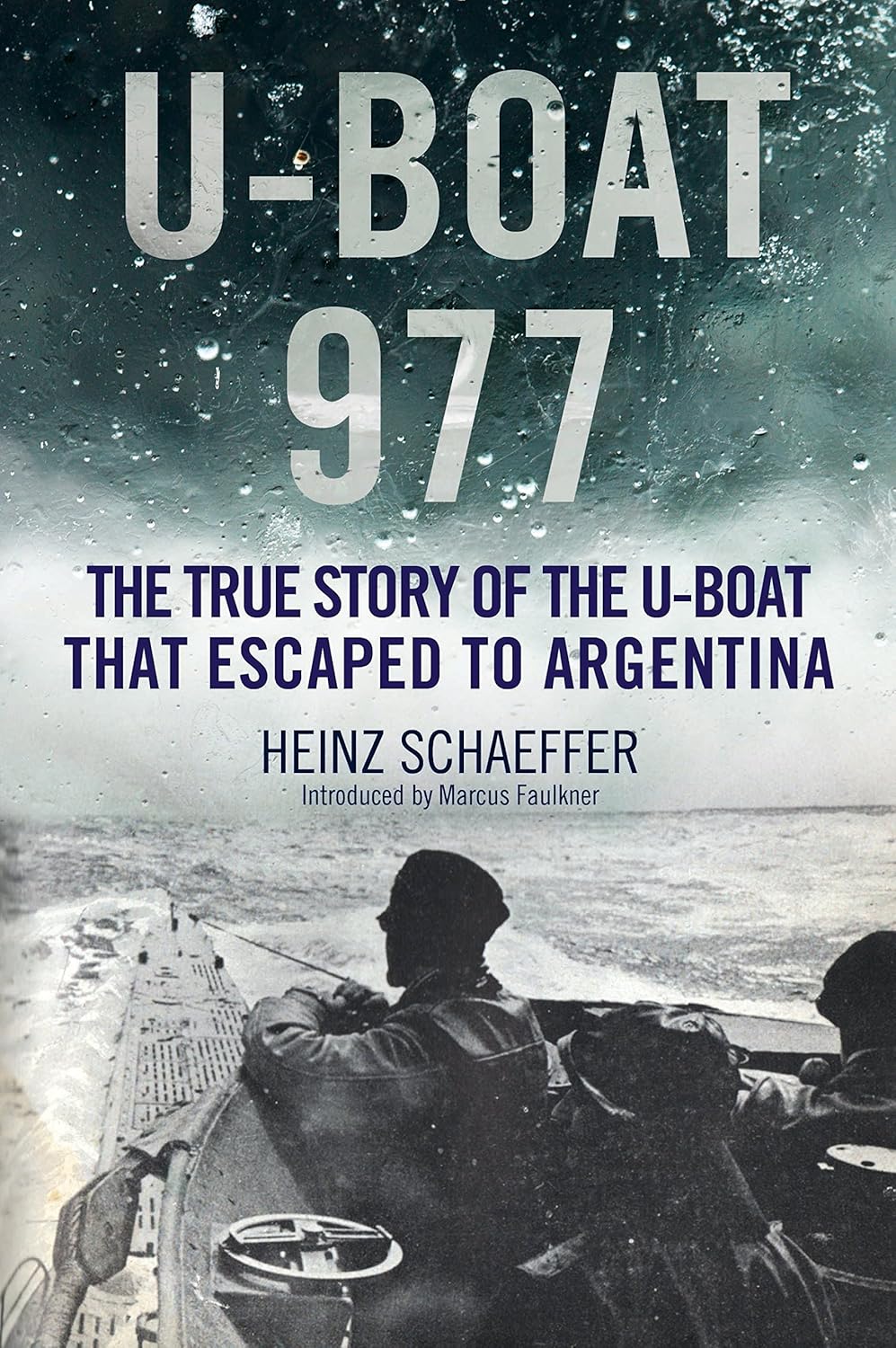
When it was first published in 1953, opinions were sharply divided between those who deplored the apparent extolling of a vicious form of warfare, and this who found in Heinz Schaeffer s account a revealing picture of the German Navys training and methods.
U-Boat 977 was the German submarine that escaped to Argentina at the end of World War Two. This epic journey started from Bergen in Norway, where in April 1945 it was temporarily based, and took three and a half months to complete. Because of the continuing Allied naval activity the commander decided to make the first part of the journey underwater.
Before surfacing near the west coast of Africa U-977 had spent a remarkable sixty-six days submerged. Heinz Schaeffer, the commander of U-977 wrote a full account of his career that culminated in this last command. It depicts the gruelling aspects of a submariner s life aboard a vessel that was subjected to harsh conditions of the sea and oceans.
As an experienced commander Schaeffer took part in many of the decisive U-boat operations in the North Sea and Atlantic Ocean. In the final months of the war, and in common with most surviving U-boat commanders, Schaeffer and his crew came under constant attacks from Allied aircraft and surface ships. The final part of U-Boat 977 is Schaeffer s account of the journey to Argentina and lays to rest some of the more fanciful sorties that followed its arrival.
13 pages added or updated in the last 1 month
Please help to maintain this site by reporting any Errors, Broken Links, Information or Site Issues on this page using this button

If you find this site useful, please consider supporting my work with a small Donation.
Please Note: Donations made using this option go directly to the site owner and not to the Submariners Association.
Thankyou for your support.
|
|
||
| Official | ||
| Admiralty Approved | 22nd Nov, 1955 | |
| Symbology | These manned craft strike from under the water. | |
| Design Notes | In chief, wavy white overall, two tilting spears in saltire proper, each grasped by a gold gauntlet. | |
| Additional Notes | This is a 'Type' badge assigned to all X-Craft. | |
|
|
||
| Unofficial | ||
| Motto | Nil nisi bonum. (Nothing but good.) | |
| Symbology | A person, object, or concept that serves as an excellent model or typical representation of a specific quality or idea. | |
| Design Notes | A harpy is depicted standing upon a rocky mount or crag issuant from the sea in base. She is facing the dexter, with her wings elevated and addorsed. In her dexter talon, she holds a small object, possibly a scroll or a piece of prey. Above her head is a celestial crown or nimbus of stars. The field is depicted with horizontal lines representing the sea and sky. | |
| Length overall | 51 ft 7 inch |
| Beam | 8 ft 6 inch (with charges) |
| 5 ft 9 1/2 inch (without charges) | |
| Displacement | Without Charges: 27 tons (surface) |
| 29 1/2 tons (submerged) | |
| Diving Depth | 300 ft |
| Speed | With Charges: 6.5 knots (surface) |
| With Charges: 5 knots (submerged) | |
| No. of shafts | 1 |
| Armament | 2 x 2-ton side charges |
| Limpet mines | |
| Endurance | Surface: 1320 miles at 4 knots (with charges) |
| Surface: 1860 miles at 4 knots (without charges) | |
| Submerged: 80 miles at 2 knots (with charges) | |
| Complement | 4 |
Unswerving (P 63) |
|
| Class: | 1936 - 1958: U Class |
| Built By: | |
| Build Group: | U2 |
|
Fate: Scrapped in July 1949 at Newport. |
|
When it was first published in 1953, opinions were sharply divided between those who deplored the apparent extolling of a vicious form of warfare, and this who found in Heinz Schaeffer s account a revealing picture of the German Navys training and methods.
U-Boat 977 was the German submarine that escaped to Argentina at the end of World War Two. This epic journey started from Bergen in Norway, where in April 1945 it was temporarily based, and took three and a half months to complete. Because of the continuing Allied naval activity the commander decided to make the first part of the journey underwater.
Before surfacing near the west coast of Africa U-977 had spent a remarkable sixty-six days submerged. Heinz Schaeffer, the commander of U-977 wrote a full account of his career that culminated in this last command. It depicts the gruelling aspects of a submariner s life aboard a vessel that was subjected to harsh conditions of the sea and oceans.
As an experienced commander Schaeffer took part in many of the decisive U-boat operations in the North Sea and Atlantic Ocean. In the final months of the war, and in common with most surviving U-boat commanders, Schaeffer and his crew came under constant attacks from Allied aircraft and surface ships. The final part of U-Boat 977 is Schaeffer s account of the journey to Argentina and lays to rest some of the more fanciful sorties that followed its arrival.
13 pages added or updated in the last 1 month
Please help to maintain this site by reporting any Errors, Broken Links, Information or Site Issues on this page using this button
If you find this site useful, please consider supporting my work with a small Donation.
Please Note: Donations made using this option go directly to the site owner and not to the Submariners Association.
Thankyou for your support.
This form is for you to comment on, or add additional information to this page. Any questions will be deleted. If you wish to ask a question contact the Branch or the Webmaster using the Contact Us page