
| Built By: | Vickers (Barrow) |
| Build Group: | XT |
| Fate: | Moored in Aberlady Bay and used for weapons trials by de Havilland Mosquito aircraft based at RAF East Fortune. |
Unofficially named Sandra
Less elaborately equipped as previous boats as they were intended for training. In May 1946 two midget submarines were moored at the low-water mark in Aberlady Bay. It is believed that these craft were XT1 and XT2, two examples of a training version of the British X craft midget submarines.
The two XT class vessels moored in Aberlady Bay were used for trials by de Havilland Mosquito aircraft based at R.A.F. East Fortune, now the Museum of Flight, part of the National Museums of Scotland. These aircraft were used to train R.A.F. crew for Coastal Command anti-shipping strike squadrons and they used the two XT craft to test the effectiveness of cannon shells in piercing the armour plate of the midget submarines. The remains of the midget submarines can still be seen at low tide.
|
||
| Official | ||
| Admiralty Approved | 22nd Nov, 1955 | |
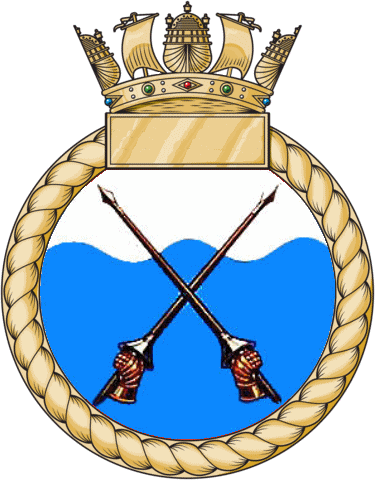
| Symbology | These manned craft strike from under the water. | |
| Design Notes | In chief, wavy white overall, two tilting spears in saltire proper, each grasped by a gold gauntlet. | |
| Additional Notes | This is a 'Type' badge assigned to all X-Craft. | |
| Length overall | 51 ft 7 inch |
| Beam | 8 ft 6 inch (with charges) |
| 5 ft 9 1/2 inch (without charges) | |
| Displacement | Without Charges: 27 tons (surface) |
| Without Charges: 29 1/2 tons (submerged) | |
| Diving Depth | 300 ft |
| Speed | With Charges: 6.5 knots (surface) |
| With Charges:5 knots (submerged) | |
| No. of shafts | 1 |
| Armament | 2 x 2-ton side charges |
| Limpet mines | |
| Endurance | Surface: 1320 miles at 4 knots (with charges) |
| Surface: 1860 miles at 4 knots (without charges) | |
| Submerged: 80 miles at 2 knots (with charges) | |
| Complement | 4 |

Germany's World War II U-Boat fleet represented the elite of their naval personnel. In terms of technology, training, tactics and combat successes, the U-Boat Waffe was far superior to that of any other combatant nation. In this comprehensive book, the wartime development of the U-Boat is traced along with the experiences of typical U-Boat crewmen, from recruitment to combat.
The author examines the operational tactics of the U-Boat fleet, as well as describing the massive bunkers that housed them. 'Wolf Pack' contains material taken from Fortress 3: 'U-Boat Bases and Bunkers 1941-45', Warrior 36: 'Grey Wolf: U-Boat Crewman of World War II' and New Vanguards 51 and 55: 'Kriegsmarine U-Boat 1939-45 (1) and (2)', with the addition of a new section on wartime tactics.
12 pages added or updated in the last 1 month
Please help to maintain this site by reporting any Errors, Broken Links, Information or Site Issues on this page using this button

If you find this site useful, please consider supporting my work with a small Donation.
Please Note: Donations made using this option go directly to the site owner and not to the Submariners Association.
Thankyou for your support.
|
|
||
| Official | ||
| Admiralty Approved | 22nd Nov, 1955 | |
| Symbology | These manned craft strike from under the water. | |
| Design Notes | In chief, wavy white overall, two tilting spears in saltire proper, each grasped by a gold gauntlet. | |
| Additional Notes | This is a 'Type' badge assigned to all X-Craft. | |
| Length overall | 51 ft 7 inch |
| Beam | 8 ft 6 inch (with charges) |
| 5 ft 9 1/2 inch (without charges) | |
| Displacement | Without Charges: 27 tons (surface) |
| Without Charges: 29 1/2 tons (submerged) | |
| Diving Depth | 300 ft |
| Speed | With Charges: 6.5 knots (surface) |
| With Charges:5 knots (submerged) | |
| No. of shafts | 1 |
| Armament | 2 x 2-ton side charges |
| Limpet mines | |
| Endurance | Surface: 1320 miles at 4 knots (with charges) |
| Surface: 1860 miles at 4 knots (without charges) | |
| Submerged: 80 miles at 2 knots (with charges) | |
| Complement | 4 |
Germany's World War II U-Boat fleet represented the elite of their naval personnel. In terms of technology, training, tactics and combat successes, the U-Boat Waffe was far superior to that of any other combatant nation. In this comprehensive book, the wartime development of the U-Boat is traced along with the experiences of typical U-Boat crewmen, from recruitment to combat.
The author examines the operational tactics of the U-Boat fleet, as well as describing the massive bunkers that housed them. 'Wolf Pack' contains material taken from Fortress 3: 'U-Boat Bases and Bunkers 1941-45', Warrior 36: 'Grey Wolf: U-Boat Crewman of World War II' and New Vanguards 51 and 55: 'Kriegsmarine U-Boat 1939-45 (1) and (2)', with the addition of a new section on wartime tactics.
12 pages added or updated in the last 1 month
Please help to maintain this site by reporting any Errors, Broken Links, Information or Site Issues on this page using this button
If you find this site useful, please consider supporting my work with a small Donation.
Please Note: Donations made using this option go directly to the site owner and not to the Submariners Association.
Thankyou for your support.

This form is for you to comment on, or add additional information to this page. Any questions will be deleted. If you wish to ask a question contact the Branch or the Webmaster using the Contact Us page or ask your question on our Facebook Page