The Swiftsure class was a class of nuclear-powered fleet attack submarines in service with the Royal Navy from the early 1970s until 2010.
Vickers built six Swiftsure Class submarines (Swiftsure, Sovereign, Superb, Sceptre, Spartan and Splendid), which incorporate major improvements.

The Dreadnought, Valiant Class and Churchill Class all had a whale-shaped hull, of near-perfect streamlining giving maximum underwater efficiency. The hulls were of British design, based on the pioneering work of the US Navy in Skipjack and Albacore. The hull of the Swiftsure class was a different shape and maintained its diameter for a much greater length than previous classes. Compared with the Valiant Class the Swiftsures were 13 feet shorter with a fuller form, with the fore-planes set further forward, with one less torpedo tube and with a deeper diving depth.
A few were upgraded with the capability to launch Tomahawk cruise missiles in addition to their original armaments of torpedoes, mines and anti-ship missiles. They were also the first class of Royal Navy submarines to be built with shrouded pump-jet propulsors. Rather than the seven/nine-bladed propeller used by the previous classes, all but the first of the Swiftsure class submarines used a shrouded pump-jet propulsor. The prototype propulsor had powered the Churchill. It is not clear why the Swiftsure was the only one of the class not fitted with a propulsor. The propulsor was perhaps as much as 50% more efficient than a propeller, producing the same speed at lower revolutions, thus reducing the noise signature. In addition all pipework connections to equipment on the main machinery raft had expansion/flexible coupling connections, which also reduced noise. The US Navy secured a licence to copy the main shaft flexible coupling arrangement in US-built submarines
Further Reading |

|
| Secret Warriors |

Paul Brown A highly illustrated history of the Cold War operations of the submarines of the Royal Navy from 1948 to 1990. |
| On Her Majesty's Nuclear Service |
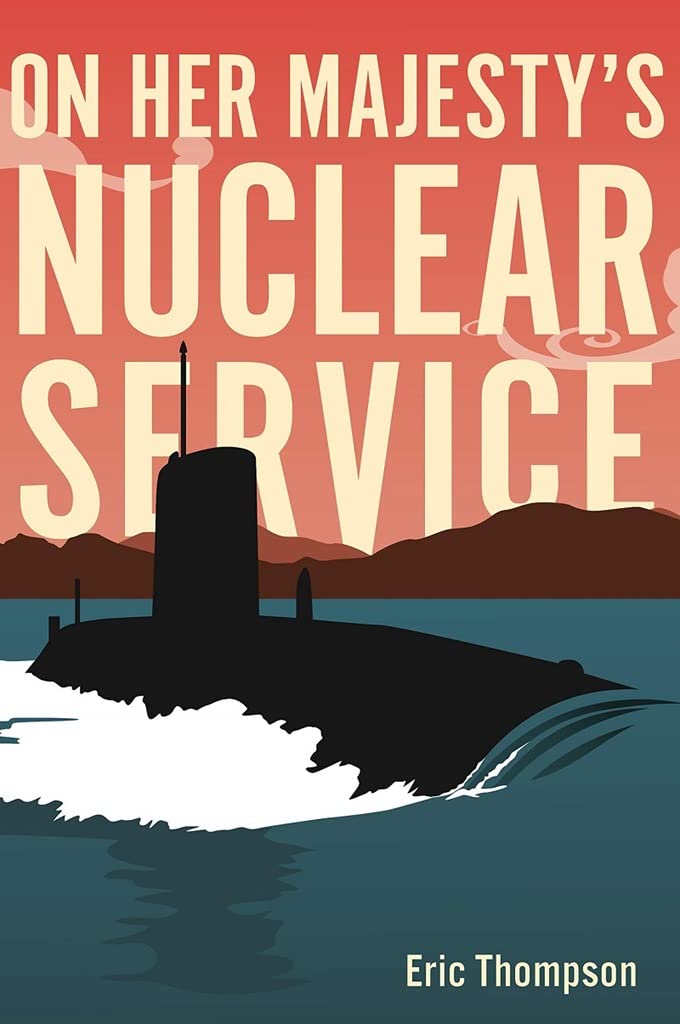
Eric Thompson During the Cold War, nuclear submarines performed the greatest public service of all: prevention of a third world war. History shows that they succeeded; the Cold War ended peacefully, but for security reasons, only now can this story be told. |
In the immediate post-war period, ships were fitted with basic gyro compasses (typically AP5005) plus a transmitting magnetic or gyro-magnetic compass (ATMC5/AGMC6) for emergencies. Vertical attitude reference data came from wholly separate stabilisers (Gyro Stabiliser Type 1-12). Radio navaids were limited to the early Decca sets (QM10) and MF DF (FM12), with widespread use of astro navigation (by hand-held sextant), plus a 1930's vintage ARL table.

This unique memoir charts the career of the author in the Royal Navy Submarine Service during the period 1967 to 1997, and in doing so details many of the Silent Service's remarkable achievements since the end of the Second World War. And it provides a dramatic first-hand account of the underwater confrontation during the Cold War between submarines of the West and the huge submarine force of the Soviet Union.
Dan Conley narrates the successive stages from his basic submarine training to taking command of two nuclear attack submarines, but he does not demur from describing the personal and professional difficulties he encountered in this journey. He sets out in detail what life was like serving onboard both diesel and nuclear submarines, and in particular, the book describes the British submariner's remarkable transformation from the somewhat buccaneering, free spirit serving on a clapped-out WW2 boat during the sunset of the British Empire, to the highly professional individual who spends prolonged periods under the sea in a platform which matches the complexity of a space craft.
The book describes the long and difficult challenges encountered in developing effective weapon systems for the British submarine force, and discusses the difficulties and shortcomings in the UK's defence procurement system, a situation which still exists today. Ultimately, however, Western technological superiority and crew proficiency enabled the submarines of the Royal and United States Navies to match those of the Soviet Union, and he describes vividly the suspense and tension of underwater confrontations which might so easily have escalated to another dimension of warfare. And the book sets out hitherto undisclosed details of submarine activities during the 1962 Cuban Missile Crisis, when the world confronted the real possibility of a massive nuclear exchange.
But it is not all serious content, and he also offers a glimpse for the reader of many humorous situations and events, of animals that found themselves under the sea in a submarine, in one case during a war patrol, and other moments of levity that broke the tension of serving in a highly complex and sophisticated fighting machine. The Cold War era is now long past. However, it is evident that as the West now confronts an aggressive, recidivist Russia and a more aggressive China, Britain's submarine force once again will be key to the security of all its citizens.
This fine memoir captures vividly the key events and history of the Cold War, and in doing so will open the reader's eyes to the significance and importance today of the Royal Navy Submarine Service.
20 pages added or updated in the last 2 month
Please help to maintain this site by reporting any Errors, Broken Links, Information or Site Issues on this page using this button

If you find this site useful, please consider supporting my work with a small Donation.
Please Note: Donations made using this option go directly to the site owner and not to the Submariners Association.
Thankyou for your support.
Further Reading |
|
| Secret Warriors |
|
Paul Brown A highly illustrated history of the Cold War operations of the submarines of the Royal Navy from 1948 to 1990. |
| On Her Majesty's Nuclear Service |
|
Eric Thompson During the Cold War, nuclear submarines performed the greatest public service of all: prevention of a third world war. History shows that they succeeded; the Cold War ended peacefully, but for security reasons, only now can this story be told. |
In the immediate post-war period, ships were fitted with basic gyro compasses (typically AP5005) plus a transmitting magnetic or gyro-magnetic compass (ATMC5/AGMC6) for emergencies. Vertical attitude reference data came from wholly separate stabilisers (Gyro Stabiliser Type 1-12). Radio navaids were limited to the early Decca sets (QM10) and MF DF (FM12), with widespread use of astro navigation (by hand-held sextant), plus a 1930's vintage ARL table.
This unique memoir charts the career of the author in the Royal Navy Submarine Service during the period 1967 to 1997, and in doing so details many of the Silent Service's remarkable achievements since the end of the Second World War. And it provides a dramatic first-hand account of the underwater confrontation during the Cold War between submarines of the West and the huge submarine force of the Soviet Union.
Dan Conley narrates the successive stages from his basic submarine training to taking command of two nuclear attack submarines, but he does not demur from describing the personal and professional difficulties he encountered in this journey. He sets out in detail what life was like serving onboard both diesel and nuclear submarines, and in particular, the book describes the British submariner's remarkable transformation from the somewhat buccaneering, free spirit serving on a clapped-out WW2 boat during the sunset of the British Empire, to the highly professional individual who spends prolonged periods under the sea in a platform which matches the complexity of a space craft.
The book describes the long and difficult challenges encountered in developing effective weapon systems for the British submarine force, and discusses the difficulties and shortcomings in the UK's defence procurement system, a situation which still exists today. Ultimately, however, Western technological superiority and crew proficiency enabled the submarines of the Royal and United States Navies to match those of the Soviet Union, and he describes vividly the suspense and tension of underwater confrontations which might so easily have escalated to another dimension of warfare. And the book sets out hitherto undisclosed details of submarine activities during the 1962 Cuban Missile Crisis, when the world confronted the real possibility of a massive nuclear exchange.
But it is not all serious content, and he also offers a glimpse for the reader of many humorous situations and events, of animals that found themselves under the sea in a submarine, in one case during a war patrol, and other moments of levity that broke the tension of serving in a highly complex and sophisticated fighting machine. The Cold War era is now long past. However, it is evident that as the West now confronts an aggressive, recidivist Russia and a more aggressive China, Britain's submarine force once again will be key to the security of all its citizens.
This fine memoir captures vividly the key events and history of the Cold War, and in doing so will open the reader's eyes to the significance and importance today of the Royal Navy Submarine Service.
20 pages added or updated in the last 2 month
Please help to maintain this site by reporting any Errors, Broken Links, Information or Site Issues on this page using this button
If you find this site useful, please consider supporting my work with a small Donation.
Please Note: Donations made using this option go directly to the site owner and not to the Submariners Association.
Thankyou for your support.
This form is for you to comment on, or add additional information to this page. Any questions will be deleted. If you wish to ask a question contact the Branch or the Webmaster using the Contact Us page or ask your question on our Facebook Page