
A repeat Valiant Class - the Vickers built Churchill and Courageous, together with Cammel Laird's Conqueror, the only British nuclear Fleet submarine to be built outside Barrow.

The Churchill class, were nuclear powered fleet submarines which served with the Royal Navy from the 1970s until the early 1990s. The Churchill class was based on the older Valiant Class, but featured many internal improvements.

The lead ship was named after the former Prime Minister and First Lord of the Admiralty Winston Churchill. HMS Conqueror was the most famous of the class, sinking the Argentinian cruiser ARA General Belgrano during the 1982 Falklands War.
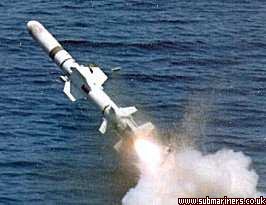
The Churchills carried a crew of 103 and had a full load displacement of 4,900 tons whilst dived. They were 86.9 metres long, had a beam of 10.1 metres and a draught of 8.2 metres. Their single pressurised water-cooled reactor supplied steam to two English Electric geared turbines, producing a total of 20,000 shp for the single shaft and resulting in a maximum of 28 knots submerged. One Kelvin Type 1006 surface-search radar was fitted. The ships were built with a Type 2001 sonar array, but this was replaced in the late 1970s with a Type 2020 array and a Type 2026 towed array. Weapons included Mark 8 torpedoes, Mark 24 Tigerfish torpedoes, and Sub-Harpoon anti-ship missiles. Six 21-inch torpedo tubes fired from the bow.
Further Reading |

|
| Secret Warriors |

Paul Brown A highly illustrated history of the Cold War operations of the submarines of the Royal Navy from 1948 to 1990. |
| On Her Majesty's Nuclear Service |
Eric Thompson During the Cold War, nuclear submarines performed the greatest public service of all: prevention of a third world war. History shows that they succeeded; the Cold War ended peacefully, but for security reasons, only now can this story be told. |

Tapir (P 335) |
|
| Class: | 1935 - 1970: T Class |
| Built By: | |
| Build Group: | T 3 |
|
Fate: Scrapped in December 1966 at Faslane. |
|

Of all the acts of gallantry in World War II few were as audacious as the attack by midget submarines on the pride of the German fleet, the battleship Tirpitz, lying in her fortified mooring in a Norwegian fjord.
Lieutenant Godfrey Place was in command of submarine X7 in September 1943 and travelled over 1000 miles, negotiating minefields and antisubmarine nets to accurately place four tons of high explosive under the hull of the Tirpitz.
11 pages added or updated in the last 1 month
Please help to maintain this site by reporting any Errors, Broken Links, Information or Site Issues on this page using this button

If you find this site useful, please consider supporting my work with a small Donation.
Please Note: Donations made using this option go directly to the site owner and not to the Submariners Association.
Thankyou for your support.
Further Reading |
|
| Secret Warriors |
|
Paul Brown A highly illustrated history of the Cold War operations of the submarines of the Royal Navy from 1948 to 1990. |
| On Her Majesty's Nuclear Service |
|
Eric Thompson During the Cold War, nuclear submarines performed the greatest public service of all: prevention of a third world war. History shows that they succeeded; the Cold War ended peacefully, but for security reasons, only now can this story be told. |
Tapir (P 335) |
|
| Class: | 1935 - 1970: T Class |
| Built By: | |
| Build Group: | T 3 |
|
Fate: Scrapped in December 1966 at Faslane. |
|
Of all the acts of gallantry in World War II few were as audacious as the attack by midget submarines on the pride of the German fleet, the battleship Tirpitz, lying in her fortified mooring in a Norwegian fjord.
Lieutenant Godfrey Place was in command of submarine X7 in September 1943 and travelled over 1000 miles, negotiating minefields and antisubmarine nets to accurately place four tons of high explosive under the hull of the Tirpitz.
11 pages added or updated in the last 1 month
Please help to maintain this site by reporting any Errors, Broken Links, Information or Site Issues on this page using this button
If you find this site useful, please consider supporting my work with a small Donation.
Please Note: Donations made using this option go directly to the site owner and not to the Submariners Association.
Thankyou for your support.
This form is for you to comment on, or add additional information to this page. Any questions will be deleted. If you wish to ask a question contact the Branch or the Webmaster using the Contact Us page or ask your question on our Facebook Page