| Built By: | Vickers (Barrow) |
| Build Group: | SSN 4 |


| 1977: | Commander | D I Ramsay | |
| 1977: | Vice Admiral | Geoffrey William Biggs | KCB |
| 1979: | Commander | Michael Cecil Boyce | |
| 1981: | Admiral | James Francis Perowne | KBE |
| 1992: | Commander | S T Williams | |
| 1995: | Vice Admiral | Peter John Wilkinson | |
| 1999: | Commander | D J Pollock | |
| 2001: | Commander | N J Hibberd | |
| 2005: | Lieutenant Commander | John Aitken | |
| 2008: | Commander | Steven Drysdale |
Launched by Mrs Williams, wife of Admiral David Williams Second Sea Lord and Chief of Naval Personnel
Superb was the 679th ship to be launched at Vickers, the 740th to be launched at Barrow, 432nd vessel built by Vickers for the RN and the 304th Submarine to be built by Vickers for the RN.
1977 Took part in the Queens Silver Jubilee Review of the Fleet in late June. Wore fag of Flag Officer Submarines.
Undertook refit 1982-1985
Giving a unique insight into the lives of some of the country's best submariners, this six part series spends 12 months charting the ups and downs of HMS Superb, a nuclear-powered submarine that can remain undetected underwater for months on end.
| 20-05-1970 | Ordered from Vickers, barrow |
| 16-03-1972 | Laid Down |
| 30-11-1974 | Launched |
| 13-11-1976 | Completed |
| 27-05-2008 | HMS Superb collided with an underwater pinnacle 80 miles south of Suez in the Red Sea and damaged its sonar equipment, forcing it to surface. None of the crew was hurt. |
|
||
| Official | ||
| Admiralty Approved | 28th Feb, 1944 | |
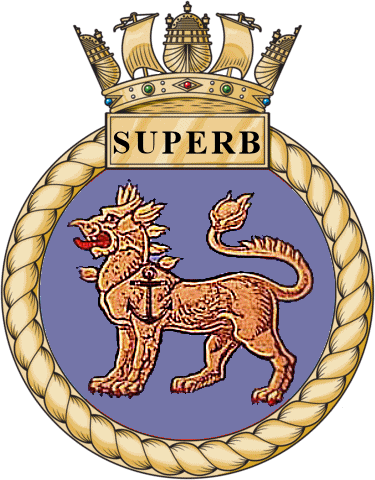
| Motto | With sword and courage. | |
| Symbology | From the arms of Admiral Sir Richard Keats, who commanded the ship 1801-1807. | |
| Design Notes | A gold heraldic tyger statant, armed and langued red, charged on the shoulder with a black anchor on a blue field. | |
| Length overall | 272 ft |
| Beam | 32 ft 3 inch |
| Displacement | 3500 tons (surface) |
| 4500 tons (submerged) | |
| Diving Depth | In excess of 1000 ft |
| Speed | In excess of 25 knots (surface) |
| 30 knots (submerged) | |
| No. of shafts | 1 |
| Armament | 5 21 inch bow tubes |
| Complement | 12 Officers and 85 Ratings |
The Quest For Higher Submerged Speed & Greater Underwater Propulsion Power

Historical documentary which explores the efforts of German soldiers during World War II.
The outbreak of the Second World War meant that both sides had to concentrate a huge amount of their workforce on rearmament, with large amounts of supplies being delivered by air.
The German army relied heavily on their U-boats, and with ambush tactics devised by their creator, Admiral Doentitz, they became a dangerous force on the water.
The programme includes rare footage of former captains and U-boats in action.
12 pages added or updated in the last Array month
Please help to maintain this site by reporting any Errors, Broken Links, Information or Site Issues on this page using this button

If you find this site useful, please consider supporting my work with a small Donation.
Please Note: Donations made using this option go directly to the site owner and not to the Submariners Association.
Thankyou for your support.
|
|
||
| Official | ||
| Admiralty Approved | 28th Feb, 1944 | |
| Motto | With sword and courage. | |
| Symbology | From the arms of Admiral Sir Richard Keats, who commanded the ship 1801-1807. | |
| Design Notes | A gold heraldic tyger statant, armed and langued red, charged on the shoulder with a black anchor on a blue field. | |
| Length overall | 272 ft |
| Beam | 32 ft 3 inch |
| Displacement | 3500 tons (surface) |
| 4500 tons (submerged) | |
| Diving Depth | In excess of 1000 ft |
| Speed | In excess of 25 knots (surface) |
| 30 knots (submerged) | |
| No. of shafts | 1 |
| Armament | 5 21 inch bow tubes |
| Complement | 12 Officers and 85 Ratings |
The Quest For Higher Submerged Speed & Greater Underwater Propulsion Power
Historical documentary which explores the efforts of German soldiers during World War II.
The outbreak of the Second World War meant that both sides had to concentrate a huge amount of their workforce on rearmament, with large amounts of supplies being delivered by air.
The German army relied heavily on their U-boats, and with ambush tactics devised by their creator, Admiral Doentitz, they became a dangerous force on the water.
The programme includes rare footage of former captains and U-boats in action.
12 pages added or updated in the last Array month
Please help to maintain this site by reporting any Errors, Broken Links, Information or Site Issues on this page using this button
If you find this site useful, please consider supporting my work with a small Donation.
Please Note: Donations made using this option go directly to the site owner and not to the Submariners Association.
Thankyou for your support.
This form is for you to comment on, or add additional information to this page. Any questions will be deleted. If you wish to ask a question contact the Branch or the Webmaster using the Contact Us page or ask your question on our Facebook Page